Goodday Sarah M, Friend Stephen
4YouandMe, Seattle, WA USA.
2Department of Psychiatry, University of Oxford, Oxford, UK.
NPJ Digit Med. 2019 Jul 31;2:75. doi: 10.1038/s41746-019-0151-8. eCollection 2019.
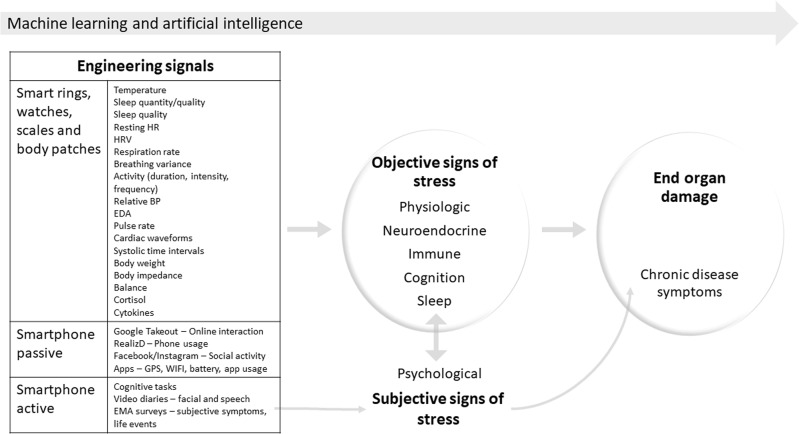
Chronic stress is a major underlying origin of the top leading causes of death, globally. Yet, the mechanistic explanation of the association between stress and disease is poorly understood. This stems from the inability to adequately measure stress in its naturally occurring state and the extreme heterogeneity by inter and intraindividual characteristics. The growth and availability of digital technologies involving wearable devices and mobile phone apps afford the opportunity to dramatically improve measurement of the biological stress response in real time. In parallel, the advancement and capabilities of artificial intelligence (AI) and machine learning could discern heterogeneous, multidimensional information from individual signs of stress, and possibly inform how these signs forecast the downstream consequences of stress in the form of end-organ damage. The marriage of these tools could dramatically enhance the field of stress research contributing to impactful and empowering interventions for individuals bridging knowledge to practice, and intervention to real-world use. Here we discuss this potential, anticipated challenges, and emerging opportunities.
慢性压力是全球主要死因的一个主要潜在根源。然而,压力与疾病之间关联的机制解释却鲜为人知。这源于无法在自然发生状态下充分测量压力,以及个体间和个体内特征的极端异质性。涉及可穿戴设备和手机应用程序的数字技术的发展和普及,为大幅改善生物应激反应的实时测量提供了机会。与此同时,人工智能(AI)和机器学习的进步与能力,可以从个体压力迹象中辨别出异质的、多维度的信息,并可能告知这些迹象如何以终末器官损伤的形式预测压力的下游后果。这些工具的结合可以极大地推动压力研究领域的发展,为将知识转化为实践、将干预措施应用于实际的个体提供有影响力且赋权的干预措施。在此,我们讨论这种潜力、预期挑战和新出现的机会。