Department of Pediatrics and Child Health Nursing, University of Gondar, Gondar, Ethiopia.
Reproductive Health, University of Gondar College of Medicine and Health Sciences, Gondar, Amhara Regional State, Ethiopia.
BMJ Open. 2021 Nov 5;11(11):e053577. doi: 10.1136/bmjopen-2021-053577.
To estimate the prevalence of various indicators of malnutrition (stunting, wasting, low birth weight, concurrent stunting and wasting, overweight/obesity and double burden malnutrition) among newborns and to investigate factors associated with these nutritional disorders.
A hospital-based cross-sectional study was conducted from 10 March through to May 2020. A total of 419 newborns were recruited into the study to estimate the prevalence of low birth weight and stunting. After excluding 28 newborns whose length was less than 45 cm, 394 newborn-mother dyads were approached to estimate wasting and overweight/obesity. A systematic random sampling technique was used to select participants. All independent variables were entered into the multivariable logistic regression model and variables that had significant associations were identified based on a p value.
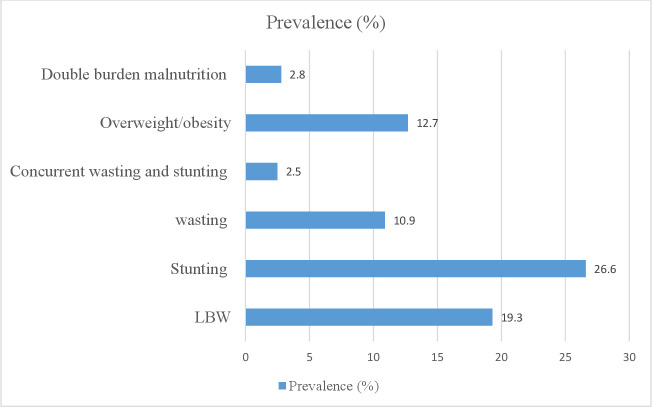
A very small proportion of the newborns 2.5% (0.9% to 4.1%) were concurrently wasted and stunted. The prevalence rates of low birth weight and wasting were 20.8% (16.8% to 24.6%) and 10.9% (7.82% to 14.01%), respectively. The magnitude of overweight/obesity was 12.7% (9.3% to 15.9%) where 2.8% (1.1% to 4.4%) of newborns have the double burden of malnutrition. Having a father with a primary level of education 2.82 (1.19 to 6.65) and being stunted at birth 3.17 (1.6 to 6.0) were variables that were associated with increased odds of low birth weight. The odds of being overweight/obese are significantly higher among newborns born to mothers who are urban dwellers 0.35 (0.12 to 0.99).
The study underscores that malnutrition is a pressing public health concern that demands due emphasis. Fathers' educational status (low level) and being stunted are associated with a high burden of low birth weight. Mothers' residency (being urban) is associated with an elevated risk of overweight/obesity among newborns. Thus, improving the health literacy of fathers and preventing stunting at birth are recommended to mitigate low birth weight.
评估新生儿中各种营养不良指标(发育迟缓、消瘦、低出生体重、同时消瘦和发育迟缓、超重/肥胖和双重负担营养不良)的流行情况,并调查与这些营养障碍相关的因素。
本研究为 2020 年 3 月 10 日至 5 月期间进行的一项基于医院的横断面研究。共招募了 419 名新生儿以估计低出生体重和发育迟缓的患病率。排除 28 名身长小于 45 厘米的新生儿后,对 394 名新生儿-母亲对子进行消瘦和超重/肥胖的评估。采用系统随机抽样技术选择参与者。将所有自变量纳入多变量逻辑回归模型,并根据 p 值确定具有显著关联的变量。
仅有很小比例的新生儿(2.5%(0.9%至 4.1%))同时消瘦和发育迟缓。低出生体重和消瘦的患病率分别为 20.8%(16.8%至 24.6%)和 10.9%(7.82%至 14.01%)。超重/肥胖的程度为 12.7%(9.3%至 15.9%),其中 2.8%(1.1%至 4.4%)的新生儿存在营养不良的双重负担。父亲接受过小学教育 2.82(1.19 至 6.65)和出生时发育迟缓 3.17(1.6 至 6.0)是与低出生体重发生风险增加相关的变量。与居住在城市的母亲所生的新生儿相比,超重/肥胖的可能性显著更高 0.35(0.12 至 0.99)。
本研究强调,营养不良是一个紧迫的公共卫生问题,需要给予应有的重视。父亲的教育程度(低水平)和发育迟缓与高出生体重的低出生体重负担有关。母亲的居住地(城市)与新生儿超重/肥胖的风险增加有关。因此,建议提高父亲的健康素养并预防出生时的发育迟缓,以减轻低出生体重的发生。