
一项综合社会艺术干预对养老院中轻度认知障碍老年人认知和心理社会结局影响的混合方法研究。
Effects of an integrated social-art intervention on cognitive and psychosocial outcomes among older adults with mild cognitive impairment in nursing homes: a mixed methods study.
作者信息
Huang Chenshan, Yan Yuanjiao, Tam Wilson Wai San, Sun Wenqian, Ye Yu, Wang Nafang, Shi Yanhong, Zhu Ziping, Chen Danting, Chen Lin, Zhao Junyu, Lin Rong, Li Hong
机构信息
The School of Nursing, Fujian Medical University, No.1 Xuefu North Road, Shangjie Town, Minhou County, Fuzhou, Fujian, 350122, China.
Alice Lee Centre for Nursing Studies, Yong Loo Lin School of Medicine, National University of Singapore, Level 2, Clinical Research Centre, Block MD11, 10 Medical Drive, Singapore, 117597, Singapore.
出版信息
BMC Med. 2025 May 2;23(1):256. doi: 10.1186/s12916-025-04085-z.
BACKGROUND
The rising prevalence of mild cognitive impairment (MCI) among older adults in nursing homes necessitates effective interventions to slow the progression to dementia. Integrated social-art interventions have shown promise in enhancing cognitive function and reducing social isolation. This study aimed to evaluate the effects of such an intervention on cognitive and psychosocial outcomes in older adults with MCI.
METHODS
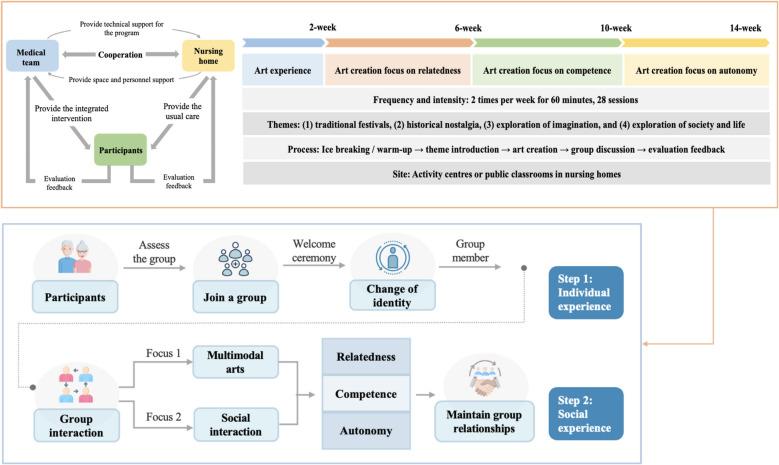
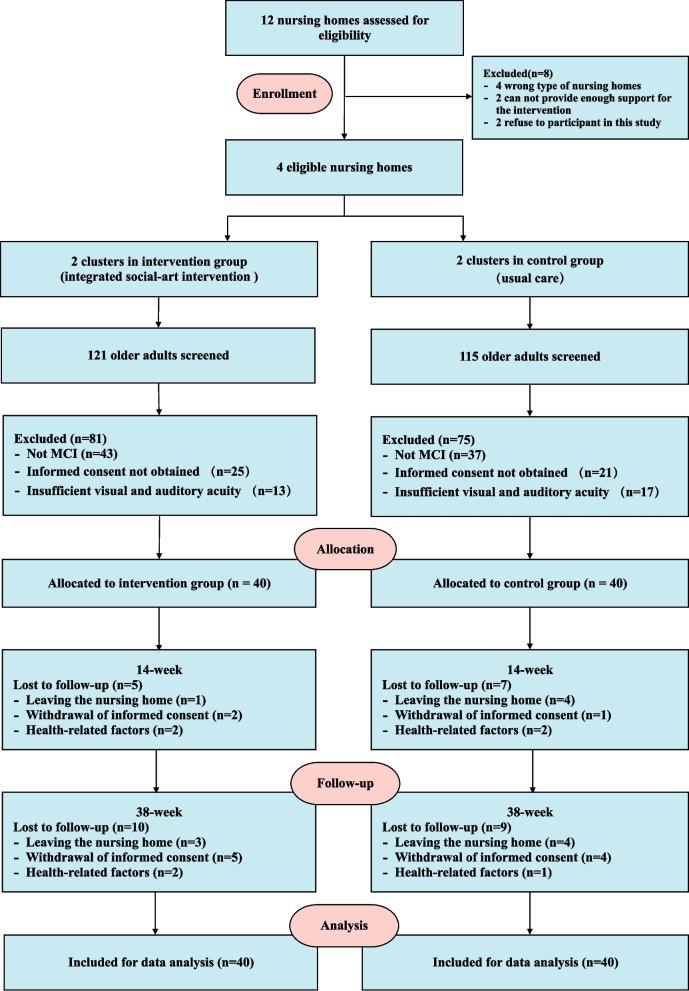
An explanatory sequential mixed-methods study was conducted, comprising a cluster randomized controlled trial (RCT) and a descriptive qualitative study. Four nursing homes in two districts of a city in southeastern China were randomly assigned (1:1) to either the intervention or the control group. The intervention group received a 14-week, 28-session integrated social-art program structured around theme-based group activities, while the control group received usual care, including assistance with daily living activities, basic medical care, recreational activities, and environmental cleaning. Quantitative outcomes were measured at baseline (T0), immediately post-intervention (T1), and at 24-week follow-up (T2), with global cognitive function as the primary outcome, and specific cognitive functions, psychosocial indicators, functional abilities, and quality of life as secondary outcomes. Qualitative interviews were conducted post-intervention to explore the reasons underlying the observed variations in efficacy.
RESULTS
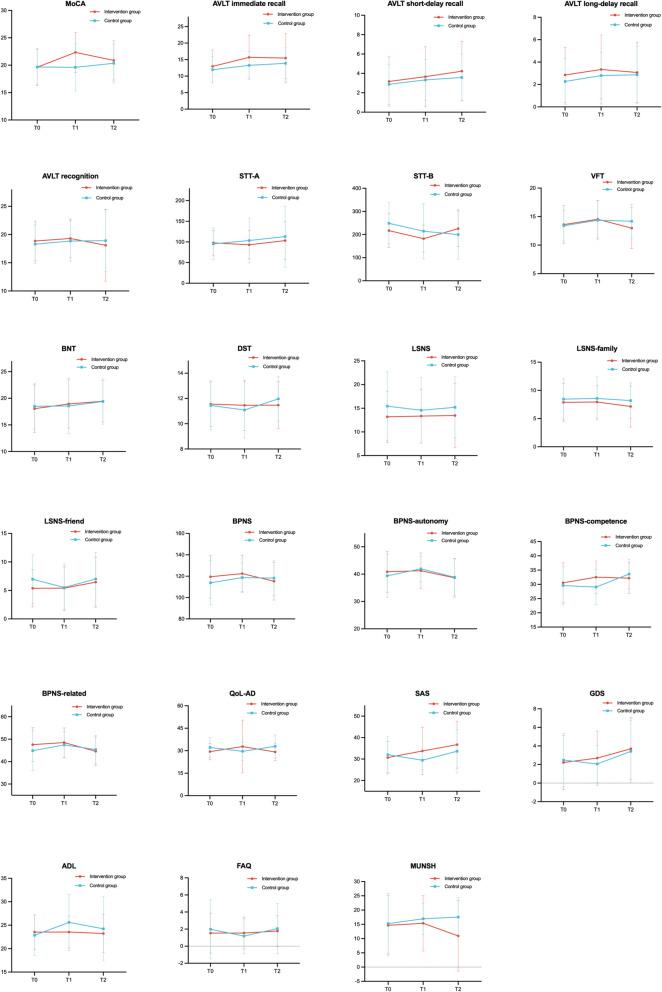
Eighty older adults with MCI (median age 86.50 years) participated, with an average attendance rate of 86.25% in the intervention group. Intention-to-treat analyses revealed a significant improvement in global cognitive function at T1 in the intervention group compared to the control group (β = 2.85; 95%CI [1.27, 4.44], P < 0.001); however, this effect was not sustained at T2. No significant improvements were observed in psychosocial indicators, functional abilities, or quality of life (P > 0.05). Qualitative findings indicated that structured, sequential tasks and professional guidance contributed to short-term cognitive gains, whereas age-related health issues and limited ongoing engagement impeded the durability of these benefits.
CONCLUSIONS
The 14-week integrated social-art intervention appears feasible and may promote short-term cognitive activation in institutionalized older adults with MCI, though its benefits were not sustained at follow-up. Future research should investigate strategies for maintaining cognitive improvements and explore modifications to enhance broader clinical outcomes in this vulnerable population.
TRIAL REGISTRATION
The trial was prospectively registered at the Chinese Clinical Trials Registry with the registration number ChiCTR2200061681 on 30 June 2022.
背景
疗养院中老年人轻度认知障碍(MCI)的患病率不断上升,因此需要有效的干预措施来减缓其向痴呆症的发展。综合社会艺术干预已显示出在增强认知功能和减少社会隔离方面的前景。本研究旨在评估这种干预对患有MCI的老年人认知和心理社会结局的影响。
方法
进行了一项解释性序贯混合方法研究,包括一项整群随机对照试验(RCT)和一项描述性定性研究。中国东南部一个城市两个区的四家疗养院被随机分配(1:1)到干预组或对照组。干预组接受了为期14周、共28节的综合社会艺术项目,该项目围绕基于主题的小组活动展开,而对照组接受常规护理,包括日常生活活动协助、基本医疗护理、娱乐活动和环境清洁。在基线(T0)、干预后即刻(T1)和24周随访(T2)时测量定量结局,以整体认知功能作为主要结局,特定认知功能、心理社会指标、功能能力和生活质量作为次要结局。干预后进行定性访谈,以探讨观察到的疗效差异背后的原因。
结果
80名患有MCI的老年人(中位年龄86.50岁)参与了研究,干预组的平均出勤率为86.25%。意向性分析显示,与对照组相比,干预组在T1时整体认知功能有显著改善(β = 2.85;95%CI [1.27, 4.44],P < 0.001);然而,这种效果在T2时未持续存在。心理社会指标、功能能力或生活质量方面未观察到显著改善(P > 0.05)。定性研究结果表明,结构化、循序渐进的任务和专业指导有助于短期认知提升,但与年龄相关的健康问题和持续参与有限阻碍了这些益处的持续性。
结论
为期14周的综合社会艺术干预似乎可行,可能会促进患有MCI的机构化老年人的短期认知激活,尽管其益处在随访时未持续存在。未来的研究应调查维持认知改善的策略,并探索改进措施以增强这一脆弱人群更广泛的临床结局。
试验注册
该试验于2022年6月30日在中国临床试验注册中心进行前瞻性注册,注册号为ChiCTR2200061681。
 Zotero 插件