Department of Mathematical Sciences, United States Military Academy, West Point, New York, United States of America.
Department of Kinesiology, School of Public Health and Health Sciences, University of Massachusetts Amherst, Amherst, Massachusetts, United States of America.
PLoS One. 2019 Aug 2;14(8):e0219933. doi: 10.1371/journal.pone.0219933. eCollection 2019.
To provide empirically-supported thresholds for step-based intensity (i.e., peak 30-min cadence; average of the top 30 steps/min in a day) and steps/day in relation to cardiometabolic health outcomes.
Receiver operating characteristic curve analysis was applied to the National Health and Nutrition Examination Survey (NHANES) 2005-2006 accelerometer-derived step data to determine steps/day and peak 30-min cadence as risk screening values (i.e., thresholds) for fasting glucose, body mass index, waist circumference, high blood pressure, triglycerides, and HDL cholesterol. Thresholds for peak 30-min cadence and steps/day were derived that, when exceeded, classify the absence of each cardiometabolic risk factor. Additionally, logistic regression models that included the influence of age and smoking were developed using the sample weights, primary sampling units (PSUs), and stratification variables provided by the NHANES survey. Finally, a decision tree analysis was performed to delineate criteria for at-risk versus healthy populations using cadence bands.
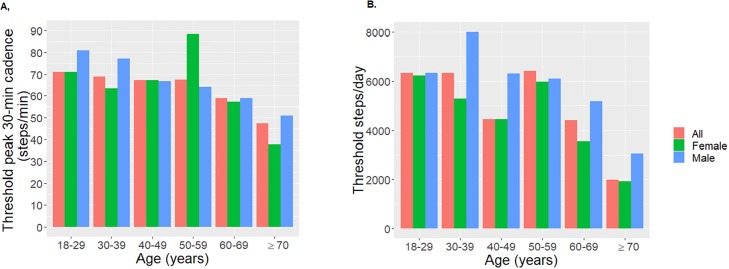
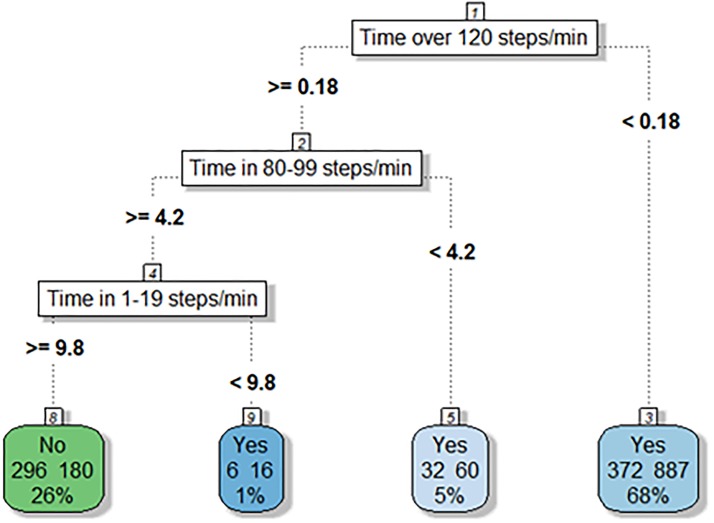
Peak 30-min cadence thresholds across cardiometabolic outcomes ranged from 66-72 steps/min. Steps/day thresholds ranged from 4325-6192 steps/day. Higher thresholds were observed in men compared to women. In men, higher steps/day thresholds were observed in age ranges of 30-39, while in women, higher thresholds were observed in the age-range 50-59 years. Decision trees for classifying being at low risk for metabolic syndrome contained one risk-free leaf at higher cadence bands, specifically for any time accumulated at ≥120 steps/min.
Minimum thresholds representing absence of cardiometabolic risk range from 4325-6192 steps/day and 66-72 steps/min for peak 30-min cadence. Any time accumulated at ≥120 steps/min was associated with an absence of cardiometabolic risk. Although based on cross-sectional data, these thresholds represent potentially important and clinically interpretable daily physical activity goals.
提供基于步频(即 30 分钟最大步频;一天中前 30 步的平均步频)和每日步数的经验支持阈值,与心血管代谢健康结果相关。
应用接收器工作特征曲线分析,对国家健康与营养调查(NHANES)2005-2006 年加速度计衍生的步频数据进行分析,确定每日步数和 30 分钟最大步频作为空腹血糖、体重指数、腰围、高血压、甘油三酯和高密度脂蛋白胆固醇的风险筛查值(即阈值)。得出 30 分钟最大步频和每日步数的阈值,超过该阈值可将每种心血管代谢风险因素的缺失分类。此外,使用 NHANES 调查提供的样本权重、主要抽样单位(PSU)和分层变量,开发了包含年龄和吸烟影响的逻辑回归模型。最后,使用节拍带进行决策树分析,以划定高危人群与健康人群的标准。
跨心血管代谢结果的 30 分钟最大步频阈值范围为 66-72 步/分钟。每日步数阈值范围为 4325-6192 步/天。男性的阈值高于女性。在男性中,30-39 岁年龄范围内观察到更高的每日步数阈值,而在女性中,50-59 岁年龄范围内观察到更高的阈值。用于分类代谢综合征低风险的决策树在较高节拍带中有一个无风险叶,特别是在任何时间内累积达到≥120 步/分钟。
无心血管代谢风险的最小阈值范围为每日 4325-6192 步和 30 分钟最大步频 66-72 步。任何时间内累积达到≥120 步/分钟与心血管代谢风险无关。尽管基于横断面数据,但这些阈值代表了潜在重要且具有临床可解释的日常体力活动目标。