Scaminaci Russo Daniele, Cinelli Francesca, Sarti Chiara, Giachetti Luca
Department of Experimental and Clinical Medicine-Unit of Dentistry, University of Florence, Via del Ponte di Mezzo, 48-50127 Firenze, Italy.
Dent J (Basel). 2019 Aug 1;7(3):74. doi: 10.3390/dj7030074.
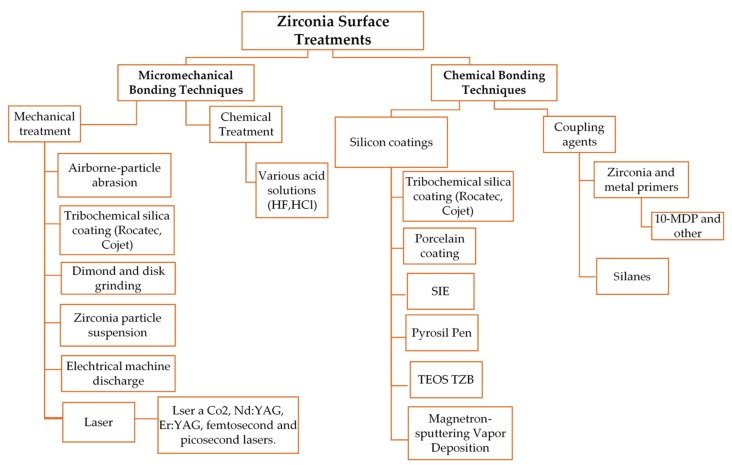
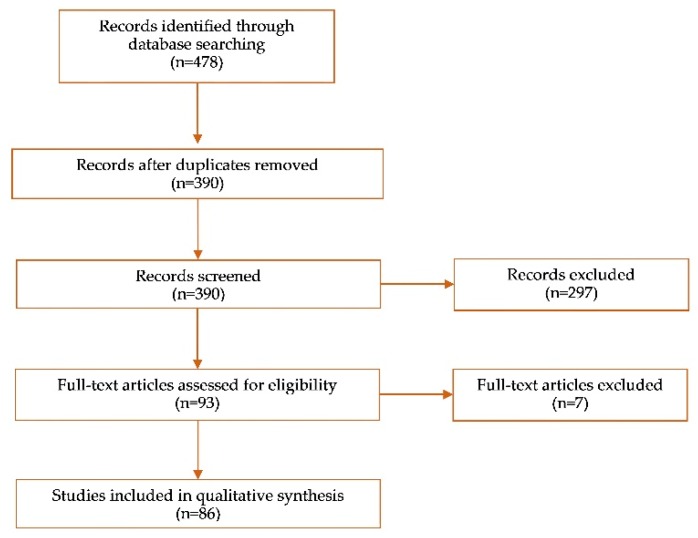
Reliable bonding between resin composite cements and high strength ceramics is difficult to achieve because of their chemical inertness and lack of silica content that makes etching impossible. The purpose of this review is to classify and analyze the existing methods and materials suggested to improve the adhesion of zirconia to dental substrate by using composite resins, in order to explore current trends in surface conditioning methods with predictable results. The current literature, examining the bond strength of zirconia ceramics, and including in vitro studies, clinical studies, and a systematic review, was analyzed. The research in the literature was carried out using PubMed and Cochrane Library databases, only papers in English, published online from 2013 to 2018. The following keywords and their combinations were used: Zirconia, 3Y-TZP, Adhesion, Adhesive cementation, Bonding, Resin, Composite resin, Composite material, Dentin, Enamel. Research, in PubMed and Cochrane Library databases, provided 390 titles with abstracts. From these, a total of 93 publications were chosen for analysis. After a full text evaluation, seven articles were discarded. Therefore, the final sample was 86, including in vitro, clinical studies, and one systematic review. Various adhesive techniques with different testing methods were examined. Airborne-particle abrasion and tribo-chemical silica coating are the pre-treatment methods with more evidence in the literature. Increased adhesion could be expected after physico-chemical conditioning of zirconia. Surface contamination has a negative effect on adhesion. There is no evidence to support a universal adhesion protocol.
由于树脂复合水门汀与高强度陶瓷具有化学惰性且缺乏可用于蚀刻的二氧化硅成分,因此很难实现二者之间可靠的粘结。本综述的目的是对现有的通过使用复合树脂来提高氧化锆与牙齿基质粘结力的方法和材料进行分类和分析,以便探索具有可预测结果的表面处理方法的当前趋势。分析了当前研究氧化锆陶瓷粘结强度的文献,包括体外研究、临床研究和一项系统评价。文献研究使用PubMed和Cochrane图书馆数据库进行,仅纳入2013年至2018年在线发表的英文论文。使用了以下关键词及其组合:氧化锆、3Y-TZP、粘结、粘结水门汀、粘结、树脂、复合树脂、复合材料、牙本质、釉质。在PubMed和Cochrane图书馆数据库中检索到390篇带有摘要的文献标题。从中总共选择了93篇出版物进行分析。经过全文评估,剔除了7篇文章。因此,最终样本为86篇,包括体外研究、临床研究和1篇系统评价。研究了采用不同测试方法的各种粘结技术。空气颗粒磨损和摩擦化学二氧化硅涂层是文献中证据较多的预处理方法。氧化锆经过物理化学处理后,粘结力有望提高。表面污染对粘结有负面影响。没有证据支持通用的粘结方案。