Institute of Science and Technology (IST) Austria, 3400, Klosterneuburg, Austria.
College of Life Sciences, Shaanxi Normal University, 710119, Xi'an, China.
Nat Commun. 2019 Aug 2;10(1):3480. doi: 10.1038/s41467-019-11471-8.
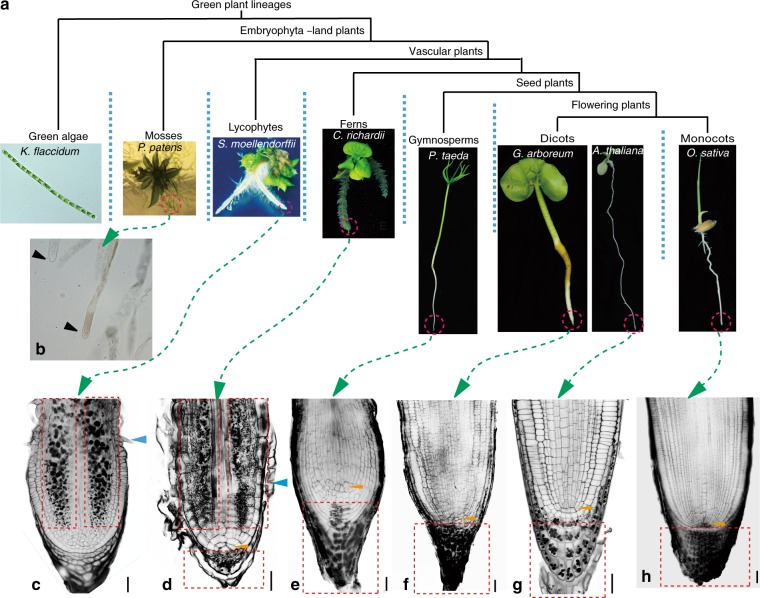
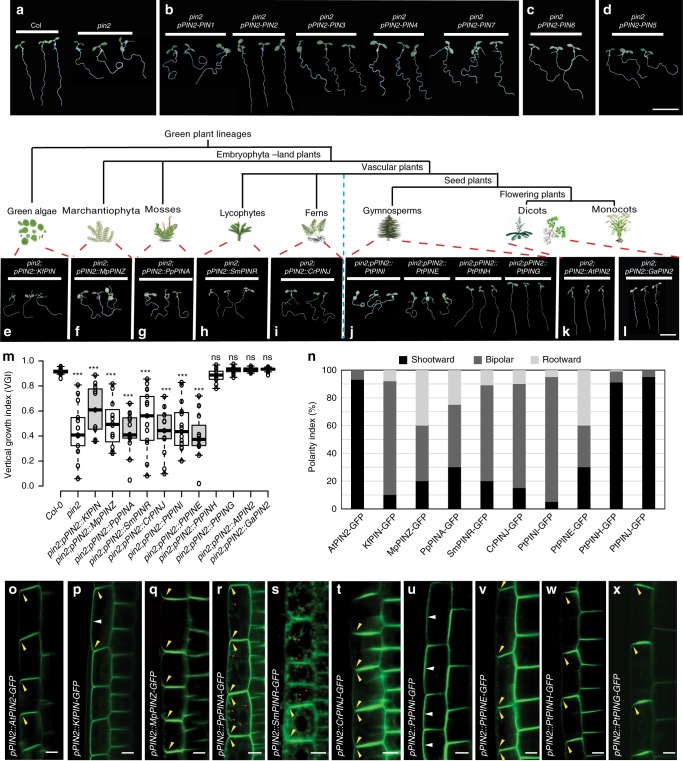
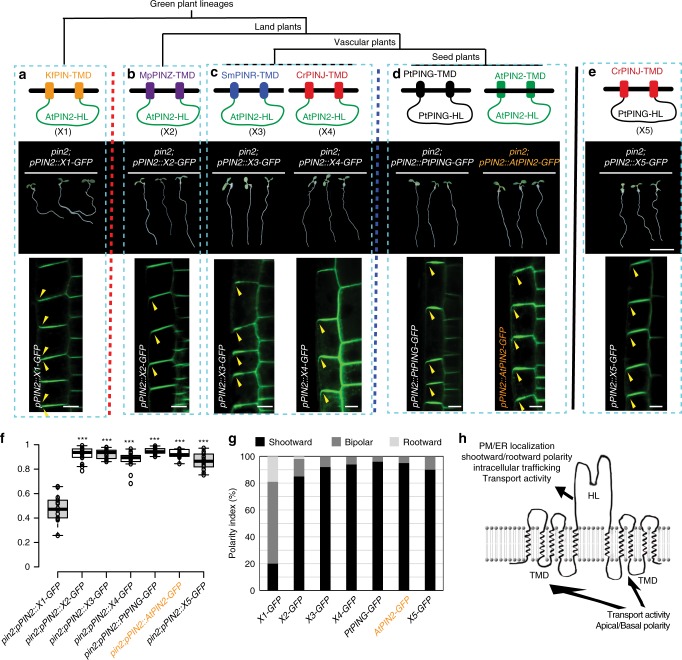
An important adaptation during colonization of land by plants is gravitropic growth of roots, which enabled roots to reach water and nutrients, and firmly anchor plants in the ground. Here we provide insights into the evolution of an efficient root gravitropic mechanism in the seed plants. Architectural innovation, with gravity perception constrained in the root tips along with a shootward transport route for the phytohormone auxin, appeared only upon the emergence of seed plants. Interspecies complementation and protein domain swapping revealed functional innovations within the PIN family of auxin transporters leading to the evolution of gravitropism-specific PINs. The unique apical/shootward subcellular localization of PIN proteins is the major evolutionary innovation that connected the anatomically separated sites of gravity perception and growth response via the mobile auxin signal. We conclude that the crucial anatomical and functional components emerged hand-in-hand to facilitate the evolution of fast gravitropic response, which is one of the major adaptations of seed plants to dry land.
植物在陆地上的殖民过程中,一个重要的适应是根的向地性生长,这使得根能够找到水和养分,并将植物牢固地固定在地上。在这里,我们深入了解了种子植物中高效根向地性机制的进化。结构创新,重力感应局限在根尖,而植物激素生长素的运输途径是朝向梢端的,这一创新仅在种子植物出现时才出现。种间互补和蛋白结构域交换揭示了生长素转运蛋白 PIN 家族内的功能创新,导致了向地性特异的 PIN 的进化。PIN 蛋白独特的顶端/梢端亚细胞定位是主要的进化创新,它通过移动的生长素信号将重力感应和生长反应在解剖上分离的部位连接起来。我们的结论是,关键的解剖学和功能组件同时出现,促进了快速向地性反应的进化,这是种子植物适应旱地的主要适应之一。