CEBAS-CSIC, Department of Soil and Water Conservation, Campus Universitario de Espinardo, 30100, Murcia, Spain.
Cooperative Institute for Research in Environmental Sciences, University of Colorado, Boulder, CO, 80309, USA.
Nat Commun. 2019 Aug 2;10(1):3481. doi: 10.1038/s41467-019-11472-7.
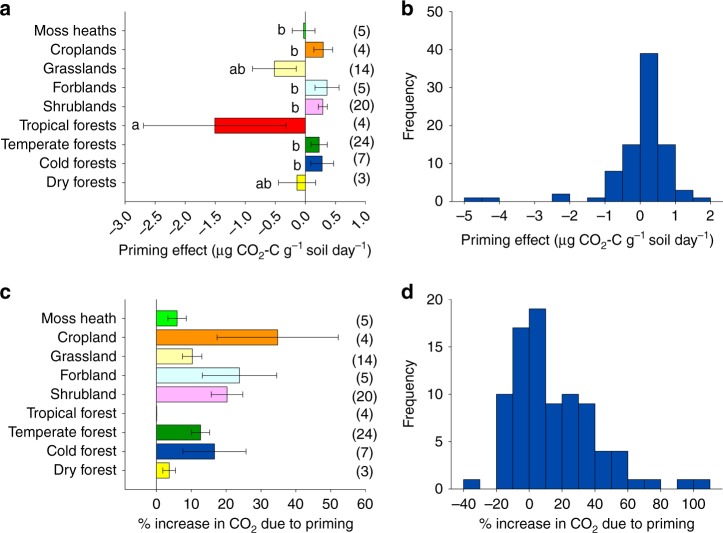
Identifying the global drivers of soil priming is essential to understanding C cycling in terrestrial ecosystems. We conducted a survey of soils across 86 globally-distributed locations, spanning a wide range of climates, biotic communities, and soil conditions, and evaluated the apparent soil priming effect using C-glucose labeling. Here we show that the magnitude of the positive apparent priming effect (increase in CO release through accelerated microbial biomass turnover) was negatively associated with SOC content and microbial respiration rates. Our statistical modeling suggests that apparent priming effects tend to be negative in more mesic sites associated with higher SOC contents. In contrast, a single-input of labile C causes positive apparent priming effects in more arid locations with low SOC contents. Our results provide solid evidence that SOC content plays a critical role in regulating apparent priming effects, with important implications for the improvement of C cycling models under global change scenarios.
确定土壤激发的全球驱动因素对于理解陆地生态系统中的碳循环至关重要。我们对全球 86 个分布广泛的地点的土壤进行了调查,这些地点涵盖了广泛的气候、生物群落和土壤条件,并使用 C-葡萄糖标记评估了明显的土壤激发效应。在这里,我们表明,正的明显激发效应(通过加速微生物生物量周转释放的 CO 增加)的幅度与 SOC 含量和微生物呼吸速率呈负相关。我们的统计模型表明,在与更高 SOC 含量相关的更湿润的地方,明显的激发效应往往是负的。相比之下,在 SOC 含量较低的更干旱的地方,单一输入的易位 C 会导致明显的激发效应。我们的结果提供了确凿的证据,表明 SOC 含量在调节明显激发效应方面起着关键作用,这对在全球变化情景下改进碳循环模型具有重要意义。