Institute of Mental Health, Suzhou Guangji Hospital, The Affiliated Guangji Hospital of Soochow Unversity, Soochow Unversity, Suzhou, Jiangsu, 215137, China.
Department of Neurosurgery, Pu Nan Hospital, Shanghai, 200125, China.
Sci Rep. 2019 Aug 2;9(1):11248. doi: 10.1038/s41598-019-47754-9.
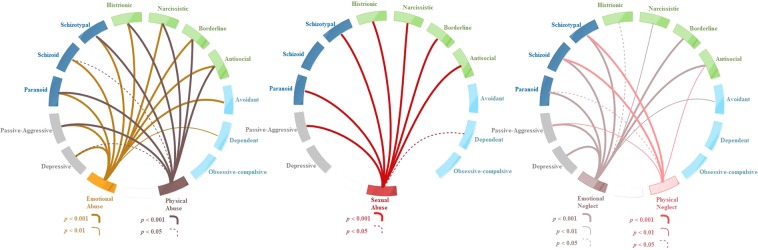
Psychiatric disorders are highly heterogeneous syndromes often explained by underlying and internalized personality disorder(PD) traits that are affected by externalized childhood trauma experiences(CTE). The present study investigated the differential subtype model by examining the association between PD traits and CTE in a clinical sample with transdiagnostic psychopathology. Outpatients(n = 2090) presenting for psychiatric treatment completed self-reported measures of PD traits(Personality Diagnostic Questionnaire) and the childhood adversity(Child Trauma Questionnaire). Canonical variates were generated by canonical correlation analysis(CCA) and then used for hierarchical cluster analysis to produce subtypes. A support vector machine(SVM) model was used and validated using a linear kernel to assess the utility of the extracted subtypes of outpatients in clinical diagnosis classifications. The CCA determined two linear combinations: emotional abuse related dissociality PD traits(antisocial and paranoid PD) and emotional neglect related sociality PD traits(schizoid, passive-aggressive, depressive, histrionic, and avoidant PD). A cluster analysis revealed three subtypes defined by distinct and relatively homogeneous patterns along two dimensions, and comprising 17.5%(cluster-1, n = 365), 34.8%(cluster-2, n = 727), and 47.8%(cluster-3, n = 998) of the sample, each with distinctive features of PD traits and CTE. These subtypes suggest more distinct PD trait correlates of CTE manifestations than were captured by clinical phenomenological diagnostic definitions. Our results highlight important subtypes of psychiatric patients that highlight PD traits and CTE that transcend current diagnostic boundaries. The three different subtypes reflect significant differences in PD and CTE characteristics and lend support to efforts to develop PD and childhood trauma targeted psychotherapy that extends to clinical diagnosis-based interventions.
精神障碍是高度异质的综合征,通常可以用潜在的和内在的人格障碍(PD)特征来解释,这些特征受到外在的儿童创伤经历(CTE)的影响。本研究通过检查临床样本中 PD 特征与 CTE 之间的关联,探讨了不同的亚型模型。有精神病理学共病的门诊患者(n=2090)完成了 PD 特征(人格诊断问卷)和儿童期逆境(儿童创伤问卷)的自我报告测量。通过典型相关分析(CCA)生成典型变量,然后用于分层聚类分析以产生亚型。使用支持向量机(SVM)模型并使用线性核进行验证,以评估提取的门诊患者亚型在临床诊断分类中的效用。CCA 确定了两个线性组合:与情感虐待相关的反社会 PD 特征(反社会和偏执 PD)和与情感忽视相关的社交 PD 特征(分裂型、被动攻击型、抑郁型、表演型和回避型 PD)。聚类分析揭示了三个由两个维度上独特且相对同质的模式定义的亚型,包括 17.5%(cluster-1,n=365)、34.8%(cluster-2,n=727)和 47.8%(cluster-3,n=998)的样本,每个亚型都具有 PD 特征和 CTE 的独特特征。这些亚型表明,PD 特征与 CTE 表现的相关性比临床表型诊断定义更具独特性。我们的研究结果强调了精神障碍患者的重要亚型,这些亚型突出了 PD 特征和 CTE,超越了当前的诊断界限。这三个不同的亚型反映了 PD 和 CTE 特征的显著差异,并支持努力开发针对 PD 和儿童创伤的靶向心理治疗,以扩展到基于临床诊断的干预措施。