Department of Neurology, Samsung Medical Center, Sungkyunkwan University School of Medicine, South Korea.
School of Biomedical Engineering, Korea University, Seoul, South Korea.
Neuroimage Clin. 2019;24:101941. doi: 10.1016/j.nicl.2019.101941. Epub 2019 Jul 19.
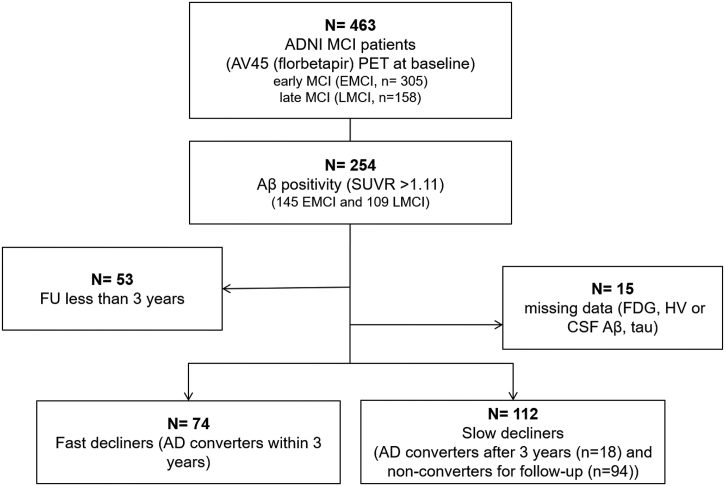
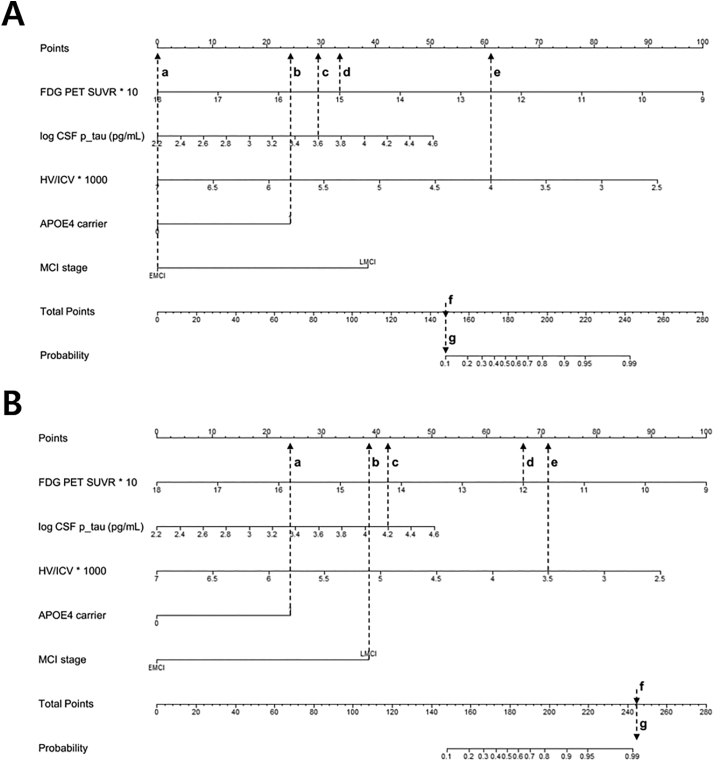
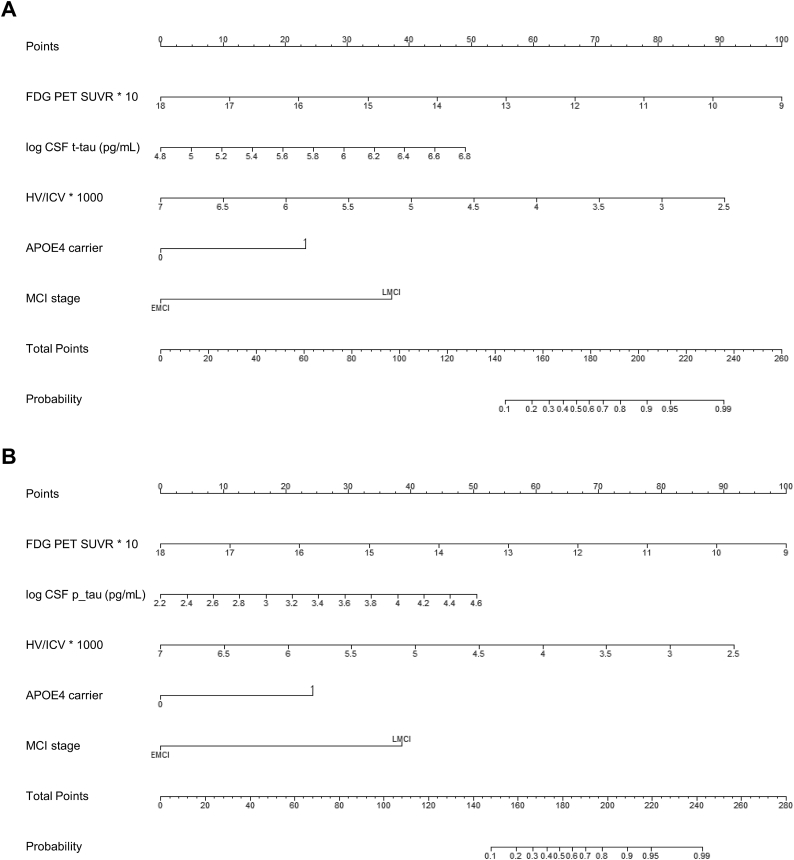
It may be possible to classify patients with Aβ positive (+) mild cognitive impairment (MCI) into fast and slow decliners according to their biomarker status. In this study, we aimed to develop a risk prediction model to predict fast decline in the Aβ+ MCI population using multimodal biomarkers. We included 186 Aβ+ MCI patients who underwent florbetapir PET, brain MRI, cerebrospinal fluid (CSF) analyses, and FDG PET at baseline. We defined conversion to dementia within 3 years (= fast decline) as the outcome. The associations of potential covariates (MCI stage, APOE4 genotype, corrected hippocampal volume (HV), FDG PET SUVR, AV45 PET SUVR, CSF Aβ, total tau (t-tau), and phosphorylated tau (p-tau)) with the outcome were tested and nomograms were constructed using logistic regression models in the training dataset (n=124, n of fast decliners=52). The model was internally validated with the testing dataset (n=62, n of fast decliners=22). The multivariable analysis (including CSF t-tau) showed that MCI stage (late MCI vs. early MCI; OR 15.88, 95% CI 4.59, 54.88), APOE4 (OR 5.65, 95% CI 1.52, 20.98), corrected HV1000 (OR 0.22, 95% CI 0.09, 0.57), FDG SUVR10 (OR 0.43, 95% CI 0.27, 0.71), and log CSF t-tau (OR 6.20, 95% CI 1.48, 25.96) were associated with being fast decliners. In the second model including CSF p-tau instead of t-tau, the above associations remained the same, with a significant association between log CSF p-tau (OR 4.53, 95% CI 1.26, 16.31) and fast decline. The constructed nomograms showed excellent predictive performance (90%) on validation with the testing dataset. Among Aβ+ MCI patients, our findings suggested that multimodal AD biomarkers are significantly associated with being classified as fast decliners. A nomogram incorporating these biomarkers might be useful in early treatment decisions or stratified enrollment of this population into clinical trials.
根据生物标志物的状态,有可能将 Aβ 阳性(+)轻度认知障碍(MCI)患者分为快速下降者和缓慢下降者。在这项研究中,我们旨在使用多模态生物标志物为 Aβ+ MCI 人群开发一种预测快速下降的风险预测模型。我们纳入了 186 名在基线时接受氟代苯丙氨酸 PET、脑 MRI、脑脊液(CSF)分析和 FDG PET 的 Aβ+ MCI 患者。我们将 3 年内转为痴呆(=快速下降)定义为结局。在训练数据集(n=124,快速下降者 n=52)中,测试了潜在协变量(MCI 阶段、APOE4 基因型、校正后的海马体积(HV)、FDG PET SUVR、AV45 PET SUVR、CSF Aβ、总 tau(t-tau)和磷酸化 tau(p-tau))与结局的相关性,并使用逻辑回归模型构建了列线图。使用测试数据集(n=62,快速下降者 n=22)对模型进行了内部验证。多变量分析(包括 CSF t-tau)表明,MCI 阶段(晚期 MCI 与早期 MCI;OR 15.88,95%CI 4.59,54.88)、APOE4(OR 5.65,95%CI 1.52,20.98)、校正后的 HV1000(OR 0.22,95%CI 0.09,0.57)、FDG SUVR10(OR 0.43,95%CI 0.27,0.71)和 log CSF t-tau(OR 6.20,95%CI 1.48,25.96)与快速下降有关。在包含 CSF p-tau 而非 t-tau 的第二个模型中,上述相关性仍然存在,log CSF p-tau(OR 4.53,95%CI 1.26,16.31)与快速下降之间存在显著相关性。验证测试数据集的列线图显示出出色的预测性能(90%)。在 Aβ+ MCI 患者中,我们的研究结果表明,多模态 AD 生物标志物与被归类为快速下降者显著相关。纳入这些生物标志物的列线图可能有助于早期治疗决策或对该人群进行临床试验分层招募。