Roque Lindsey, Karawani Hanin, Gordon-Salant Sandra, Anderson Samira
Department of Hearing and Speech Sciences, University of Maryland, College Park, College Park, MD, United States.
Department of Communication Sciences and Disorders, University of Haifa, Haifa, Israel.
Front Neurosci. 2019 Jul 19;13:749. doi: 10.3389/fnins.2019.00749. eCollection 2019.
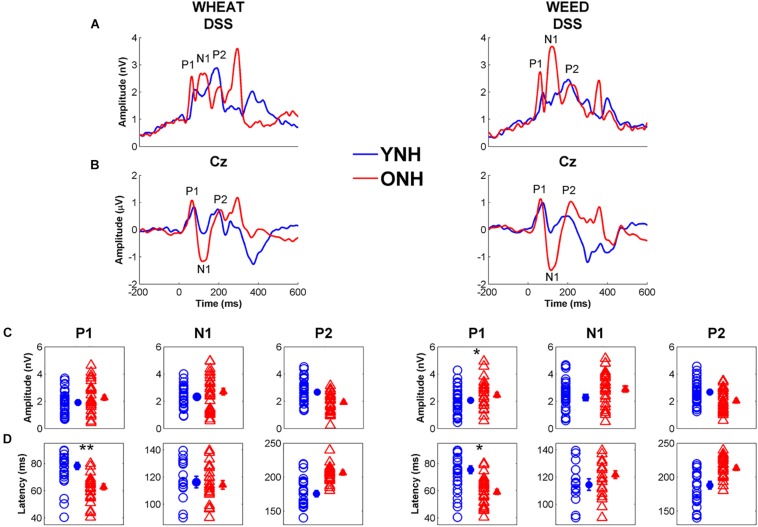
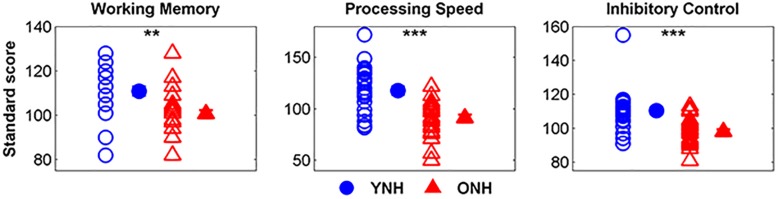
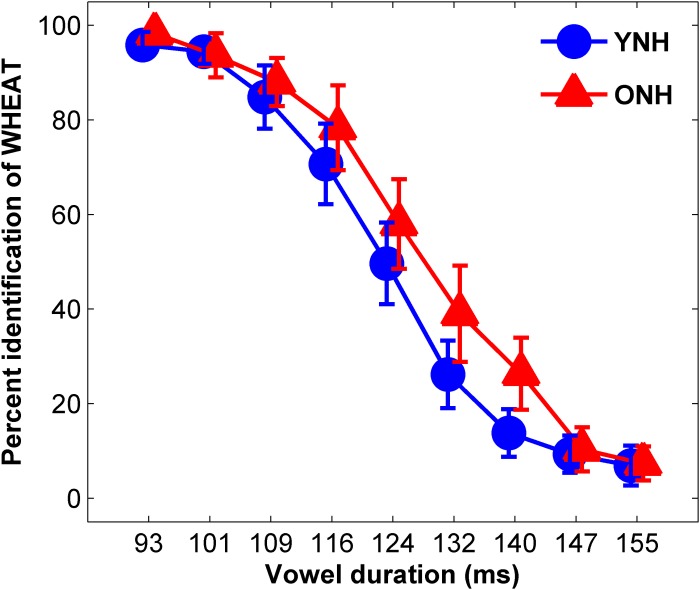
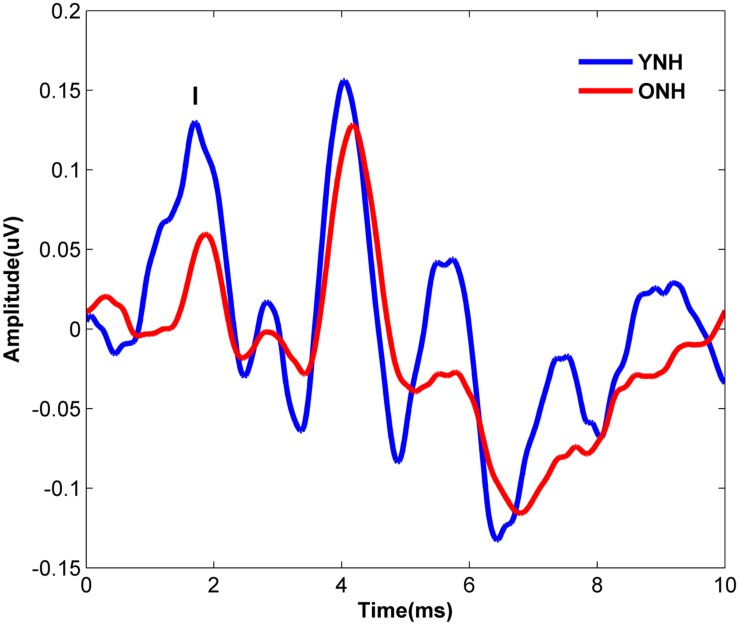
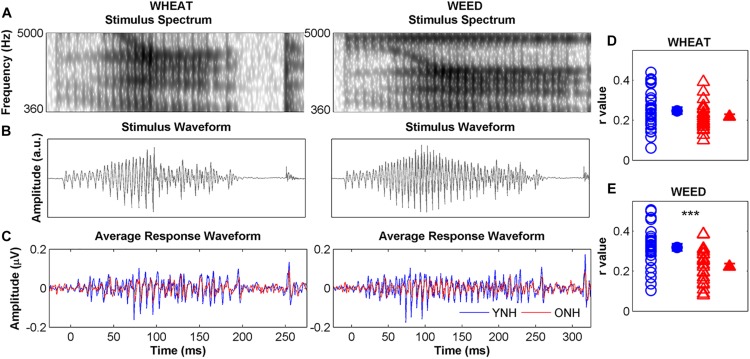
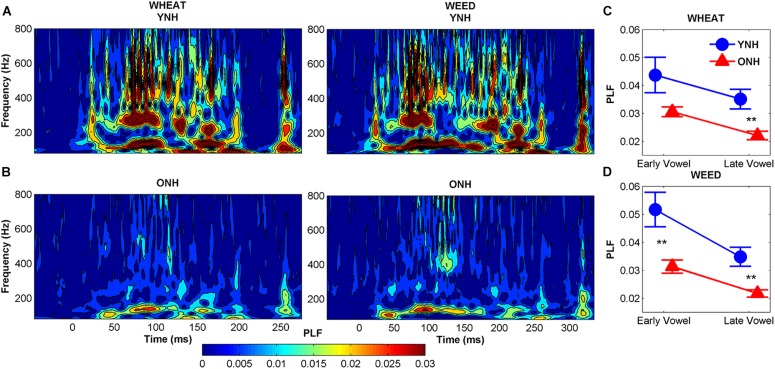
Older adults commonly report difficulty understanding speech, particularly in adverse listening environments. These communication difficulties may exist in the absence of peripheral hearing loss. Older adults, both with normal hearing and with hearing loss, demonstrate temporal processing deficits that affect speech perception. The purpose of the present study is to investigate aging, cognition, and neural processing factors that may lead to deficits on perceptual tasks that rely on phoneme identification based on a temporal cue - vowel duration. A better understanding of the neural and cognitive impairments underlying temporal processing deficits could lead to more focused aural rehabilitation for improved speech understanding for older adults. This investigation was conducted in younger (YNH) and older normal-hearing (ONH) participants who completed three measures of cognitive functioning known to decline with age: working memory, processing speed, and inhibitory control. To evaluate perceptual and neural processing of auditory temporal contrasts, identification functions for the contrasting word-pair WHEAT and WEED were obtained on a nine-step continuum of vowel duration, and frequency-following responses (FFRs) and cortical auditory-evoked potentials (CAEPs) were recorded to the two endpoints of the continuum. Multiple linear regression analyses were conducted to determine the cognitive, peripheral, and/or central mechanisms that may contribute to perceptual performance. YNH participants demonstrated higher cognitive functioning on all three measures compared to ONH participants. The slope of the identification function was steeper in YNH than in ONH participants, suggesting a clearer distinction between the contrasting words in the YNH participants. FFRs revealed better response waveform morphology and more robust phase-locking in YNH compared to ONH participants. ONH participants also exhibited earlier latencies for CAEP components compared to the YNH participants. Linear regression analyses revealed that cortical processing significantly contributed to the variance in perceptual performance in the WHEAT/WEED identification functions. These results suggest that reduced neural precision contributes to age-related speech perception difficulties that arise from temporal processing deficits.
老年人普遍表示在理解言语方面存在困难,尤其是在不利的听力环境中。这些沟通困难可能在没有外周听力损失的情况下存在。无论是听力正常还是有听力损失的老年人,都表现出影响言语感知的时间处理缺陷。本研究的目的是调查可能导致基于时间线索——元音时长进行音素识别的感知任务出现缺陷的衰老、认知和神经处理因素。更好地理解时间处理缺陷背后的神经和认知障碍,可能会带来更有针对性的听觉康复,以改善老年人的言语理解。这项调查是在年轻(YNH)和老年听力正常(ONH)的参与者中进行的,他们完成了三项已知会随年龄下降的认知功能测量:工作记忆、处理速度和抑制控制。为了评估听觉时间对比度的感知和神经处理,在元音时长的九步连续体上获得了对比词对WHEAT和WEED的识别函数,并记录了连续体两个端点的频率跟随反应(FFR)和皮层听觉诱发电位(CAEP)。进行了多元线性回归分析,以确定可能有助于感知性能的认知、外周和/或中枢机制。与ONH参与者相比,YNH参与者在所有三项测量中都表现出更高的认知功能。YNH参与者的识别函数斜率比ONH参与者更陡,这表明YNH参与者中对比词之间的区别更明显。与ONH参与者相比,YNH参与者的FFR显示出更好的反应波形形态和更强的锁相。与YNH参与者相比,ONH参与者的CAEP成分潜伏期也更早。线性回归分析表明,皮层处理对WHEAT/WEED识别函数中感知性能的方差有显著贡献。这些结果表明,神经精度降低导致了与年龄相关的、由时间处理缺陷引起的言语感知困难。