Crozier Dena, Zhang Zhaoran, Park Se-Woong, Sternad Dagmar
Department of Physics, Northeastern University, Boston, MA, United States.
Department of Biology, Northeastern University, Boston, MA, United States.
Front Hum Neurosci. 2019 Jul 18;13:231. doi: 10.3389/fnhum.2019.00231. eCollection 2019.
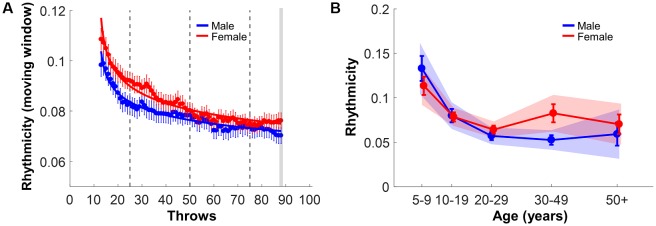
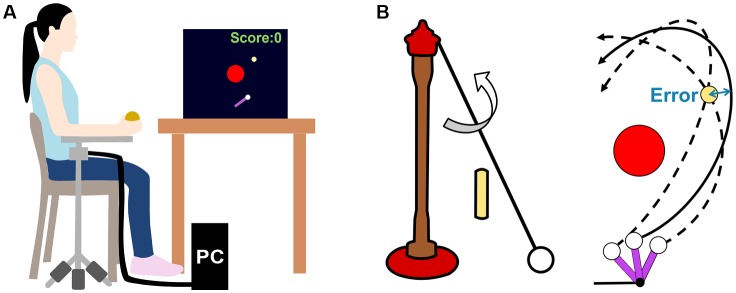
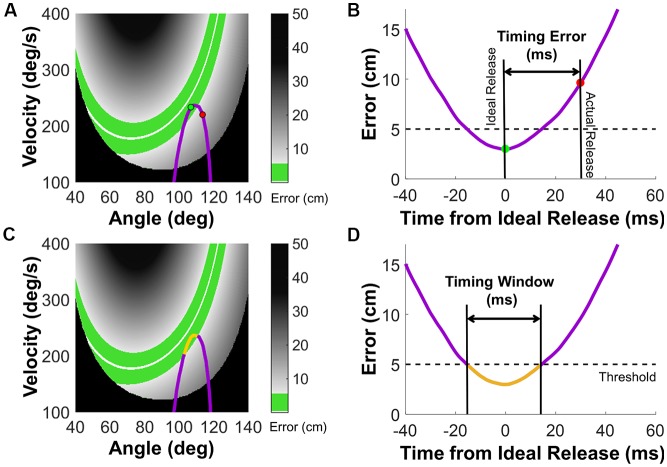
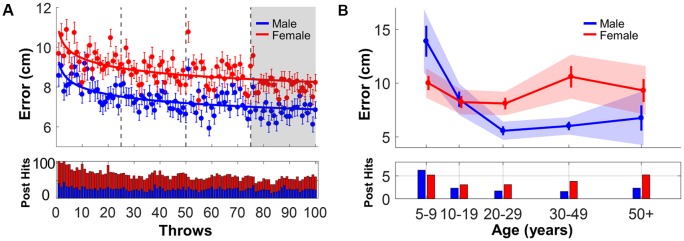
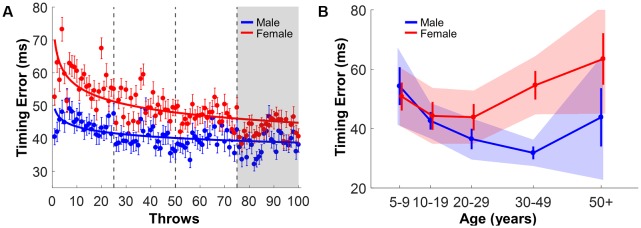
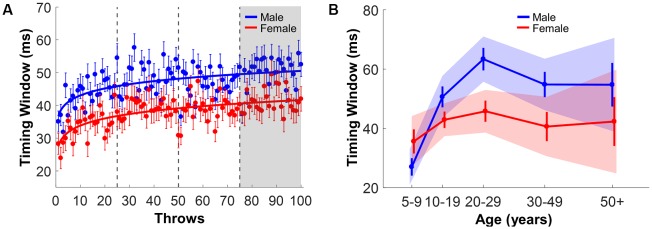
Numerous studies have demonstrated that boys throw balls faster, farther and more accurately than girls. This may be largely due to well-known anatomical and muscle-physiological differences that play a central role in overarm throwing. With the objective to understand the potential contribution of the equally essential coordinative aspects in throwing for this gender difference, this large cross-sectional study examined a simplified forearm throw that eliminated the requirements that give males an advantage.While the overall performance error indeed became similar in the age groups younger than 20 years and older than 50 years, it was attenuated for middle-aged individuals. The gender differences remained in individuals who reported no throwing experience, but females with throwing experience reached similar performance as males. Two fine-grained spatiotemporal metrics displayed similar age-dependent gender disparities: while overall, males showed better spatiotemporal coordination of the ball release, age group comparisons specified that it was particularly middle-aged females that made more timing errors and did not develop a noise-tolerant strategy as males did. As throwing experience did not explain this age-dependency, the results are discussed in the context of spatial abilities and video game experience, both more pronounced in males. In contrast, a measure of rhythmicity developed over successive throws only revealed weak gender differences, speaking to the fundamental tendency in humans to fall into rhythmic patterns. Only the youngest individuals between 5 and 9 years of age showed significantly less rhythmicity in their performance. This computational study was performed in a large cohort in the context of an outreach activity, demonstrating that robust quantitative measures can also be obtained in less controlled environments. The findings also alert that motor neuroscience may need to pay more attention to gender differences.
众多研究表明,男孩扔球比女孩更快、更远且更准确。这可能在很大程度上归因于众所周知的解剖学和肌肉生理学差异,这些差异在过肩投掷中起着核心作用。为了了解投掷中同样重要的协调方面对这种性别差异的潜在贡献,这项大型横断面研究考察了一种简化的前臂投掷,消除了那些使男性具有优势的要求。虽然在20岁以下和50岁以上的年龄组中,总体表现误差确实变得相似,但中年个体的误差有所减小。在没有投掷经验的个体中,性别差异仍然存在,但有投掷经验的女性达到了与男性相似的表现。两个细粒度的时空指标显示出类似的年龄依赖性性别差异:总体而言,男性在球释放时表现出更好的时空协调性,但年龄组比较表明,尤其是中年女性会出现更多的时间误差,并且没有像男性那样形成一种抗干扰策略。由于投掷经验并不能解释这种年龄依赖性,因此在空间能力和电子游戏经验的背景下讨论了这些结果,这两方面在男性中更为明显。相比之下,连续投掷过程中形成的节奏感测量仅显示出微弱的性别差异,这表明人类有陷入节奏模式的基本倾向。只有5至9岁的最年轻个体在其表现中显示出明显较低的节奏感。这项计算研究是在一次外展活动的背景下对一大群人进行的,表明在控制较少的环境中也可以获得可靠的定量测量结果。研究结果还提醒运动神经科学可能需要更多地关注性别差异。