Institut de Neurosciences de la Timone UMR 7289, CNRS and Aix Marseille Université, Faculté de Médecine de la Timone, 27 Bd Jean Moulin, 13005, Marseille, France.
Institute of Communication Technology, Electronics and Applied Mathematics, Université Catholique de Louvain, Avenue Georges Lemaitre 4-6 bte, 1348, Louvain-la-neuve, Belgium.
Sci Rep. 2020 Jul 17;10(1):11863. doi: 10.1038/s41598-020-68069-0.
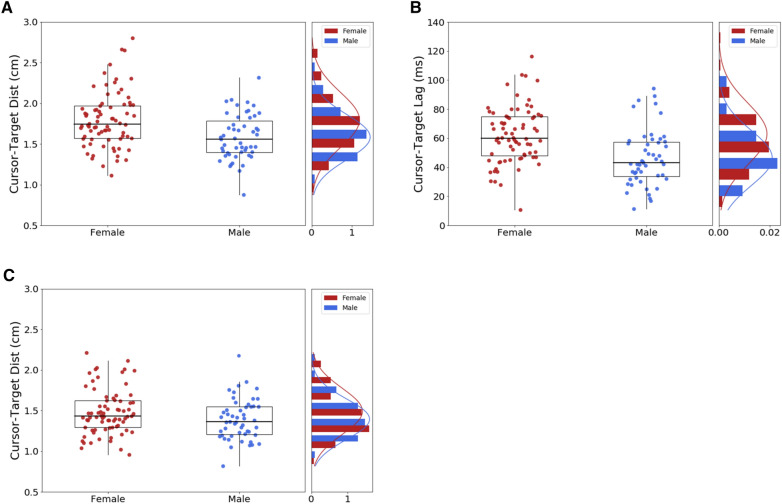
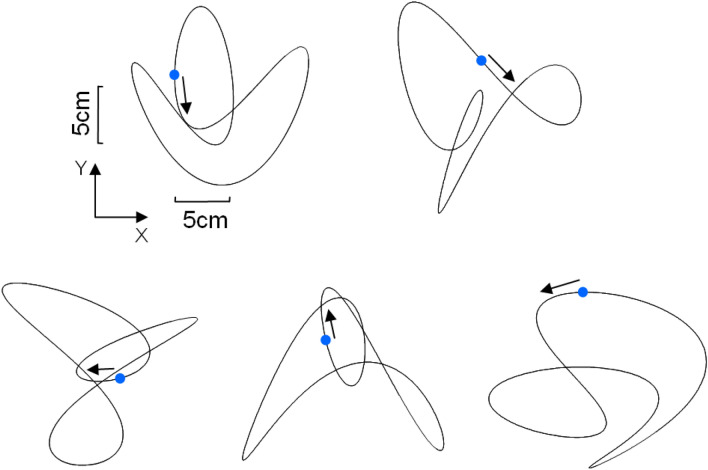
There is a growing interest in sex differences in human and animal cognition. However, empirical evidences supporting behavioral and neural sex differences in humans remain sparse. Visuomotor behaviors offer a robust and naturalistic empirical framework to seek for the computational mechanisms underlying sex biases in cognition. In a large group of human participants (N = 127), we investigated sex differences in a visuo-oculo-manual motor task that consists of tracking with the hand a target moving unpredictably. We report a clear male advantage in hand tracking accuracy. We tested whether men and women employ different gaze strategy or hand movement kinematics. Results show no key difference in these distinct visuomotor components. However, highly consistent differences in eye-hand coordination were evidenced by a larger temporal lag between hand motion and target motion in women. This observation echoes with other studies showing a male advantage in manual reaction time to visual stimuli. We propose that the male advantage for visuomotor tracking does not reside in a more reliable gaze strategy, or in more sophisticated hand movements, but rather in a faster decisional process linking visual information about target motion with forthcoming hand, but not eye, actions.
人们对人类和动物认知中的性别差异越来越感兴趣。然而,支持人类行为和神经性别差异的经验证据仍然很少。视觉运动行为提供了一个强大而自然的经验框架,以寻求认知中性别偏见的计算机制。在一大群人类参与者中(N=127),我们研究了视觉-眼-手动运动任务中的性别差异,该任务包括用手跟踪不可预测移动的目标。我们报告了手跟踪准确性方面的明显男性优势。我们测试了男性和女性是否采用不同的注视策略或手部运动运动学。结果表明,在这些不同的视觉运动成分中没有关键差异。然而,在女性中,手运动和目标运动之间存在更大的时间滞后,这表明眼手协调存在高度一致的差异。这一观察结果与其他研究结果一致,即男性在手动反应时间上对视觉刺激具有优势。我们提出,视觉运动跟踪的男性优势不在于更可靠的注视策略,也不在于更复杂的手部运动,而在于将关于目标运动的视觉信息与即将到来的手部而非眼部动作联系起来的更快决策过程。