Gavrilov Sergey N, Korzhenkov Aleksei A, Kublanov Ilya V, Bargiela Rafael, Zamana Leonid V, Popova Alexandra A, Toshchakov Stepan V, Golyshin Peter N, Golyshina Olga V
Laboratory of Metabolism of Extremophiles, Winogradsky Institute of Microbiology, FRC Biotechnology, RAS, Moscow, Russia.
Laboratory of Bioinformatics, Genomics and Genome Editing, NRC Kurchatov Institute, Moscow, Russia.
Front Microbiol. 2019 Jul 17;10:1573. doi: 10.3389/fmicb.2019.01573. eCollection 2019.
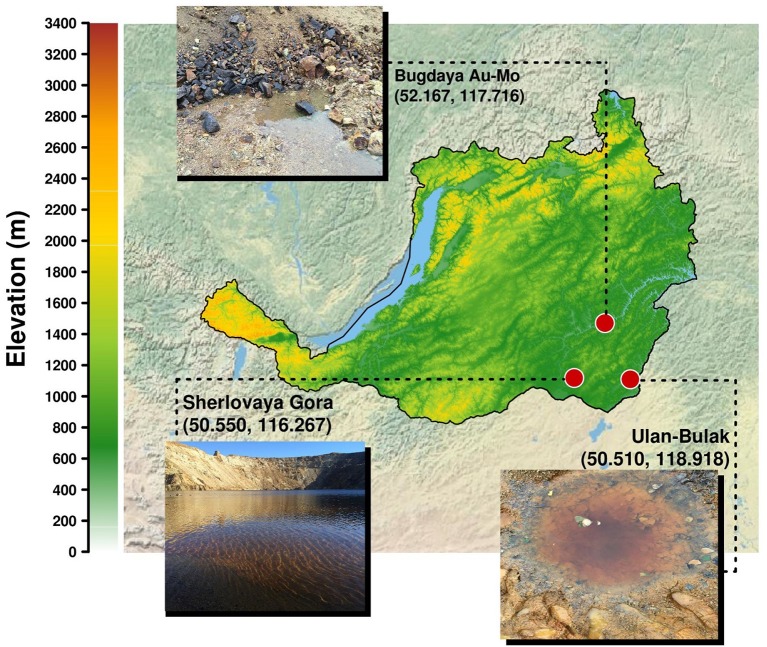
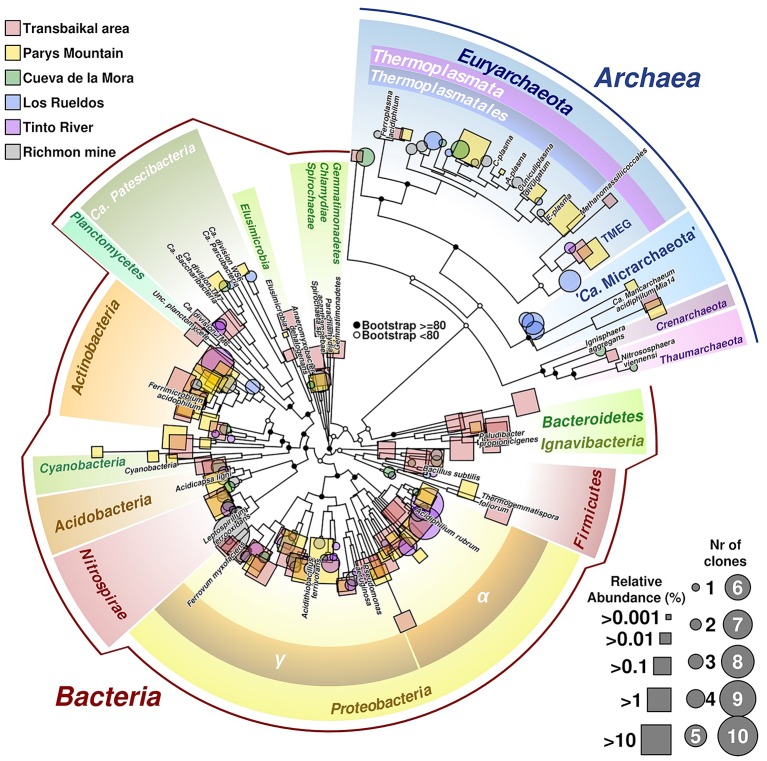
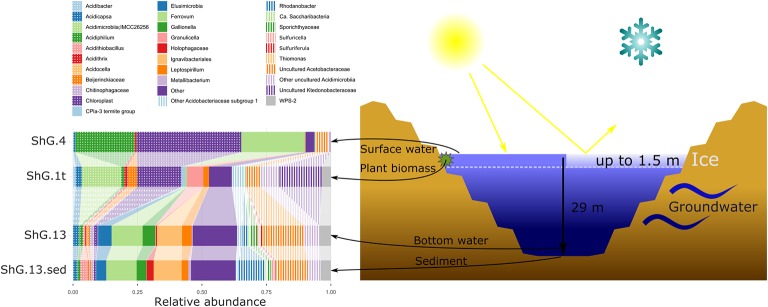
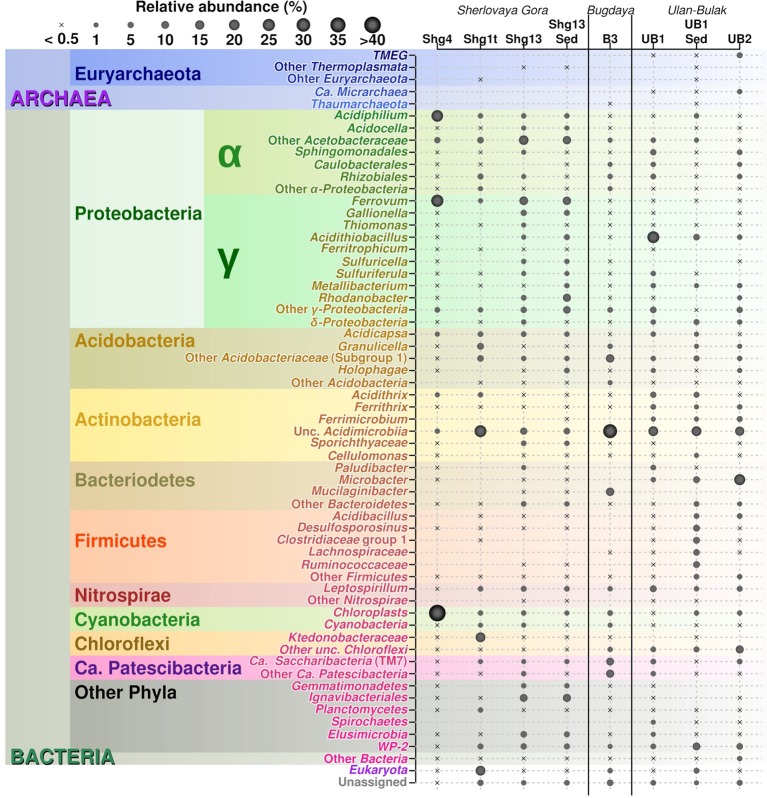
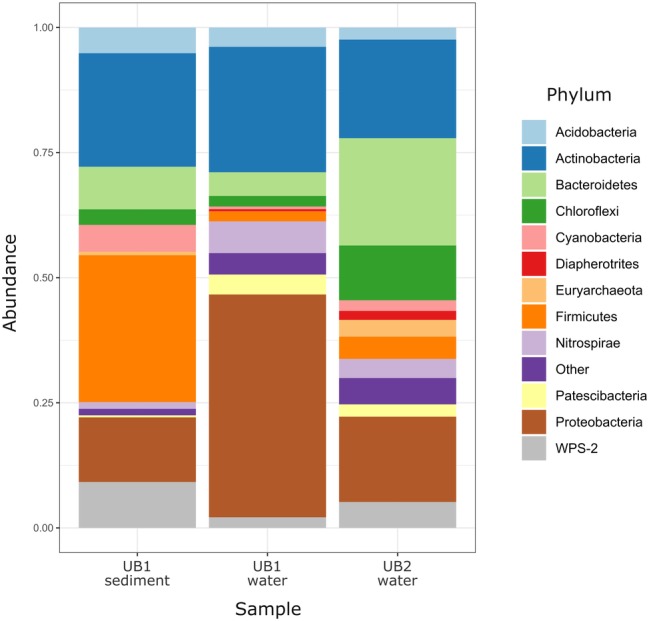
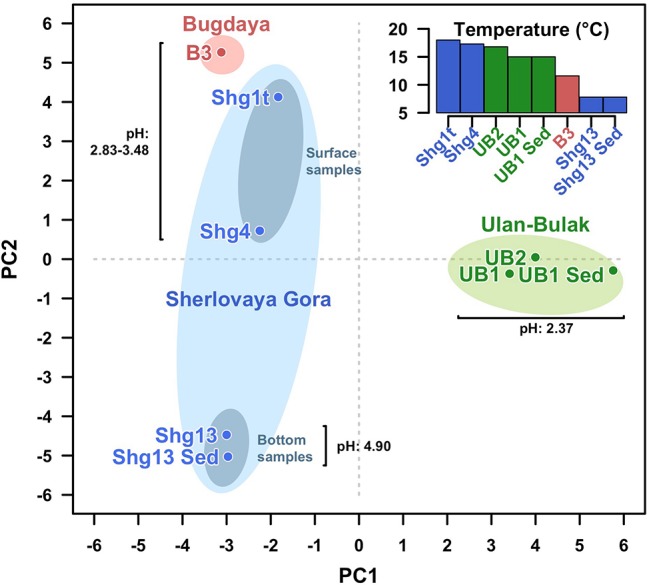
Acid mine drainage (AMD) systems are globally widespread and are an important source of metal pollution in riverine and coastal systems. Microbial AMD communities have been extensively studied for their ability to thrive under extremely acidic conditions and for their immense contribution to the dissolution of metal ores. However, little is known on microbial inhabitants of AMD systems subjected to extremely contrasting continental seasonal temperature patterns as opposed to maritime climate zones, experiencing much weaker annual temperature variations. Here, we investigated three types of AMD sites in Eastern Transbaikalia (Russia). In this region, all surface water bodies undergo a deep and long (up to 6 months) freezing, with seasonal temperatures varying between -33 and +24°C, which starkly contrasts the common well-studied AMD environments. We sampled acidic pit lake (Sherlovaya Gora site) located in the area of a polymetallic deposit, acidic drainage water from Bugdaya gold-molybdenum-tungsten deposit and Ulan-Bulak natural acidic spring. These systems showed the abundance of bacteria-derived reads mostly affiliated with and , chloroplasts, , and . Furthermore, candidate taxa ". Saccharibacteria" (previously known as TM7), ". Parcubacteria" (OD1) and WPS-2 were represented in substantial quantities (10-20%). Heterotrophy and iron redox cycling can be considered as central processes of carbon and energy flow for majority of detected bacterial taxa. Archaea were detected in low numbers, with Terrestrial Miscellaneous Euryarchaeal Group (TMEG), to be most abundant (3%) in acidic spring Ulan-Bulak. Composition of these communities was found to be typical in comparison to other AMD sites; however, certain groups (as ) could be specifically associated with this area. This study provides insight into the microbial diversity patterns in acidic ecosystems formed in areas of polymetallic deposits in extreme continental climate zone with contrasting temperature parameters.
酸性矿山排水(AMD)系统在全球广泛分布,是河流和沿海系统中金属污染的重要来源。微生物AMD群落因其在极端酸性条件下的生存能力以及对金属矿石溶解的巨大贡献而受到广泛研究。然而,与海洋气候区相比,在经历年度温度变化小得多的极端大陆季节性温度模式下的AMD系统中的微生物居民却鲜为人知。在此,我们调查了俄罗斯外贝加尔东部的三种类型的AMD场地。在该地区,所有地表水体都会经历深度且漫长(长达6个月)的冻结,季节性温度在-33°C至+24°C之间变化,这与常见的、经过充分研究的AMD环境形成鲜明对比。我们对位于多金属矿床区域的酸性矿坑湖(谢尔洛瓦亚戈拉场地)、布格代亚金-钼-钨矿床的酸性排水水以及乌兰-布拉克天然酸性泉进行了采样。这些系统显示出大量细菌来源的读数,主要隶属于 、 、叶绿体、 和 。此外,候选分类群“糖细菌”(以前称为TM7)、“ Parcubacteria”(OD1)和WPS-2大量存在(10%-20%)。对于大多数检测到的细菌分类群而言,异养和铁氧化还原循环可被视为碳和能量流动的核心过程。古菌检测数量较少,陆地杂项广古菌组(TMEG)在酸性泉乌兰-布拉克中最为丰富(3%)。与其他AMD场地相比,这些群落的组成被发现是典型的;然而,某些类群(如 )可能与该地区有特定关联。本研究深入了解了在具有对比温度参数的极端大陆气候区的多金属矿床区域形成的酸性生态系统中的微生物多样性模式。