The John Curtin School of Medical Research, The Australian National University, Canberra, ACT, Australia.
ANU Medical School, The Australian National University, Canberra, ACT, Australia.
Front Immunol. 2019 Jul 16;10:1618. doi: 10.3389/fimmu.2019.01618. eCollection 2019.
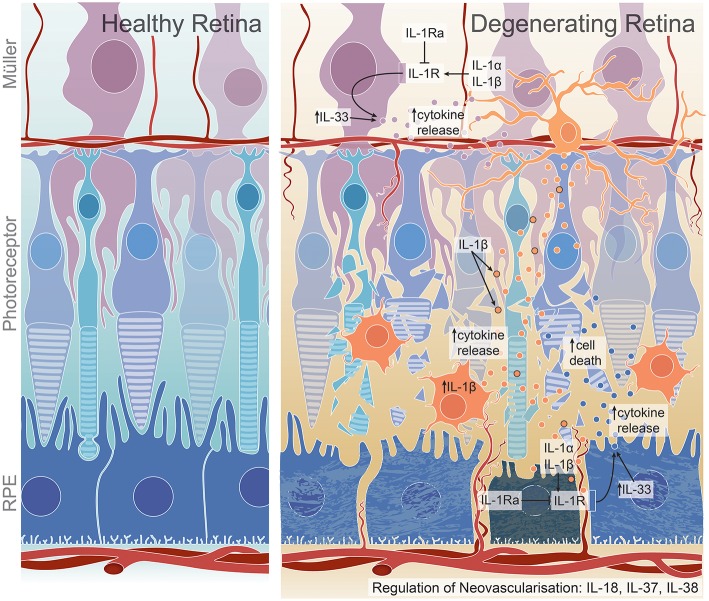
Inflammation underpins and contributes to the pathogenesis of many retinal degenerative diseases. The recruitment and activation of both resident microglia and recruited macrophages, as well as the production of cytokines, are key contributing factors for progressive cell death in these diseases. In particular, the interleukin 1 (IL-1) family consisting of both pro- and anti-inflammatory cytokines has been shown to be pivotal in the mediation of innate immunity and contribute directly to a number of retinal degenerations, including Age-Related Macular Degeneration (AMD), diabetic retinopathy, retinitis pigmentosa, glaucoma, and retinopathy of prematurity (ROP). In this review, we will discuss the role of IL-1 family members and inflammasome signaling in retinal degenerative diseases, piecing together their contribution to retinal disease pathology, and identifying areas of research expansion required to further elucidate their function in the retina.
炎症是许多视网膜退行性疾病发病机制的基础和促成因素。在这些疾病中,常驻小胶质细胞和募集的巨噬细胞的募集和激活,以及细胞因子的产生,是进行性细胞死亡的关键促成因素。特别是白细胞介素 1(IL-1)家族,包括促炎和抗炎细胞因子,已被证明在先天免疫的介导中至关重要,并直接导致多种视网膜变性,包括年龄相关性黄斑变性(AMD)、糖尿病性视网膜病变、色素性视网膜炎、青光眼和早产儿视网膜病变(ROP)。在这篇综述中,我们将讨论 IL-1 家族成员和炎性小体信号在视网膜退行性疾病中的作用,将它们对视网膜疾病病理学的贡献联系起来,并确定需要进一步研究扩展的领域,以阐明它们在视网膜中的功能。