Bascom Palmer Eye Institute, University of Miami Miller School of Medicine, Miami, FL, 33136, USA.
J Neuroinflammation. 2022 Sep 5;19(1):216. doi: 10.1186/s12974-022-02576-x.
Retinal degenerative diseases are a group of conditions characterized by photoreceptor death and vision loss. Excessive inflammation and microglial activation contribute to the pathology of retinal degenerations and a major focus in the field is identifying more effective anti-inflammatory therapeutic strategies that promote photoreceptor survival. A major challenge to developing anti-inflammatory treatments is to selectively suppress detrimental inflammation while maintaining beneficial inflammatory responses. We recently demonstrated that endogenous levels of the IL-27 cytokine were upregulated in association with an experimental treatment that increased photoreceptor survival. IL-27 is a pleiotropic cytokine that regulates tissue reactions to infection, neuronal disease and tumors by inducing anti-apoptotic and anti-inflammatory genes and suppressing pro-inflammatory genes. IL-27 is neuroprotective in the brain, but its function during retinal degeneration has not been investigated. In this study, we investigated the effect of IL-27 in the rd10 mouse model of inherited photoreceptor degeneration.
Male and female rd10 mice were randomly divided into experimental (IL-27) and control (saline) groups and intravitreally injected at age post-natal day (P) 18. Retina function was analyzed by electroretinograms (ERGs), visual acuity by optomotor assay, photoreceptor death by TdT-mediated dUTP nick-end labeling (TUNEL) assay, microglia/macrophage were detected by immunodetection of IBA1 and inflammatory mediators by cytoplex and QPCR analysis. The distribution of IL-27 in the retina was determined by immunohistochemistry on retina cross-sections and primary Muller glia cultures.
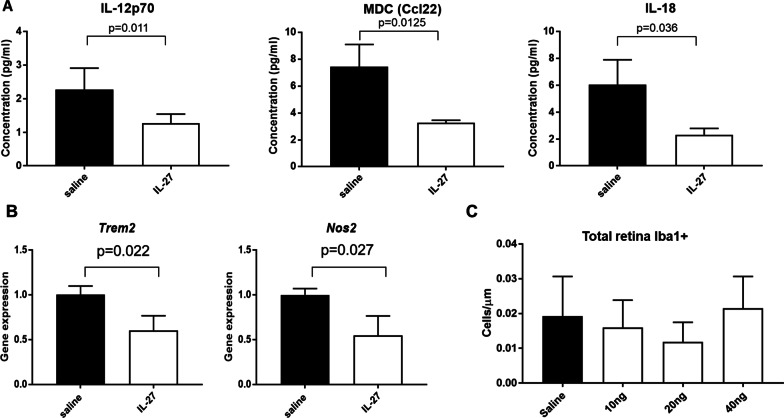
We demonstrate that recombinant IL-27 decreased photoreceptor death, increased retinal function and reduced inflammation in the rd10 mouse model of retinal degeneration. Furthermore, IL-27 injections led to lower levels of the pro-inflammatory proteins Ccl22, IL-18 and IL-12. IL-27 expression was localized to Muller glia and IL-27 receptors to microglia, which are key cell types that regulate photoreceptor survival.
Our results identify for the first time anti-inflammatory and neuroprotective activities of IL-27 in a genetic model of retinal degeneration. These findings provide new insight into the therapeutic potential of anti-inflammatory cytokines as a treatment for degenerative diseases of the retina.
视网膜退行性疾病是一组以光感受器死亡和视力丧失为特征的疾病。过度炎症和小胶质细胞激活导致视网膜变性的病理学,并成为该领域的主要焦点,即确定更有效的抗炎治疗策略,以促进光感受器的存活。开发抗炎治疗的主要挑战是选择性地抑制有害炎症,同时保持有益的炎症反应。我们最近证明,内源性白细胞介素 27(IL-27)细胞因子的水平与一种增加光感受器存活的实验治疗相关上调。IL-27 是一种多效细胞因子,通过诱导抗细胞凋亡和抗炎基因,抑制促炎基因,调节组织对感染、神经疾病和肿瘤的反应。IL-27 在大脑中具有神经保护作用,但它在视网膜变性中的功能尚未被研究。在这项研究中,我们研究了 IL-27 在遗传性光感受器变性 rd10 小鼠模型中的作用。
雄性和雌性 rd10 小鼠随机分为实验组(IL-27)和对照组(盐水),并于出生后第 18 天(P)经玻璃体腔内注射。通过视网膜电图(ERG)分析视网膜功能,通过光感受器测定法分析视力,通过末端转移酶介导的 dUTP 缺口末端标记(TUNEL)测定法分析光感受器死亡,通过免疫检测 IBA1 检测小胶质细胞/巨噬细胞,通过 cytoplex 和 QPCR 分析检测炎症介质。通过视网膜切片和原代 Muller 胶质细胞培养物的免疫组织化学确定 IL-27 在视网膜中的分布。
我们证明,重组 IL-27 可减少 rd10 小鼠视网膜变性模型中的光感受器死亡,增加视网膜功能并减少炎症。此外,IL-27 注射导致促炎蛋白 Ccl22、IL-18 和 IL-12 的水平降低。IL-27 表达定位于 Muller 胶质细胞,IL-27 受体定位于小胶质细胞,小胶质细胞是调节光感受器存活的关键细胞类型。
我们的研究结果首次确定了 IL-27 在遗传性视网膜变性模型中的抗炎和神经保护作用。这些发现为作为治疗视网膜退行性疾病的治疗方法的抗炎细胞因子的治疗潜力提供了新的见解。