Kakande Taufik, Batunge Yonah, Eilu Emmanuel, Shabohurira Ambrose, Abimana Justus, Akinola Saheed Adekunle, Muhwezi Reagan, Sunusi Adam Abubakar, Kemuma Onkoba Sarah, Almustapha Aliero Adamu, Atuheire Collins, Kato Charles Drago, Ntulume Ibrahim
School of Pharmacy, Kampala International University Western Campus, Ishaka, P.O. Box 71, Bushenyi, Uganda.
Department of Medical Laboratory Science, Kampala International University Western Campus, Ishaka, P.O. Box 71, Bushenyi, Uganda.
Dermatol Res Pract. 2019 Jul 11;2019:9328621. doi: 10.1155/2019/9328621. eCollection 2019.
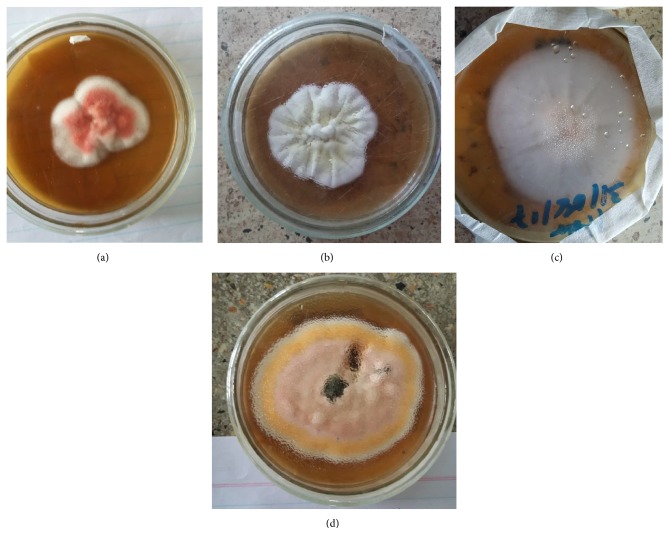
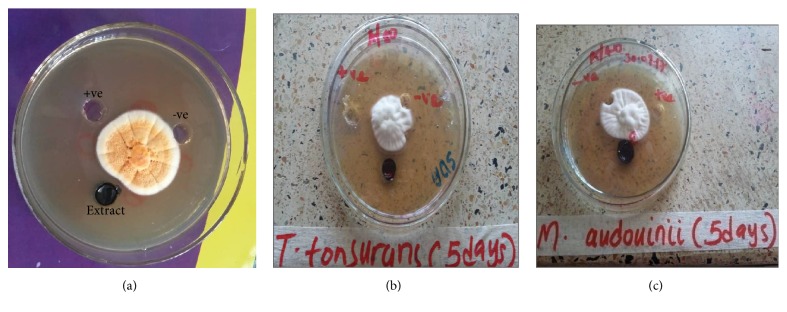
Dermatophyte infections are a global health problem but neglected in Uganda. This work aimed at determining prevalence of dermatophytosis and antifungal activity of ethanolic crude leaf extract of against dermatophytes isolated from patients attending Kampala International University Teaching Hospital (KIU-TH), Uganda. A total of 100 samples of skin and nail scrapings were collected and processed using standard microscopy (KOH) and cultural methods. leaves were collected and processed with 95% ethanol using standard extraction method. The crude leaves ethanolic extract was tested against three dermatophytes: , and using modified agar well diffusion method. Minimum inhibitory concentration (MIC) and minimum fungicidal concentration (MFC) of the ethanolic leaves crude extract were also determined using broth tube dilution and culture, respectively. Out of 100 samples collected, 49 (49%, 95%CI: 0.3930-0.5876) were found positive for microscopy. The prevalence of dermatophytosis was significantly (p=0.001) associated with age groups of participants with higher infection among those aged 11-20 and 21-30 years with 75.0% each. Out of the 49 that were positive by microscopy, 28 (57.15%, 95% CI: 0.1987-0.3739) were positive by culture. Thirty-one (31) fungal isolates were obtained which included both dermatophyte and non-dermatophyte fungi. had highest distribution 6 (19.35%) among dermatophytes species while spp. were found to have highest distribution 7 (22.58%) among non-dermatophyte species. The result of the antidermatophytic test showed that ethanolic crude leaves extract had activity against tested dermatophytes at 1 g/ml. MIC and MFC of the crude extract of against tested dermatophytes ranged from 62.5 to 250 mg/ml and 125 to 500 mg/ml, respectively. The findings of this study reported the presence of dermatophytes causing dermatophytosis among patients attending KIU-TH. The results of the current study showed that leaves ethanolic crude extract has antidermatophytic activity against tested dermatophytes.
皮肤癣菌感染是一个全球性的健康问题,但在乌干达却被忽视了。这项工作旨在确定乌干达坎帕拉国际大学教学医院(KIU-TH)就诊患者中分离出的皮肤癣菌病的患病率以及 叶乙醇粗提物对皮肤癣菌的抗真菌活性。共收集了100份皮肤和指甲刮屑样本,并采用标准显微镜检查(KOH)和培养方法进行处理。采集 叶,采用标准提取方法用95%乙醇进行处理。使用改良的琼脂孔扩散法,对粗叶乙醇提取物针对三种皮肤癣菌: 、 和 进行了测试。还分别采用肉汤管稀释法和培养法测定了乙醇叶粗提物的最低抑菌浓度(MIC)和最低杀菌浓度(MFC)。在收集的100份样本中,49份(49%,95%CI:0.3930-0.5876)显微镜检查呈阳性。皮肤癣菌病的患病率与参与者的年龄组显著相关(p=0.001),11至20岁和21至30岁的人群感染率较高,均为75.0%。在显微镜检查呈阳性的49份样本中,28份(57.15%,95%CI:0.1987-0.3739)培养呈阳性。获得了31株真菌分离株,其中包括皮肤癣菌和非皮肤癣菌真菌。在皮肤癣菌种类中, 分布最高,为6株(19.35%),而在非皮肤癣菌种类中, 属分布最高,为7株(22.58%)。抗皮肤癣菌试验结果表明, 叶乙醇粗提物在1 g/ml时对受试皮肤癣菌具有活性。 粗提物对受试皮肤癣菌的MIC和MFC分别为62.5至250 mg/ml和125至500 mg/ml。本研究结果报告了在KIU-TH就诊患者中存在引起皮肤癣菌病的皮肤癣菌。当前研究结果表明, 叶乙醇粗提物对受试皮肤癣菌具有抗皮肤癣菌活性。