UCL Cancer Institute, University College London, London WC1E 6DD, UK.
Cells. 2019 Aug 2;8(8):814. doi: 10.3390/cells8080814.
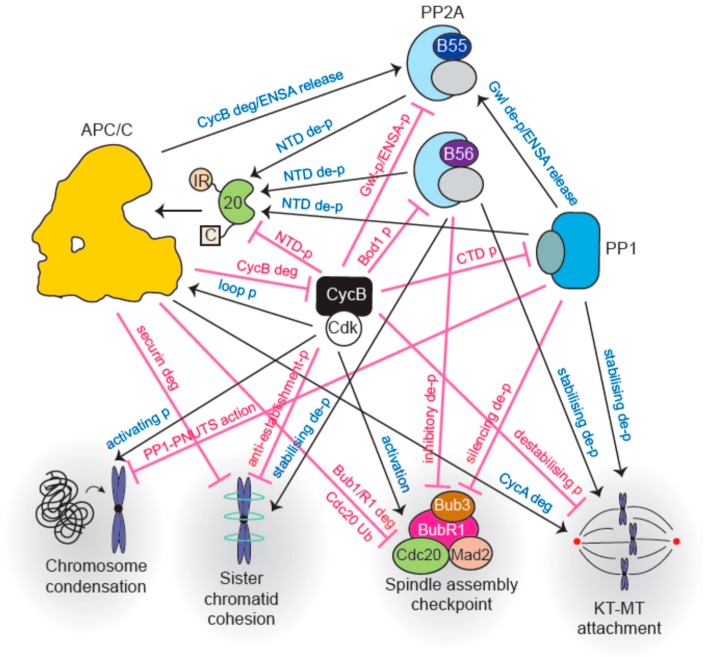
Accurate division of cells into two daughters is a process that is vital to propagation of life. Protein phosphorylation and selective degradation have emerged as two important mechanisms safeguarding the delicate choreography of mitosis. Protein phosphatases catalyze dephosphorylation of thousands of sites on proteins, steering the cells through establishment of the mitotic phase and exit from it. A large E3 ubiquitin ligase, the anaphase-promoting complex/cyclosome (APC/C) becomes active during latter stages of mitosis through G1 and marks hundreds of proteins for destruction. Recent studies have revealed the complex interregulation between these two classes of enzymes. In this review, we highlight the direct and indirect mechanisms by which phosphatases and the APC/C mutually influence each other to ensure accurate spatiotemporal and orderly progression through mitosis, with a particular focus on recent insights and conceptual advances.
细胞准确地分裂为两个子细胞是生命繁衍的关键过程。蛋白质磷酸化和选择性降解已成为保障有丝分裂这一精细过程的两个重要机制。蛋白磷酸酶可催化上千个蛋白质上的磷酸基团去除,引导细胞进入有丝分裂阶段并从中退出。在有丝分裂后期,一种大型的 E3 泛素连接酶——后期促进复合物/周期蛋白体(APC/C)通过 G1 期激活,并对数百种蛋白质进行标记使其被破坏。最近的研究揭示了这两类酶之间复杂的相互调控关系。在这篇综述中,我们重点介绍了磷酸酶和 APC/C 之间通过直接和间接机制相互影响的方式,以确保有丝分裂过程中时空上的精确和有序进展,特别关注了最近的新见解和概念进展。