Kotenkova Elena, Bataeva Dagmara, Minaev Mikhail, Zaiko Elena
V.M. Gorbatov Federal Research Center for Food Systems of RAS, 109316, Talalikhina St., 26, Moscow, Russia.
AIMS Microbiol. 2019 Jan 25;5(1):39-47. doi: 10.3934/microbiol.2019.1.39. eCollection 2019.
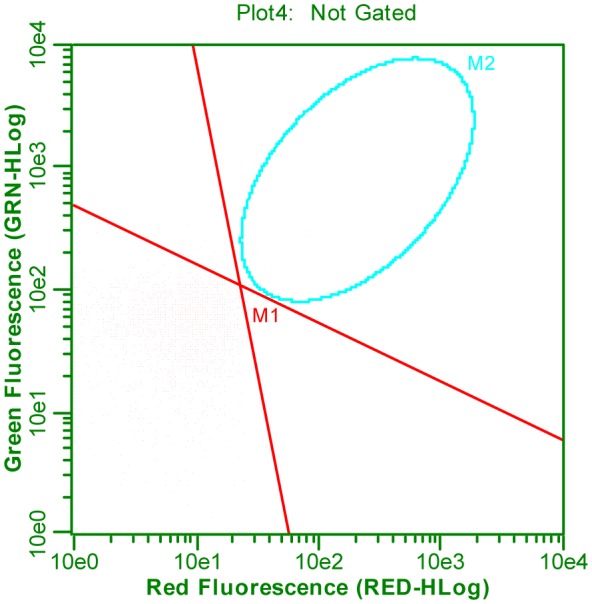
Determination of eukaryotic cell viability using flow cytometry is widespread and based on the use of fluorescent dyes such as SYTO, DAPI, SYBR, PI, and SYTOX. For many years, traditional microbiological methods have been used to successfully analyze prokaryotic cells, but the application of flow cytometry should be considered because it provides an opportunity for quantitative assessment. A combination of SYTO 9 or SYBR green and PI has been used successfully. DNA-binding dyes such as SYTO 9, SYBR green, and EvaGreen are used in qPCR. The aim of this study was to assess the feasibility of EvaGreen to determine the viability of АТСС 13932 cells using flow cytometry. RNA from ATCC 25922 was isolated using the MagNA Pure LC RNA Isolation Kit-High Performance (Roche, Germany) according to the kit instructions on MagNA Pure LC® 2.0 (Roche, Switzerland). Chicken DNA was isolated using the Sorb-GMO-B kit (Syntol CJSC, Russia) according to the kit instructions. RNA from ATCC 25922, chicken DNA, a positive control, and a negative control of АТСС 13932 were stained with EvaGreen and analyzed on the Guava EasyCyte flow cytometer (Merck Millipore, Germany). Chicken DNA demonstrated both green and red fluorescence, while RNA displayed only red fluorescence. While the positive АТСС 13932 control and chicken DNA demonstrated similar fluorescence properties, the negative control showed a localization similar to that observed with RNA. Degraded ssDNA and RNA stained with EvaGreen demonstrated red fluorescence. Although EvaGreen is a class III dye, we observed fluorescence of live АТСС 13932 cells in the positive control stained with EvaGreen. The observed phenomenon was linked to the solution composition. It is necessary to repeat this analysis with various solution compositions as well as a wide range of both Gram-positive and Gram-negative bacteria to determine the effects on cell envelope permeability of EvaGreen.
使用流式细胞术测定真核细胞活力已广泛应用,且基于使用如SYTO、DAPI、SYBR、PI和SYTOX等荧光染料。多年来,传统微生物学方法已成功用于分析原核细胞,但应考虑应用流式细胞术,因为它提供了定量评估的机会。SYTO 9或SYBR green与PI的组合已成功使用。DNA结合染料如SYTO 9、SYBR green和EvaGreen用于定量聚合酶链反应(qPCR)。本研究的目的是评估使用流式细胞术,EvaGreen测定ATCC 13932细胞活力的可行性。根据MagNA Pure LC® 2.0(瑞士罗氏公司)上的试剂盒说明,使用MagNA Pure LC RNA分离试剂盒-高性能版(德国罗氏公司)从ATCC 25922中分离RNA。根据试剂盒说明,使用Sorb-GMO-B试剂盒(俄罗斯Syntol CJSC公司)分离鸡DNA。用EvaGreen对来自ATCC 25922的RNA、鸡DNA、阳性对照和ATCC 13932的阴性对照进行染色,并在Guava EasyCyte流式细胞仪(德国默克密理博公司)上进行分析。鸡DNA显示出绿色和红色荧光,而RNA仅显示红色荧光。虽然ATCC 13932阳性对照和鸡DNA显示出相似的荧光特性,但阴性对照显示出与RNA观察到的相似定位。用EvaGreen染色的降解单链DNA和RNA显示出红色荧光。尽管EvaGreen是III类染料,但我们在用EvaGreen染色的阳性对照中观察到了活的ATCC 13932细胞的荧光。观察到的现象与溶液组成有关。有必要用各种溶液组成以及广泛的革兰氏阳性菌和革兰氏阴性菌重复此分析,以确定EvaGreen对细胞包膜通透性产生的影响。