Baumann Astrid, Andersen Berit, Østergaard Lars, Larsen Mette Bach
Department of Public Health Programmes, Randers Regional Hospital, Denmark.
Department of Infectious Diseases, Aarhus University Hospital, Denmark.
Vaccine X. 2019 Apr 4;2:100020. doi: 10.1016/j.jvacx.2019.100020. eCollection 2019 Aug 9.
Vaccination against human papillomavirus (HPV) has been part of the Danish Childhood Vaccination Programme (CVP) since 2009 and initially had a high uptake. Following an intense public debate on the alleged side-effects to the vaccine in 2015, coverage rates declined dramatically leaving the current coverage at 54%.The main aim of this study was to identify differences in the sources of information and factors of importance in mothers' decision to have or not to have their adolescent daughters vaccinated against HPV.
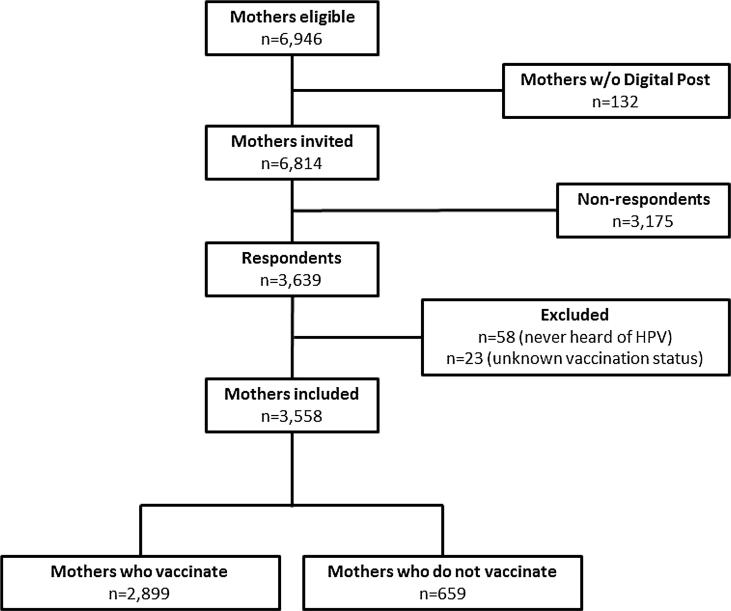
This cross-sectional study was based on survey and register data from 3,558 mothers of daughters born in 2003 living in the Central Denmark Region. The survey examined, among others, sources of information and factors of value in the decision-making process. Socioeconomic register data were retrieved from Statistics Denmark.Pearson's chi-squared test was used to determine differences in socioeconomic distribution between both respondents and non-respondents, and mothers who had their daughters vaccinated versus those who did not. Associations between vaccination status and various events were estimated using logistic regression.
A strong association was found between vaccine uptake and general practitioner (GP) recommendation (odds ratio (OR) 0.17, 95% confidence interval (CI) 0.10; 0.30), seeking GP guidance (OR 0.63, 95% CI 0.50; 0.78) and agreeing with the daughter's father to vaccinate (OR 0.60, 95% CI 0.37; 0.96). Inversely, vaccination decline was associated with a negative first impression of HPV vaccination (OR 4.05, 95% CI 3.28; 5.00), valuing media stories (OR 3.57, 95% CI 2.63; 4.85) and distrusting the first source of information (OR 2.49, 95% CI 1.92; 3.23).
The results indicate that the impression left behind by information sources is more important in determining vaccination status than the information sources themselves, indicating that mothers are liable to make healthcare decisions based on sensibility rather than sense.
自2009年以来,人乳头瘤病毒(HPV)疫苗接种一直是丹麦儿童疫苗接种计划(CVP)的一部分,最初接种率很高。2015年,在针对该疫苗所谓副作用的激烈公众辩论之后,接种率大幅下降,目前的接种率为54%。本研究的主要目的是确定母亲决定让或不让其青春期女儿接种HPV疫苗时信息来源的差异以及重要因素。
这项横断面研究基于对丹麦中部地区2003年出生女儿的3558名母亲的调查和登记数据。该调查除其他外,还研究了决策过程中的信息来源和有价值的因素。社会经济登记数据从丹麦统计局获取。使用Pearson卡方检验来确定受访者和非受访者之间以及女儿接种疫苗的母亲与未接种疫苗的母亲之间社会经济分布的差异。使用逻辑回归估计疫苗接种状况与各种事件之间的关联。
发现疫苗接种率与全科医生(GP)的建议(优势比(OR)0.17,95%置信区间(CI)0.10;0.30)、寻求全科医生指导(OR 0.63,95%CI 0.50;0.78)以及与女儿的父亲就接种疫苗达成一致(OR 0.60,95%CI 0.37;0.96)之间存在强烈关联。相反,接种率下降与对HPV疫苗接种的负面第一印象(OR 4.05,95%CI