Truth Initiative Schroeder Institute, 900 G Street NW, Washington, DC, 20001, USA.
Office on Smoking and Health, National Center for Chronic Disease Prevention and Health Promotion, Centers for Disease Control and Prevention, 1600 Clifton Road Atlanta, GA, 30329, USA.
Drug Alcohol Depend. 2019 Oct 1;203:1-7. doi: 10.1016/j.drugalcdep.2019.05.029. Epub 2019 Jul 19.
Considerable declines in cigarette smoking have occurred in the U.S. over the past half century. Yet emerging tobacco products, including e-cigarettes, have increased in popularity among U.S. youth and adults in recent years. Nicotine content is an important factor in weighing the potential benefits and risks of e-cigarettes on individual and population level health. This study examined how nicotine concentrations of e-cigarette products sold have changed from 2013 to 2018.
E-cigarette sales data aggregated in 4-week periods from March 2, 2013 to September 8, 2018 (66 months total) from convenience store and mass market channels were obtained from Nielsen. Internet and vape shop sales were not available. Internet searches were used to supplement information for nicotine concentration and flavor. Products were categorized by nicotine concentration, flavor, type (disposable or rechargeable), and brand. Dollar sales, unit sales, and average nicotine concentration were assessed.
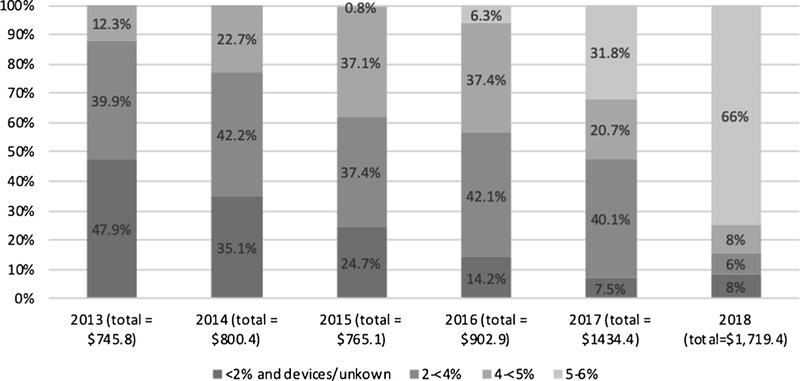
During 2013-2018, the average nicotine concentration in e-cigarettes sold increased overall, for all flavor categories, and for rechargeable e-cigarettes. The proportion of total dollar sales comprised of higher nicotine concentration e-cigarettes (>4% mg/mL) increased from 12.3% to 74.7% during 2013-2018, with a similar increase in unit share. Zero-nicotine products accounted for less than 1% of dollar market share across all years analyzed.
E-cigarettes with higher nicotine concentrations comprise a substantial and increasing portion of U.S. e-cigarette sales. Higher nicotine concentrations may influence patterns of e-cigarette use, including harms from e-cigarette initiation among youth and potential health benefits for adult smokers switching completely to e-cigarettes.
在过去的半个世纪里,美国的吸烟率大幅下降。然而,近年来,包括电子烟在内的新兴烟草产品在美国青少年和成年人中越来越受欢迎。尼古丁含量是衡量电子烟产品对个人和人群健康潜在益处和风险的一个重要因素。本研究调查了电子烟产品的尼古丁浓度自 2013 年至 2018 年期间的变化情况。
从尼尔森(Nielsen)获得了 2013 年 3 月 2 日至 2018 年 9 月 8 日(共 66 个月)便利店和大众市场渠道中每 4 周汇总的电子烟销售数据。互联网和蒸汽烟商店的销售数据无法获得。通过互联网搜索来补充尼古丁浓度和口味的信息。根据尼古丁浓度、口味、类型(一次性或可充电)和品牌对产品进行分类。评估了美元销售额、单位销售额和平均尼古丁浓度。
2013 年至 2018 年期间,所有口味类别和可充电电子烟的销售电子烟平均尼古丁浓度总体上均有所增加。高尼古丁浓度电子烟(>4mg/mL)的总销售额比例从 2013 年的 12.3%增加到 2018 年的 74.7%,单位份额也有类似的增长。在所有分析年份中,零尼古丁产品的美元市场份额均不到 1%。
高尼古丁浓度的电子烟在美国电子烟销售中占很大且不断增加的比例。更高的尼古丁浓度可能会影响电子烟的使用模式,包括青少年电子烟初始使用的危害,以及完全转向电子烟的成年吸烟者的潜在健康益处。