Department of Chemistry , University of Virginia , Charlottesville , Virginia 22904 , United States.
ACS Sens. 2019 Sep 27;4(9):2403-2411. doi: 10.1021/acssensors.9b00994. Epub 2019 Aug 21.
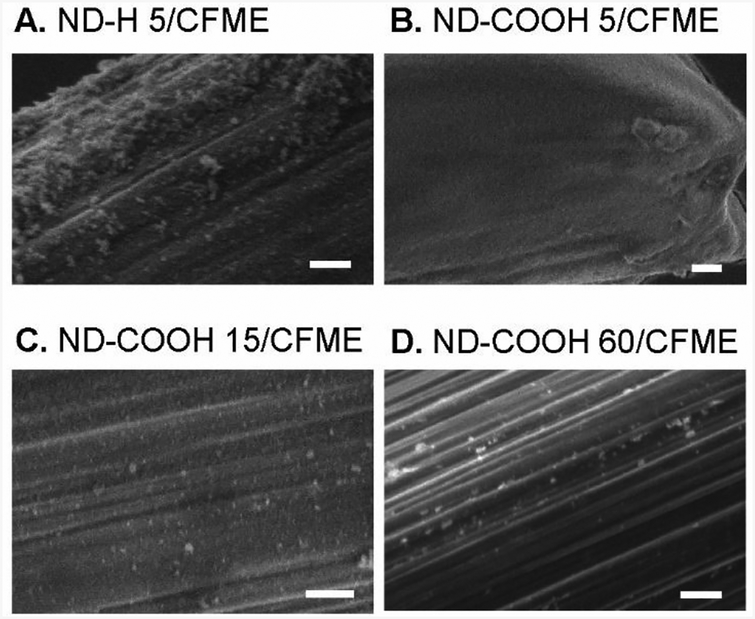
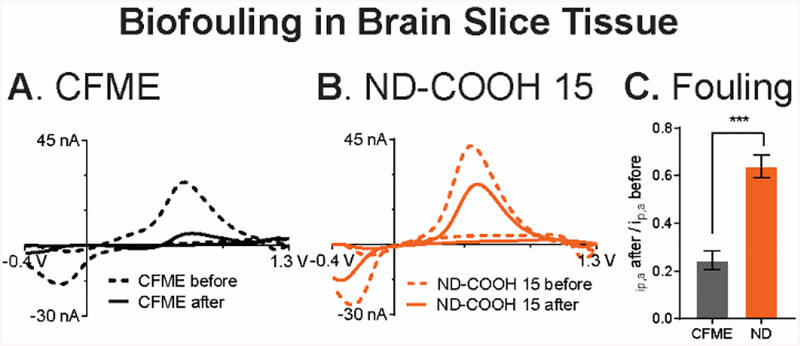
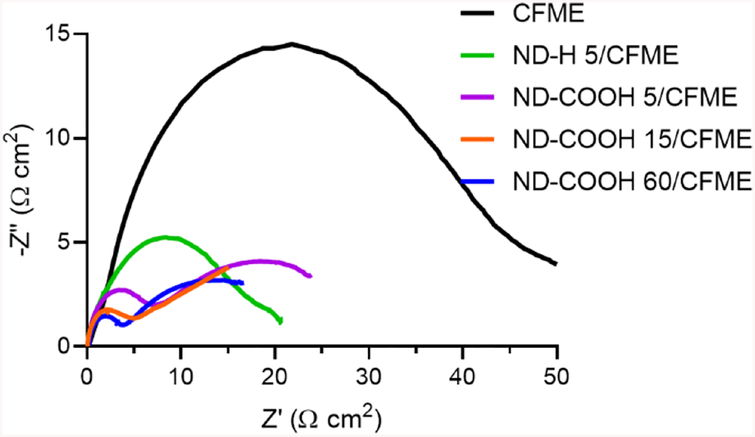
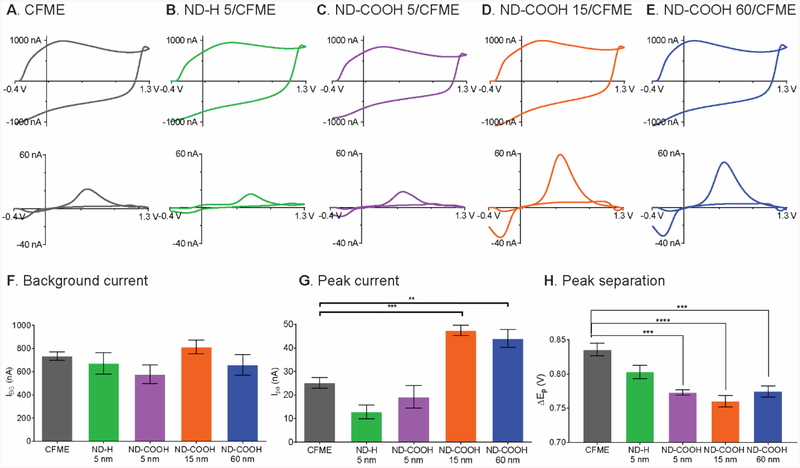
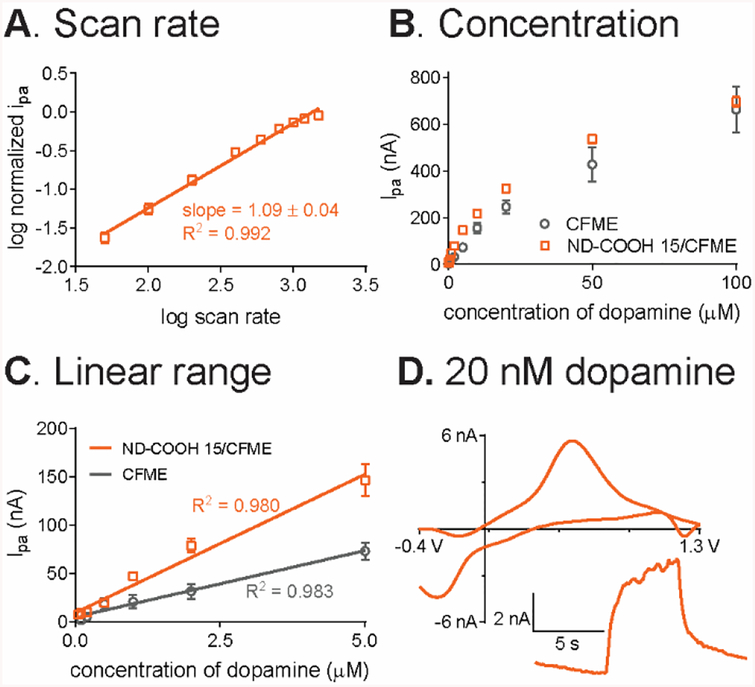
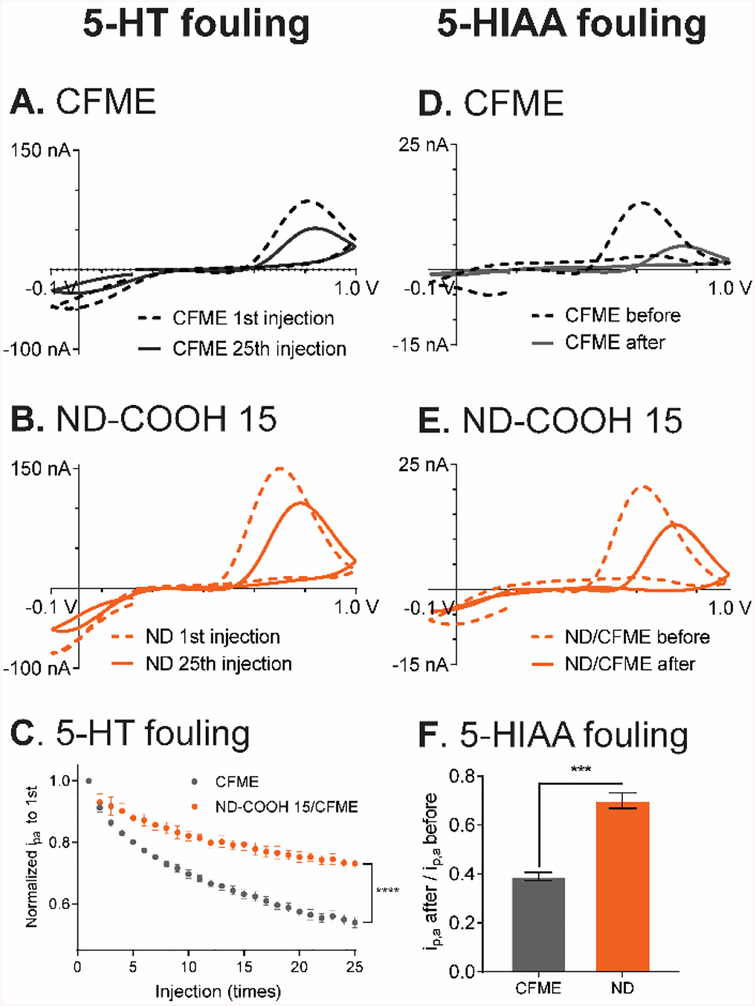
Nanodiamonds (NDs) are carbon nanomaterials with a core diamond crystalline structure and crystal defects, such as graphitic carbon and heteroatoms, on their surface. For electrochemistry, NDs are promising to increase active sites and decrease fouling, but NDs have not been studied for neurotransmitter electrochemistry. Here, we optimized ND coatings on microelectrodes and found that ND increases the sensitivity for neurotransmitters with fast-scan cyclic voltammetry detection and decreases electrochemical and biofouling. Different sizes and functionalizations of NDs were tested, and ND suspensions were drop-casted onto carbon-fiber microelectrodes (CFMEs). The 5 nm ND-H and 5 nm ND-COOH formed thick coatings, while the 15 and 60 nm ND-COOH formed more sparse coatings. With electrochemical impedance spectroscopy, 5 nm ND-H and 5 nm ND-COOH had high charge-transfer resistance, while 15 and 60 nm ND-COOH had low charge-transfer resistance. ND-COOH (15 nm) was optimal, with the best electrocatalytic properties and current for dopamine. Sensitivity was enhanced 2.1 ± 0.2 times and the limit of detection for dopamine improved to 3 ± 1 nM. ND coating increased current for other cations such as serotonin, norepinephrine, and epinephrine, but not for the anion ascorbic acid. Moreover, NDs decreased electrochemical fouling from serotonin and 5-hydroxyindoleacetic acid, and they also decreased biofouling in brain slice tissue by 50%. The current at biofouled ND-coated electrodes is similar to the signal of pristine, unfouled CFMEs. The carboxylated ND-modified CFMEs are beneficial for neurotransmitter detection because of easy fabrication, improved limit of detection, and antifouling properties.
纳米金刚石(NDs)是具有核心金刚石晶体结构和表面晶体缺陷(如石墨碳和杂原子)的碳纳米材料。对于电化学而言,NDs 有望增加活性位点并减少污垢,但尚未对其进行神经递质电化学研究。在这里,我们对微电极上的 ND 涂层进行了优化,并发现 ND 通过快速扫描循环伏安法检测增加了对神经递质的灵敏度,并降低了电化学和生物污垢。测试了不同尺寸和功能化的 NDs,并将 ND 悬浮液滴铸到碳纤维微电极(CFMEs)上。5nm ND-H 和 5nm ND-COOH 形成了厚涂层,而 15nm 和 60nm ND-COOH 形成了更稀疏的涂层。通过电化学阻抗谱,5nm ND-H 和 5nm ND-COOH 具有高电荷转移电阻,而 15nm 和 60nm ND-COOH 具有低电荷转移电阻。ND-COOH(15nm)是最佳的,具有最佳的电催化性能和对多巴胺的电流。多巴胺的灵敏度提高了 2.1±0.2 倍,检测限提高到 3±1 nM。ND 涂层增加了其他阳离子(如血清素、去甲肾上腺素和肾上腺素)的电流,但对阴离子抗坏血酸没有影响。此外,ND 减少了血清素和 5-羟吲哚乙酸的电化学污垢,并且还将脑切片组织中的生物污垢减少了 50%。生物污垢的 ND 涂层电极的电流与原始、未污染的 CFMEs 的信号相似。羧基化 ND 修饰的 CFMEs 有利于神经递质的检测,因为其易于制造、提高了检测限和抗污垢性能。