Cancer Genomics and Immunology Group, The Wellcome Centre for Human Genetics, University of Oxford, Roosevelt Drive, Oxford, OX3 7BN, UK.
Department of Oncology, University of Oxford, Oxford, UK.
Br J Cancer. 2019 Sep;121(6):474-482. doi: 10.1038/s41416-019-0540-4. Epub 2019 Aug 7.
Intratumoural T-cell infiltrate intensity cortes wrelaith clinical outcome in stage II/III colorectal cancer (CRC). We aimed to determine whether this association varies across this heterogeneous group.
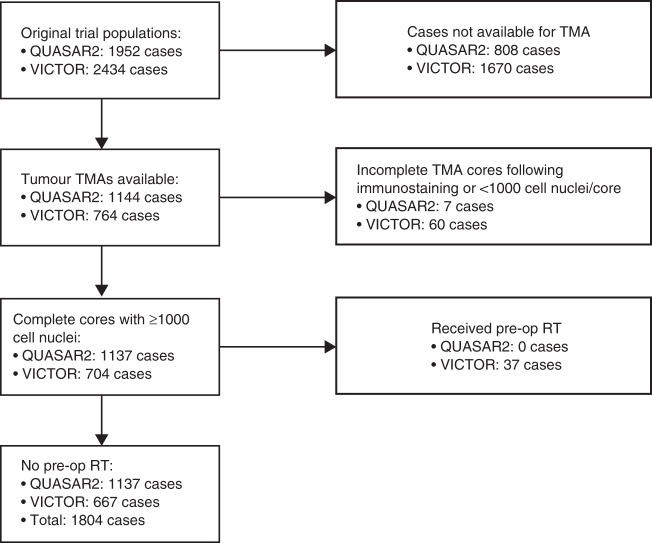
We performed a pooled analysis of 1804 CRCs from the QUASAR2 and VICTOR trials. Intratumoural CD8 and CD3 densities were quantified by immunohistochemistry in tissue microarray (TMA) cores, and their association with clinical outcome analysed by Cox regression. We validated our results using publicly available gene expression data in a pooled analysis of 1375 CRCs from seven independent series.
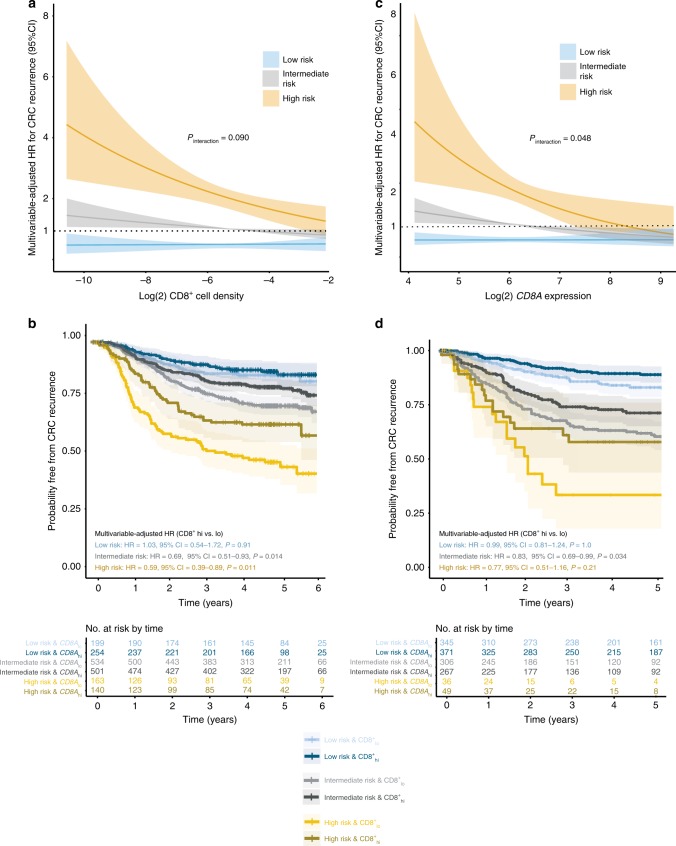
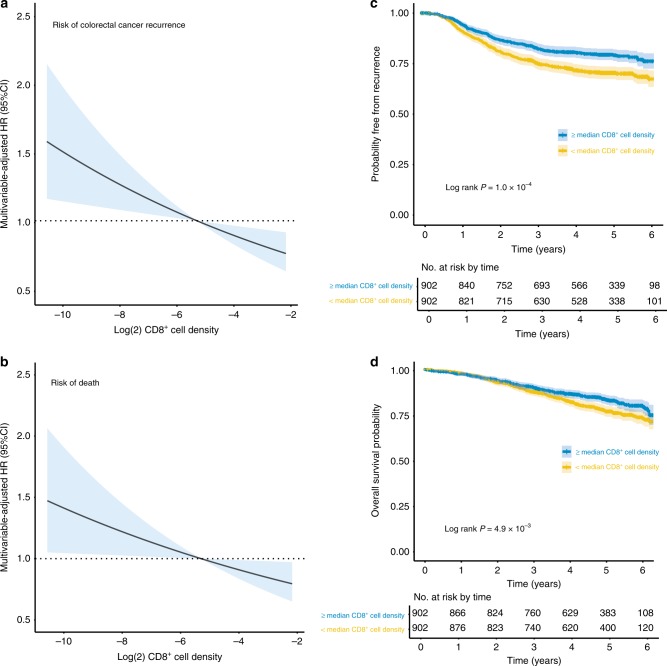
In QUASAR2, intratumoural CD8 was a stronger predictor of CRC recurrence than CD3 and showed similar discriminative ability to both markers in combination. Pooled multivariable analysis of both trials showed increasing CD8 density was associated with reduced recurrence risk independent of confounders including DNA mismatch repair deficiency, POLE mutation and chromosomal instability (multivariable hazard ratio [HR] for each two-fold increase = 0.92, 95%CI = 0.87-0.97, P = 3.6 × 10). This association was not uniform across risk strata defined by tumour and nodal stage: absent in low-risk (pT3,N0) cases (HR = 1.03, 95%CI = 0.87-1.21, P = 0.75), modest in intermediate-risk (pT4,N0 or pT1-3,N1-2) cases (HR = 0.92, 95%CI = 0.86-1.0, P = 0.046) and strong in high-risk (pT4,N1-2) cases (HR = 0.87, 95%CI = 0.79-0.97, P = 9.4 × 10); P = 0.090. Analysis of tumour CD8A expression in the independent validation cohort revealed similar variation in prognostic value across risk strata (P = 0.048).
The prognostic value of intratumoural CD8 cell infiltration in stage II/III CRC varies across tumour and nodal risk strata.
肿瘤内 T 细胞浸润强度与 II/III 期结直肠癌(CRC)的临床结局相关。我们旨在确定这种关联是否在这个异质群体中存在差异。
我们对 QUASAR2 和 VICTOR 两项试验中的 1804 例 CRC 进行了汇总分析。采用免疫组织化学方法在组织微阵列(TMA)芯中定量检测肿瘤内 CD8 和 CD3 的密度,并通过 Cox 回归分析其与临床结局的关系。我们使用来自七个独立系列的 1375 例 CRC 的公开基因表达数据进行了验证分析。
在 QUASAR2 中,肿瘤内 CD8 是 CRC 复发的更强预测因子,比 CD3 更具预测能力,且与两者标志物联合具有相似的区分能力。两项试验的汇总多变量分析显示,CD8 密度增加与复发风险降低独立相关,不受包括错配修复缺陷、POLE 突变和染色体不稳定性在内的混杂因素的影响(每增加两倍的多变量危险比[HR]为 0.92,95%CI 为 0.87-0.97,P=3.6×10)。这种关联在肿瘤和淋巴结分期定义的风险分层中并不均匀:在低危(pT3,N0)病例中不存在(HR=1.03,95%CI=0.87-1.21,P=0.75),在中危(pT4,N0 或 pT1-3,N1-2)病例中中等(HR=0.92,95%CI=0.86-1.0,P=0.046),在高危(pT4,N1-2)病例中较强(HR=0.87,95%CI=0.79-0.97,P=9.4×10);P=0.090。在独立验证队列中对肿瘤 CD8A 表达的分析显示,在风险分层中预后价值存在相似的变化(P=0.048)。
肿瘤内 CD8 细胞浸润在 II/III 期 CRC 中的预后价值在肿瘤和淋巴结风险分层中存在差异。