Division of Geriatrics, Department of Medicine, University of California San Francisco, San Francisco, California.
Philip R. Lee Institute for Health Policy Studies, University of California San Francisco, San Francisco, California.
J Am Geriatr Soc. 2019 Sep;67(9):1907-1912. doi: 10.1111/jgs.16054. Epub 2019 Aug 7.
Little population-level evidence exists to guide the development of interventions for people with dementia in non-nursing home settings. We hypothesized people living at home with moderately severe dementia would differ in social, functional, and medical characteristics from those in either residential care or nursing home settings.
Retrospective cohort study using pooled data from the National Health and Aging Trends Study, an annual survey of a nationally representative sample of Medicare beneficiaries.
US national sample.
Respondents newly meeting criteria for incident moderately severe dementia, defined as probable dementia with functional impairment: 728 older adults met our definition between 2012 and 2016.
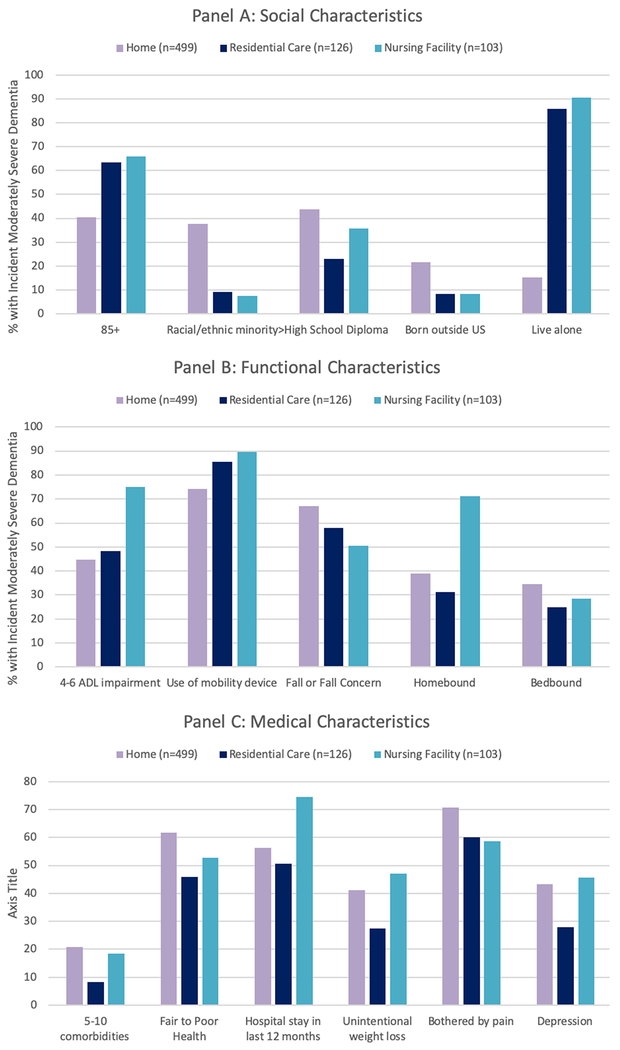
Social characteristics examined included age, sex, race/ethnicity, country of origin, income, educational attainment, partnership status, and household size. Functional characteristics included help with daily activities, falls, mobility device use, and limitation to home or bed. Medical characteristics included comorbid conditions, self-rated health, hospital stay, symptoms, and dementia behaviors.
Extrapolated to the population, an estimated 3.3 million older adults developed incident moderately severe dementia between 2012 and 2016. Within this cohort, 64% received care at home, 19% in residential care, and 17% in a nursing facility. social, functional, and medical characteristics differed across care settings. Older adults living at home were 2 to 5 times more likely to be members of disadvantaged populations and had more medical needs: 71% reported bothersome pain compared with 60% in residential care or 59% in nursing homes.
Over a 5-year period, 2.1 million people lived at home with incident moderately severe dementia. People living at home had a higher prevalence of demographic characteristics associated with systematic patterns of disadvantage, more social support, less functional impairment, worse health, and more symptoms compared with people living in residential care or nursing facilities. This novel study provides insight into setting-specific differences among people with dementia. J Am Geriatr Soc 67:1907-1912, 2019.
针对非养老院环境中痴呆症患者的干预措施,目前仅有少量人群层面的证据可供参考。我们假设,与居住在养老院或护理院环境中的患者相比,家中居住且患有中度至重度痴呆症的患者在社会、功能和医疗特征方面会有所不同。
利用全国健康老龄化趋势研究(一项针对医疗保险受益人的全国代表性样本的年度调查)的汇总数据进行回顾性队列研究。
美国全国样本。
2012 年至 2016 年期间,共有 728 名符合新发中度至重度痴呆症标准的老年人(定义为有功能障碍的可能痴呆症),符合我们的定义。
检查的社会特征包括年龄、性别、种族/民族、原籍国、收入、教育程度、伴侣状况和家庭规模。功能特征包括日常活动帮助、跌倒、使用移动设备以及限制在家庭或床上。医疗特征包括合并症、自我报告的健康状况、住院时间、症状和痴呆症行为。
据估计,2012 年至 2016 年期间,该人群中有 330 万老年人新发中度至重度痴呆症。在这一队列中,64%的人在家中接受护理,19%的人在养老院接受护理,17%的人在护理院接受护理。不同的护理环境存在社会、功能和医疗特征差异。居家生活的老年人更容易成为弱势群体的一员,且医疗需求更高:71%的人报告有烦扰性疼痛,而在养老院或护理院的这一比例分别为 60%和 59%。
在 5 年期间,有 210 万人在家中患有新发中度至重度痴呆症。与居住在养老院或护理院的患者相比,居家生活的患者具有更多与系统弱势模式相关的人口统计学特征,更多的社会支持,更少的功能障碍,更差的健康状况和更多的症状。这项新的研究提供了有关痴呆症患者特定环境差异的深入见解。美国老年学会杂志 67:1907-1912,2019。