Department of Psychiatry and Behavioral Sciences, Johns Hopkins University School of Medicine, Baltimore, MD, USA.
Department of Medicine, Johns Hopkins University School of Medicine, Baltimore, MD, USA.
Int Psychogeriatr. 2019 Nov;31(11):1643-1654. doi: 10.1017/S1041610218002296. Epub 2019 Feb 4.
Understanding which characteristics of persons with dementia (PWD) and their caregivers are associated with unmet needs can inform strategies to address those needs. Our purpose was to determine the percentage of PWD having unmet needs and significant correlates of unmet needs in PWD.
Cross-sectional data were analyzed using bivariate and hierarchical multiple linear regression analyses.
Participants lived in the greater Baltimore, Maryland and Washington DC suburban area.
A sample of 646 community-living PWD and their informal caregivers participated in an in-home assessment of dementia-related needs.
Unmet needs were identified using the Johns Hopkins Dementia Care Needs Assessment. Correlates of unmet needs were determined using demographic, socioeconomic, clinical, functional and quality of life characteristics of the PWD and their caregivers.
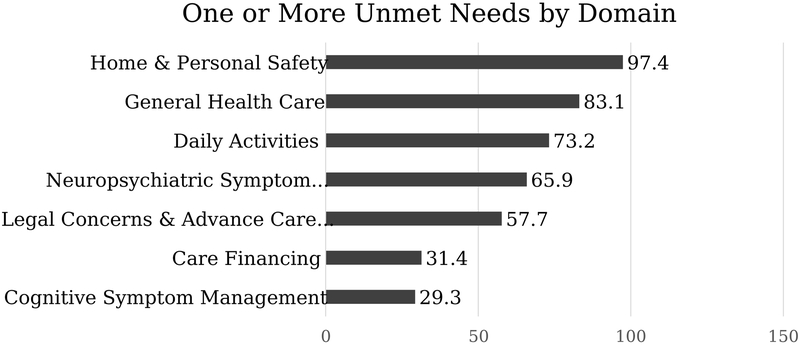
PWD had a mean of 10.6 (±4.8) unmet needs out of 43 items (24.8%). Unmet needs were most common in Home/Personal Safety (97.4%), General Health Care (83.1%), and Daily Activities (73.2%) domains. Higher unmet needs were significantly related to non-white race, lower education, higher cognitive function, more neuropsychiatric symptoms, lower quality of life in PWD, and having caregivers with lower education or who spent fewer hours/week with the PWD.
Unmet needs are common in community-living PWD, and most are non-medical. Home-based dementia care can identify and address PWD's unmet needs by focusing on care recipients and caregivers to enable PWD to remain safely at home.
了解痴呆症患者(PWD)及其照顾者的哪些特征与未满足的需求相关,这可以为满足这些需求提供策略。我们的目的是确定有未满足需求的 PWD 的百分比,以及 PWD 未满足需求的重要相关因素。
使用双变量和分层多元线性回归分析对横断面数据进行分析。
参与者居住在马里兰州巴尔的摩大都市区和华盛顿特区郊区。
一项针对 646 名居住在社区的 PWD 及其非正规照顾者的研究,他们接受了一项关于痴呆症相关需求的家庭评估。
使用约翰霍普金斯痴呆症护理需求评估来确定未满足的需求。使用 PWD 和其照顾者的人口统计学、社会经济、临床、功能和生活质量特征来确定未满足需求的相关因素。
PWD 有 10.6(±4.8)项 43 项中的未满足需求(24.8%)。未满足需求在家庭/个人安全(97.4%)、一般医疗保健(83.1%)和日常活动(73.2%)方面最为常见。较高的未满足需求与非白种人种族、较低的教育程度、较高的认知功能、更多的神经精神症状、PWD 较低的生活质量以及照顾者教育程度较低或每周与 PWD 相处时间较少有关。
在居住在社区的 PWD 中,未满足的需求很常见,而且大多数是非医疗需求。以家庭为基础的痴呆症护理可以通过关注护理接受者和照顾者来识别和满足 PWD 的未满足需求,使 PWD 能够安全地留在家里。