Nan Wenya, Dias Ana Paula Barbosa, Rosa Agostinho C
Department of Psychology, Shanghai Normal University, Shanghai, China.
Department of Bioengineering, LaSEEB-System and Robotics Institute, Instituto Superior Tecnico, Universidade de Lisboa, Lisbon, Portugal.
Front Neurol. 2019 Jul 24;10:800. doi: 10.3389/fneur.2019.00800. eCollection 2019.
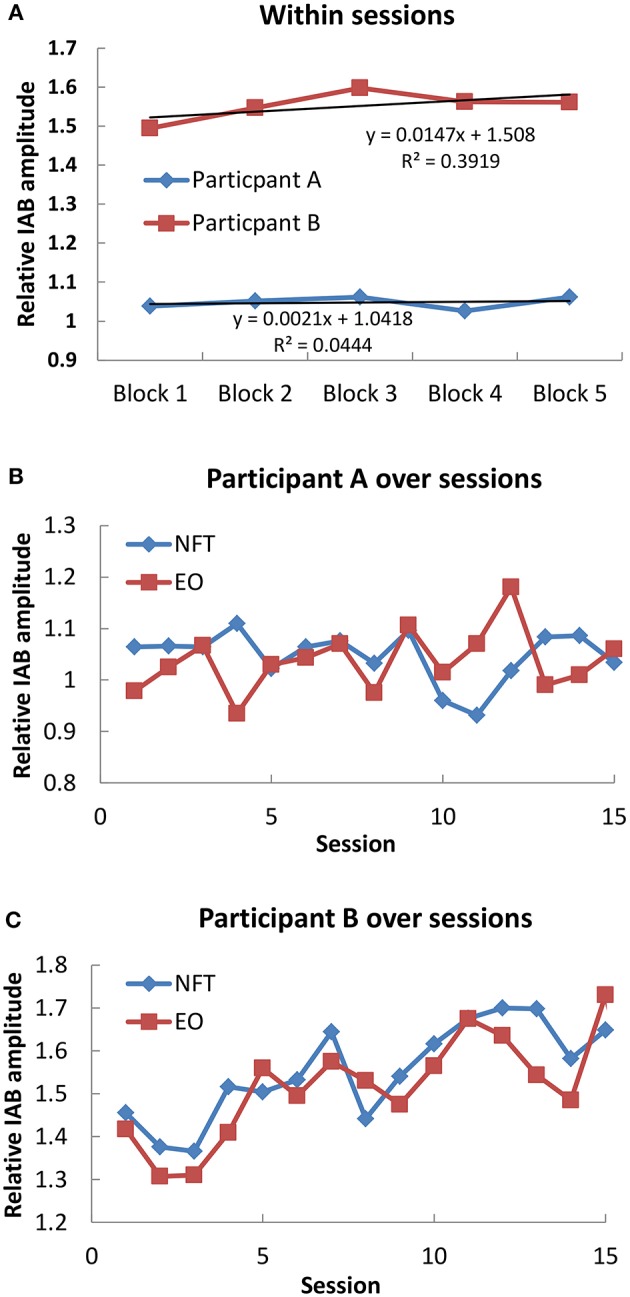
Stroke is a debilitating neurological condition which usually results in the abnormal electrical brain activity and the impairment of sensation, motor, or cognition functions. In this context, neurofeedback training, i.e., a non-invasive and relatively low cost technique that contributes to neuroplasticity and behavioral performance, might be promising for stroke rehabilitation. We intended to explore neurofeedback training on a 63-year-old male patient and a 77-year-old female patient with chronic stroke. Both of them had suffered from an ischemic stroke for rather long period (more than 3 years) and could not gain further improvement by traditional therapy. The neurofeedback training was designed to enhance alpha activity by 15 sessions distributed over 2 months, for the purpose of overall cognitive improvement and hopefully also motor function improvement for the female patient. We found that the two patients showed alpha enhancement during NFT compared to eyes open baseline within most sessions. Furthermore, both patients reduced their anxiety and depression level. The male patient showed an evolution in speech pattern in terms of naming, sentences completion and verbal fluency, while the female patient improved functionality of the march. These results suggested that alpha neurofeedback training could provide a spectrum of improvements, providing new hope for chronic stroke patients who could not gain further improvements through traditional therapies.
中风是一种使人衰弱的神经疾病,通常会导致大脑电活动异常以及感觉、运动或认知功能受损。在这种情况下,神经反馈训练,即一种有助于神经可塑性和行为表现的非侵入性且成本相对较低的技术,可能对中风康复具有前景。我们打算对一名63岁男性患者和一名77岁女性慢性中风患者进行神经反馈训练。他们两人都患有缺血性中风很长时间了(超过3年),并且无法通过传统疗法获得进一步改善。神经反馈训练旨在通过在2个月内进行15次训练来增强阿尔法脑电波活动,目的是全面改善认知,并且有望也改善女性患者的运动功能。我们发现,与大多数训练时段的睁眼基线相比,两名患者在神经反馈训练期间阿尔法脑电波增强。此外,两名患者的焦虑和抑郁水平都有所降低。男性患者在命名、句子完成和语言流畅性方面的言语模式有了变化,而女性患者的行走功能得到了改善。这些结果表明,阿尔法神经反馈训练可以带来一系列改善,为那些无法通过传统疗法获得进一步改善的慢性中风患者带来了新希望。