Department of Oncology, The First Affiliated Hospital of Xi'an Jiaotong University, Xi'an, 710061 Shaanxi Province, China.
Department of Hematology, Zhongnan Hospital of Wuhan University, 430071 Hubei, China.
Oxid Med Cell Longev. 2019 Jul 15;2019:5813985. doi: 10.1155/2019/5813985. eCollection 2019.
The mechanisms of crosstalk between depression and gastric cancer (GC) remain ill defined. Given that reactive oxygen species (ROS) is involved in the pathophysiology of both GC and depression, we try to explore the activities of ROS in the development of GC and GC-related depression.
110 patients with newly diagnosed GC were recruited in our study. The clinical characteristics of these patients were recorded. Inflammation and oxidative stress markers were detected by ELISA. The depression status of patients with GC was assessed during follow-up. The association between ROS, ABL1, and inflammation factors was evaluated in HO-treated GC cell lines and The Cancer Genome Atlas (TCGA) database. The effect of ABL1 on inflammation was detected with Imatinib/Nilotinib-treated GC cell lines. A chronic mild stress- (CMS-) induced patient-derived xenograft (PDX) mice model was established to assess the crosstalk between depression and GC.
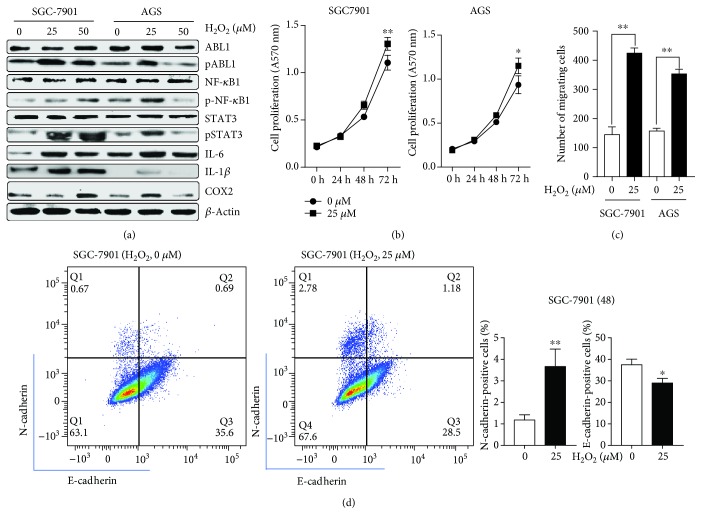
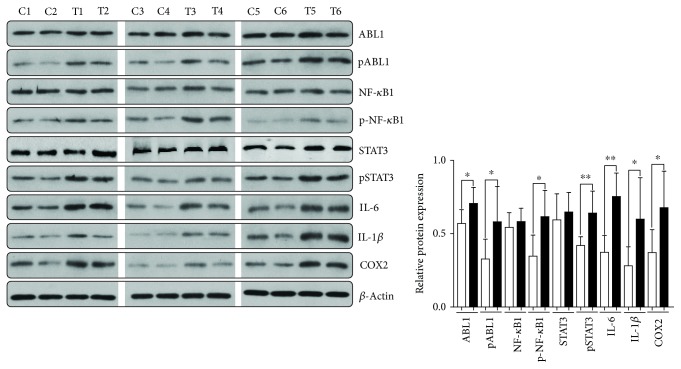
Depression was correlated with poor prognosis of patients with GC. GC patients with depression were under a high level of oxidative status as well as dysregulated inflammation. In the CMS-induced GC PDX mice model, CMS could facilitate the development of GC. Additionally, tumor bearing could induce depressive-like behaviors of mice. With the treatment of ROS, the activities of ABL1 and inflammatory signaling were enhanced both in vitro and in vivo, and blocking the activities of ABL1 inhibited inflammatory signaling.
ROS-activated ABL1 mediates inflammation through regulating NF-B1 and STAT3, which subsequently leads to the development of GC and GC-related depression.
抑郁症和胃癌(GC)之间相互作用的机制仍不清楚。鉴于活性氧(ROS)参与 GC 和抑郁症的病理生理学过程,我们试图探讨 ROS 在 GC 发展和 GC 相关抑郁症中的作用。
本研究纳入了 110 例新诊断为 GC 的患者。记录这些患者的临床特征。通过 ELISA 检测炎症和氧化应激标志物。在随访期间评估 GC 患者的抑郁状态。评估 HO 处理的 GC 细胞系和癌症基因组图谱(TCGA)数据库中 ROS、ABL1 和炎症因子之间的相关性。用伊马替尼/尼罗替尼处理 GC 细胞系检测 ABL1 对炎症的影响。建立慢性轻度应激(CMS)诱导的患者来源异种移植(PDX)小鼠模型,以评估抑郁和 GC 之间的相互作用。
抑郁与 GC 患者的预后不良相关。患有抑郁症的 GC 患者氧化状态较高,炎症失调。在 CMS 诱导的 GC PDX 小鼠模型中,CMS 可促进 GC 的发展。此外,肿瘤的存在可诱导小鼠出现抑郁样行为。用 ROS 处理后,ABL1 的活性及其炎症信号在体外和体内均增强,阻断 ABL1 的活性可抑制炎症信号。
ROS 激活的 ABL1 通过调节 NF-B1 和 STAT3 介导炎症,从而导致 GC 和 GC 相关抑郁症的发生。