1Section of Microbiology, Department of Biology, University of Copenhagen, 2100 Copenhagen, Denmark.
2Department of Bacterial, Parasites and Fungi, Statens Serum Institut, 2300 Copenhagen S, Denmark.
Commun Biol. 2019 Aug 5;2:291. doi: 10.1038/s42003-019-0540-1. eCollection 2019.
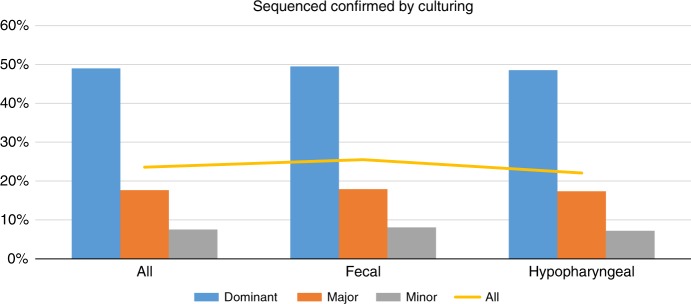
Next-Generation Sequencing (NGS) of 16S rRNA gene is now one of the most widely used application to investigate the microbiota at any given body site in research. Since NGS is more sensitive than traditional culture methods (TCMs), many studies have argued for them to replace TCMs. However, are we really ready for this transition? Here we compare the diagnostic efficiency of the two methods using a large number of samples ( = 1,748 fecal and = 1,790 hypopharyngeal), among healthy children at different time points. Here we show that bacteria identified by NGS represented 75.70% of the unique bacterial species cultured in each sample, while TCM only identified 23.86% of the bacterial species found by amplicon sequencing. We discuss the pros and cons of both methods and provide perspective on how NGS can be implemented effectively in clinical settings.
下一代测序(NGS)16S rRNA 基因是目前研究中最广泛应用于研究任何特定身体部位微生物组的方法之一。由于 NGS 比传统的培养方法(TCMs)更敏感,许多研究主张用 NGS 替代 TCMs。然而,我们真的准备好进行这种转变了吗?在这里,我们使用大量样本(健康儿童在不同时间点的粪便样本=1748 个,咽喉样本=1790 个)比较了这两种方法的诊断效率。结果显示,NGS 鉴定的细菌占每个样本培养的独特细菌种类的 75.70%,而 TCM 仅鉴定出扩增测序发现的细菌种类的 23.86%。我们讨论了这两种方法的优缺点,并就如何在临床环境中有效地实施 NGS 提供了一些观点。