Department of Psychology, Humboldt-Universität zu Berlin, Berlin, Germany.
Bernstein Center for Computational Neuroscience, Humboldt-Universität zu Berlin, Berlin, Germany.
PLoS Comput Biol. 2019 Aug 9;15(8):e1006695. doi: 10.1371/journal.pcbi.1006695. eCollection 2019 Aug.
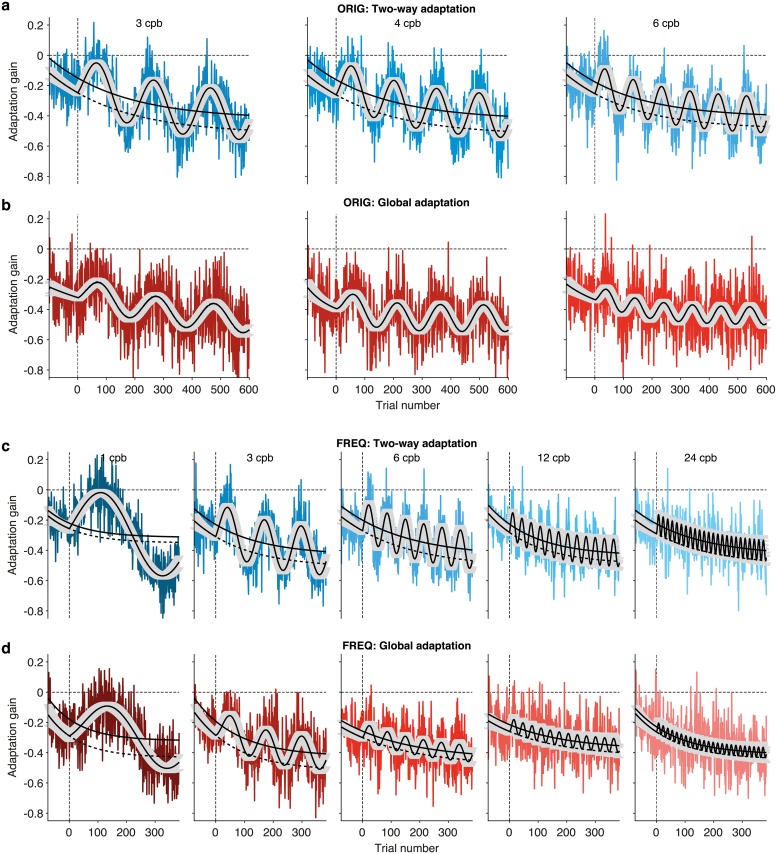
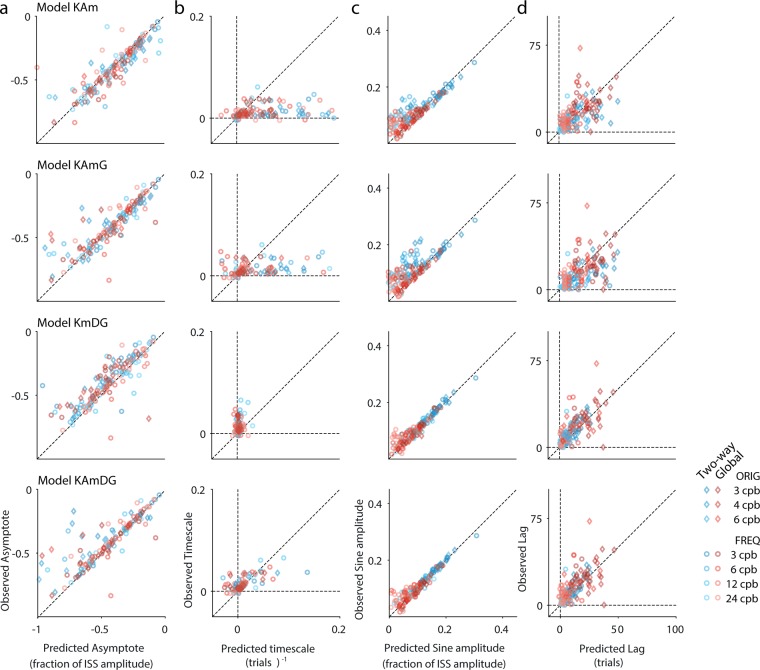
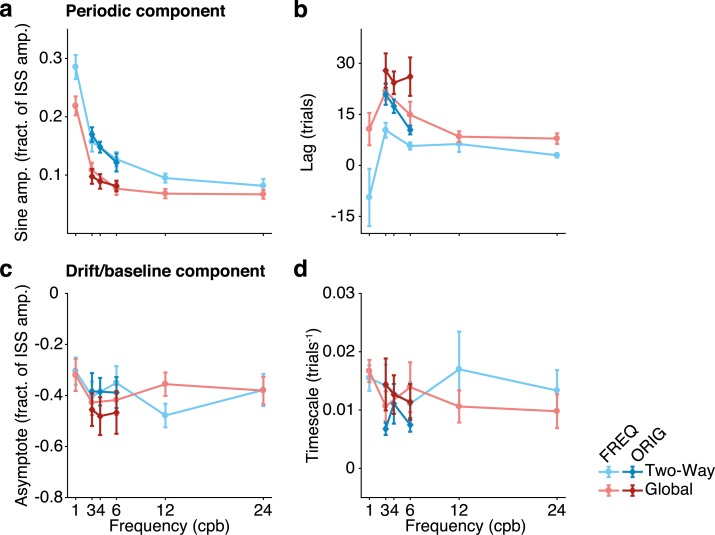
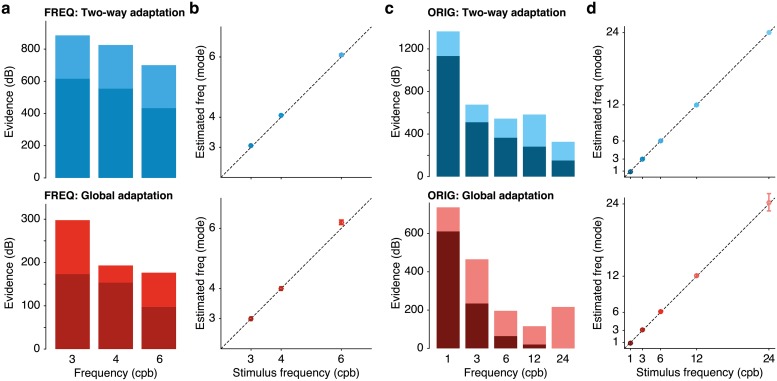
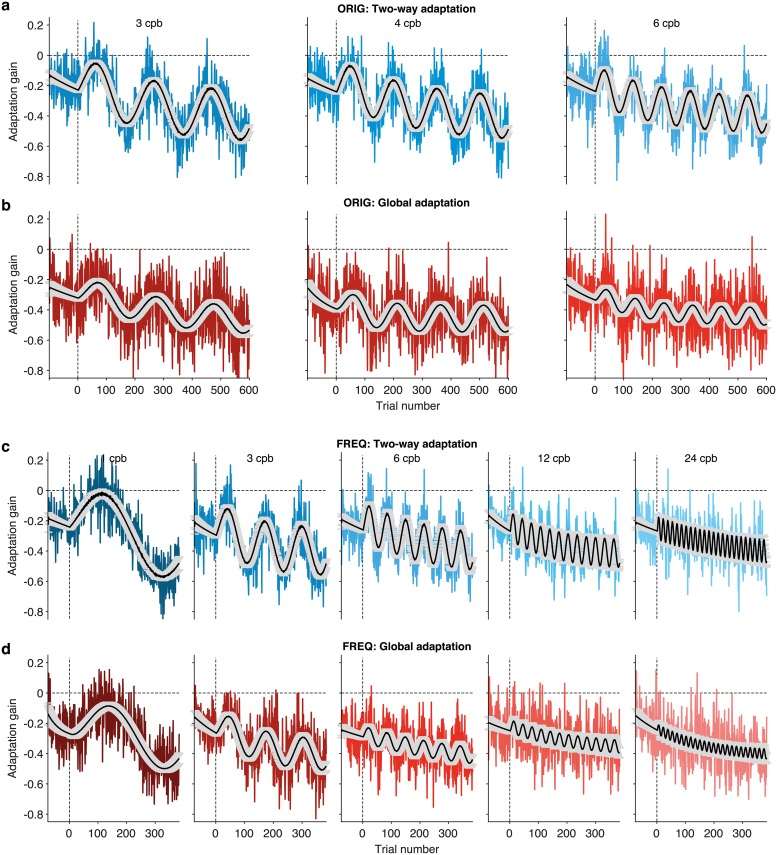
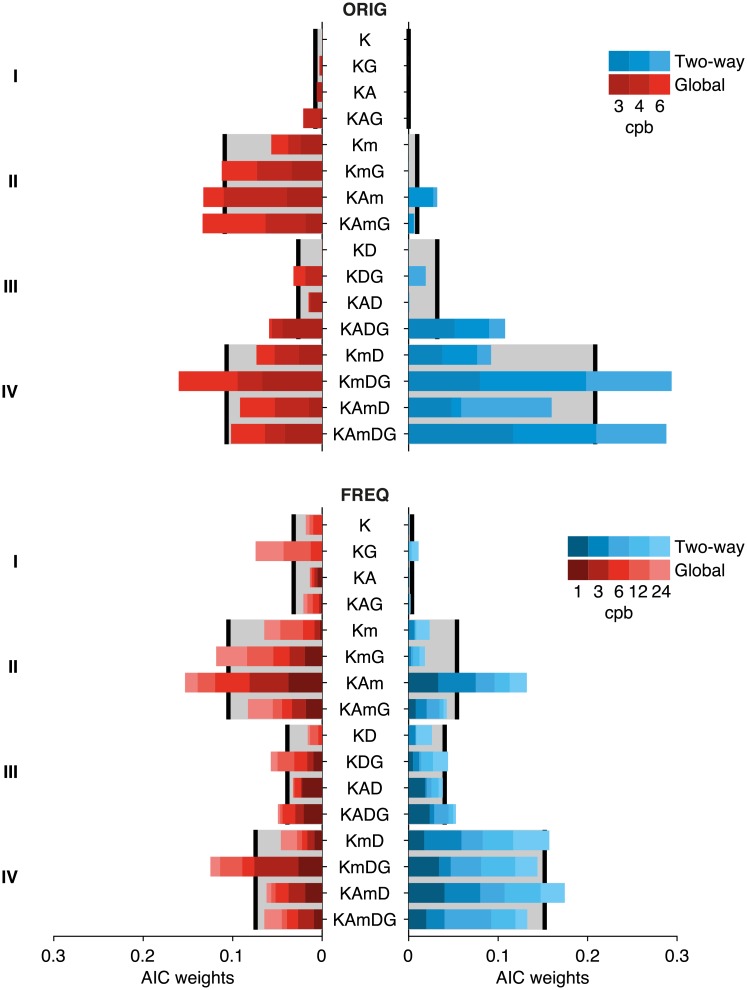
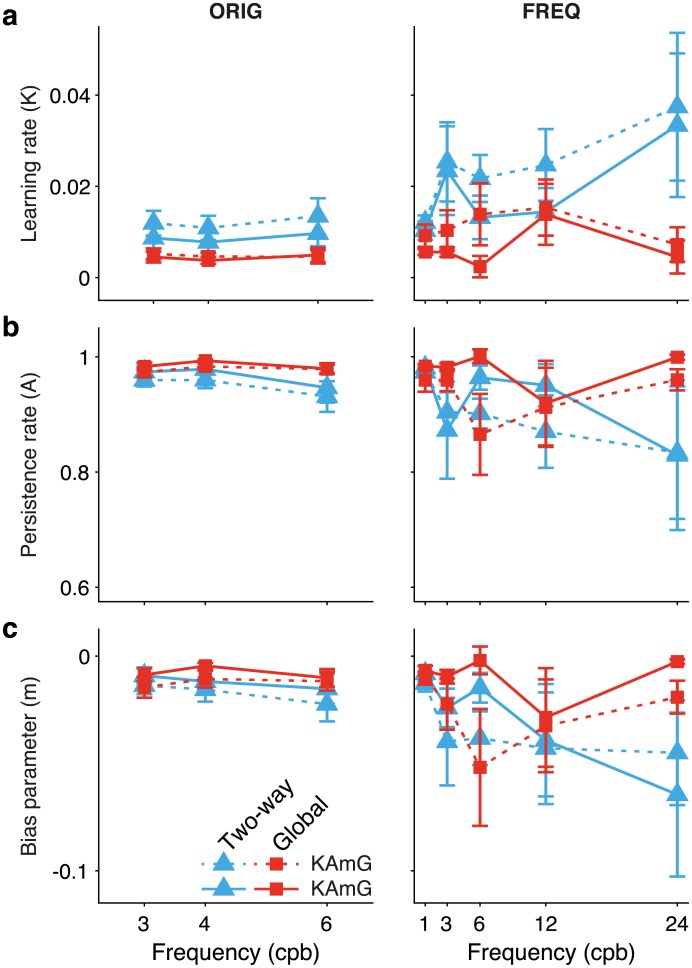
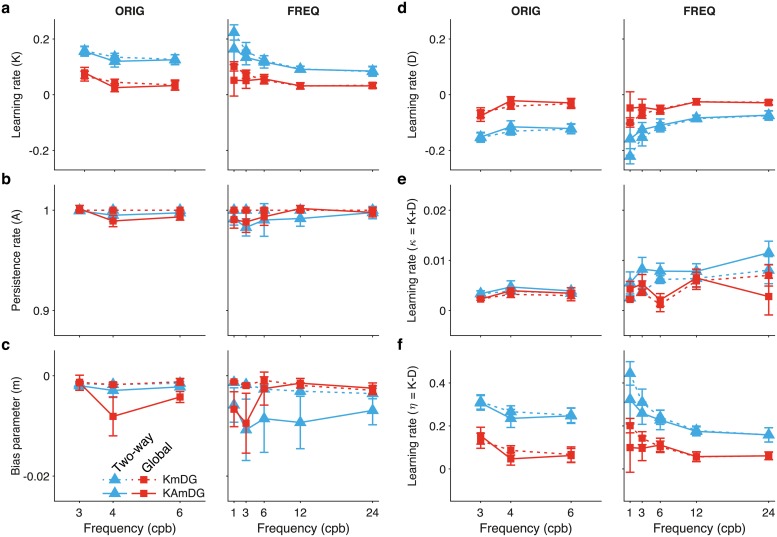
Plasticity in the oculomotor system ensures that saccadic eye movements reliably meet their visual goals-to bring regions of interest into foveal, high-acuity vision. Here, we present a comprehensive description of sensorimotor learning in saccades. We induced continuous adaptation of saccade amplitudes using a double-step paradigm, in which participants saccade to a peripheral target stimulus, which then undergoes a surreptitious, intra-saccadic shift (ISS) as the eyes are in flight. In our experiments, the ISS followed a systematic variation, increasing or decreasing from one saccade to the next as a sinusoidal function of the trial number. Over a large range of frequencies, we confirm that adaptation gain shows (1) a periodic response, reflecting the frequency of the ISS with a delay of a number of trials, and (2) a simultaneous drift towards lower saccade gains. We then show that state-space-based linear time-invariant systems (LTIS) represent suitable generative models for this evolution of saccade gain over time. This state-equation algorithm computes the prediction of an internal (or hidden state-) variable by learning from recent feedback errors, and it can be compared to experimentally observed adaptation gain. The algorithm also includes a forgetting rate that quantifies per-trial leaks in the adaptation gain, as well as a systematic, non-error-based bias. Finally, we study how the parameters of the generative models depend on features of the ISS. Driven by a sinusoidal disturbance, the state-equation admits an exact analytical solution that expresses the parameters of the phenomenological description as functions of those of the generative model. Together with statistical model selection criteria, we use these correspondences to characterize and refine the structure of compatible state-equation models. We discuss the relation of these findings to established results and suggest that they may guide further design of experimental research across domains of sensorimotor adaptation.
动眼系统的可塑性确保了眼球运动能够可靠地达到其视觉目标——将感兴趣的区域带入中央凹、高分辨率的视觉中。在这里,我们全面描述了眼球运动中的感觉运动学习。我们使用双步范式诱导眼球运动幅度的连续适应,在此过程中,参与者向周边目标刺激物进行扫视,然后在眼球运动过程中,该目标物会发生偷偷的、眼跳内的转移(ISS)。在我们的实验中,ISS 遵循系统变化,作为试验次数的正弦函数,从上一个眼跳到下一个眼跳增加或减少。在很大的频率范围内,我们确认适应增益表现出(1)周期性响应,反映了 ISS 的频率,具有试验次数的延迟,(2)同时向较低的扫视增益漂移。然后,我们表明基于状态空间的线性时不变系统(LTIS)是表示扫视增益随时间演变的合适生成模型。该状态方程算法通过从最近的反馈误差中学习来计算内部(或隐藏状态)变量的预测,并且可以与实验观察到的适应增益进行比较。该算法还包括遗忘率,用于量化每次试验中适应增益的泄漏,以及基于系统的、非基于误差的偏差。最后,我们研究了生成模型的参数如何取决于 ISS 的特征。在正弦干扰的驱动下,状态方程有一个精确的解析解,该解将现象描述的参数表示为生成模型参数的函数。结合统计模型选择标准,我们使用这些对应关系来描述和精炼兼容状态方程模型的结构。我们讨论了这些发现与已建立的结果之间的关系,并建议它们可能为感觉运动适应的各个领域的实验研究提供进一步的设计指导。