Department of Biological Sciences, University of Bergen, P.O. Box 7803, 5020, Bergen, Norway.
BMC Genomics. 2019 Aug 9;20(1):642. doi: 10.1186/s12864-019-5995-4.
The candidate genus "Methylacidiphilum" comprises thermoacidophilic aerobic methane oxidizers belonging to the Verrucomicrobia phylum. These are the first described non-proteobacterial aerobic methane oxidizers. The genes pmoCAB, encoding the particulate methane monooxygenase do not originate from horizontal gene transfer from proteobacteria. Instead, the "Ca. Methylacidiphilum" and the sister genus "Ca. Methylacidimicrobium" represent a novel and hitherto understudied evolutionary lineage of aerobic methane oxidizers. Obtaining and comparing the full genome sequences is an important step towards understanding the evolution and physiology of this novel group of organisms.
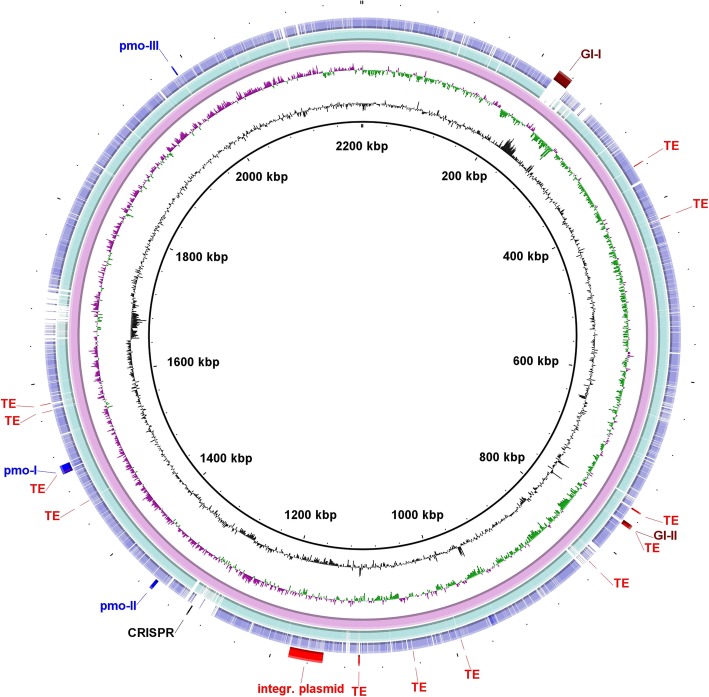
Here we present the closed genome of "Ca. Methylacidiphilum kamchatkense" strain Kam1 and a comparison with the genomes of its two closest relatives "Ca. Methylacidiphilum fumariolicum" strain SolV and "Ca. Methylacidiphilum infernorum" strain V4. The genome consists of a single 2,2 Mbp chromosome with 2119 predicted protein coding sequences. Genome analysis showed that the majority of the genes connected with metabolic traits described for one member of "Ca. Methylacidiphilum" is conserved between all three genomes. All three strains encode class I CRISPR-cas systems. The average nucleotide identity between "Ca. M. kamchatkense" strain Kam1 and strains SolV and V4 is ≤95% showing that they should be regarded as separate species. Whole genome comparison revealed a high degree of synteny between the genomes of strains Kam1 and SolV. In contrast, comparison of the genomes of strains Kam1 and V4 revealed a number of rearrangements. There are large differences in the numbers of transposable elements found in the genomes of the three strains with 12, 37 and 80 transposable elements in the genomes of strains Kam1, V4 and SolV respectively. Genomic rearrangements and the activity of transposable elements explain much of the genomic differences between strains. For example, a type 1h uptake hydrogenase is conserved between strains Kam1 and SolV but seems to have been lost from strain V4 due to genomic rearrangements.
Comparing three closed genomes of "Ca. Methylacidiphilum" spp. has given new insights into the evolution of these organisms and revealed large differences in numbers of transposable elements between strains, the activity of these explains much of the genomic differences between strains.
候选属“Methylacidiphilum”包含属于疣微菌门的嗜热嗜酸好氧甲烷氧化菌。这些是首次描述的非变形菌好氧甲烷氧化菌。编码颗粒状甲烷单加氧酶的 pmoCAB 基因不是来自于变形菌的水平基因转移。相反,“Ca. Methylacidiphilum”和姊妹属“Ca. Methylacidimicrobium”代表了一个新的、迄今研究较少的好氧甲烷氧化菌进化谱系。获得和比较全基因组序列是理解这个新型生物群体的进化和生理学的重要步骤。
本文介绍了“Ca. Methylacidiphilum kamchatkense”菌株 Kam1 的封闭基因组,并与它的两个最亲近的亲缘菌株“Ca. Methylacidiphilum fumariolicum”菌株 SolV 和“Ca. Methylacidiphilum infernorum”菌株 V4 的基因组进行了比较。基因组由一个 2.2 Mbp 的单一染色体组成,包含 2119 个预测的蛋白质编码序列。基因组分析表明,与“Ca. Methylacidiphilum”的一个成员描述的代谢特征相关的大多数基因在三个基因组之间都是保守的。三个菌株都编码 I 类 CRISPR-cas 系统。“Ca. M. kamchatkense”菌株 Kam1 与菌株 SolV 和 V4 的平均核苷酸同一性均≤95%,表明它们应被视为不同的种。全基因组比较显示,菌株 Kam1 和 SolV 的基因组之间具有高度的同线性。相比之下,菌株 Kam1 和 V4 的基因组比较显示出许多重排。在三个菌株的基因组中发现的转座元件数量存在很大差异,菌株 Kam1、V4 和 SolV 的基因组中分别有 12、37 和 80 个转座元件。基因组重排和转座元件的活性解释了菌株之间基因组差异的大部分原因。例如,菌株 Kam1 和 SolV 之间保守的 I 型氢酶,但由于基因组重排,菌株 V4 似乎已经失去了这种酶。
比较三个“Ca. Methylacidiphilum” spp 的封闭基因组,使我们对这些生物的进化有了新的认识,并揭示了菌株之间转座元件数量的巨大差异,这些元件的活性解释了菌株之间基因组差异的大部分原因。