Department of Medical Psychology, University Medical Center Hamburg-Eppendorf, Martinistraße 52 | W 26, 20246, Hamburg, Germany.
University of Applied Sciences Hamburg, Alexanderstraße 1, 20099, Hamburg, Germany.
Orphanet J Rare Dis. 2019 Aug 9;14(1):194. doi: 10.1186/s13023-019-1171-9.
Achondroplasia is the most common form of disproportionate short stature and might affect not only the quality of life of the affected child but also that of the parents.
We aimed to investigate the quality of life of children with achondroplasia from child- and parent perspective as well as the parental quality of life.
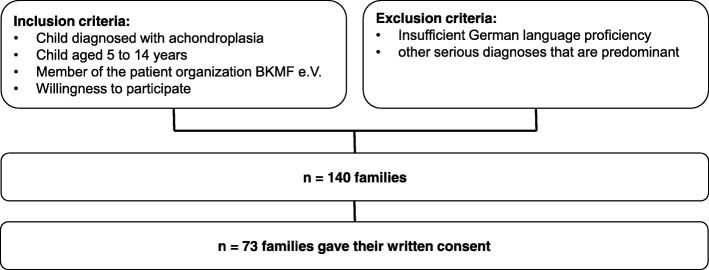
Forty-seven children with achondroplasia and 73 parents from a German patient organization participated. We assessed children's quality of life using the generic Peds QL 4.0™ as self-reports for children aged 8-14 and parent-reports for children aged 4-14 years. Parental quality of life we assessed using the short-form 8-questionnaire.
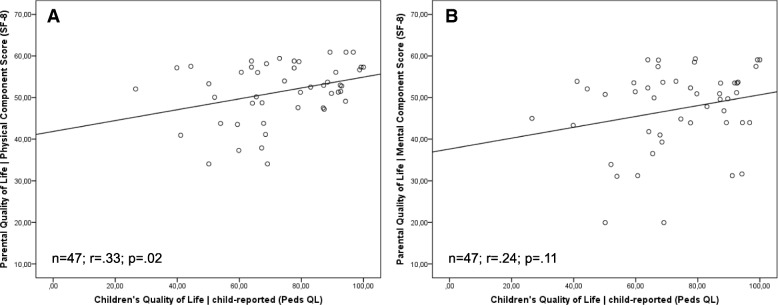
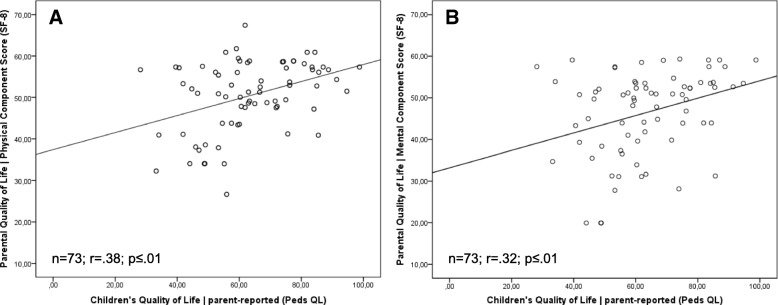
Children with achondroplasia showed significantly lower quality of life scores compared to a healthy reference population from both the child- and parent-report (p = ≤.01), except the child-report of the emotional domain (t (46) = - 1.73, p = .09). Parents reported significantly lower mental health in comparison with a German reference population (t (72) = 5.64, p ≤ .01) but no lower physical health (t (72) = .20, p = .85). While the parental quality of life was a significant predictor of parent-reported children's quality of life (F (6,66) = 2.80, p = .02), it was not for child-reported children's quality of life (F (6,66) = .92, p = .49).
Achondroplasia is chronically debilitating. Thus special efforts are needed to address patients' and parent's quality of life needs. This special health condition may influence the daily life of the entire family because they have to adapt to the child's particular needs. Therefore, clinicians should not only focus on the child's quality of life but also those of the parents.
软骨发育不全是最常见的不成比例身材矮小的形式,不仅会影响受影响儿童的生活质量,也会影响父母的生活质量。
我们旨在从儿童和家长的角度以及父母的生活质量来调查软骨发育不全儿童的生活质量。
我们招募了德国患者组织中的 47 名软骨发育不全儿童和 73 名父母。我们使用通用 PedsQL 4.0 量表评估儿童的生活质量,该量表适用于 8-14 岁的儿童自评,4-14 岁的儿童家长报告。我们使用简短的 8 项问卷评估父母的生活质量。
与健康对照组相比,软骨发育不全儿童在儿童和家长报告中都表现出明显较低的生活质量评分(p≤.01),除了儿童情感领域的报告(t (46) = -1.73,p=0.09)。与德国普通人群相比,父母报告的心理健康明显较低(t (72) = 5.64,p≤0.01),但身体健康水平无差异(t (72) = 0.20,p=0.85)。虽然父母的生活质量是父母报告儿童生活质量的显著预测因素(F (6,66) = 2.80,p = 0.02),但不是儿童报告的儿童生活质量的显著预测因素(F (6,66) = 0.92,p = 0.49)。
软骨发育不全是一种慢性致残疾病。因此,需要特别努力满足患者和家长的生活质量需求。这种特殊的健康状况可能会影响整个家庭的日常生活,因为他们必须适应孩子的特殊需求。因此,临床医生不仅要关注儿童的生活质量,还要关注父母的生活质量。