Mulugeta Gersam Abera, Awlachew Seble
Jimma University, Jimma, Ethiopia.
BMC Surg. 2019 Aug 9;19(1):107. doi: 10.1186/s12893-019-0561-1.
Sigmoid volvulus is the commonest cause of large bowel obstruction in many regions of the world. Its prevalence varies greatly geographically. In Ethiopia, the disease is the commonest cause of emergency admissions due to intestinal obstruction. However, few studies have been conducted discussing the management outcome in Ethiopia and Africa. This research was conducted to assess the pattern & management outcome of acute sigmoid volvulus at a district hospital in South-west Ethiopia.
A facility based retrospective cross-sectional review of surgical records was done to identify patients who had acute sigmoid volvulus. Data was collected using structured questionnaire by three pre trained data collectors. The collected data was checked for its completeness, and then entered, edited, cleaned and analyzed using Statistical Package for the Social Sciences (SPSS) version 22.0. For all statistical significance tests the cut-off value set was P < 0.05.
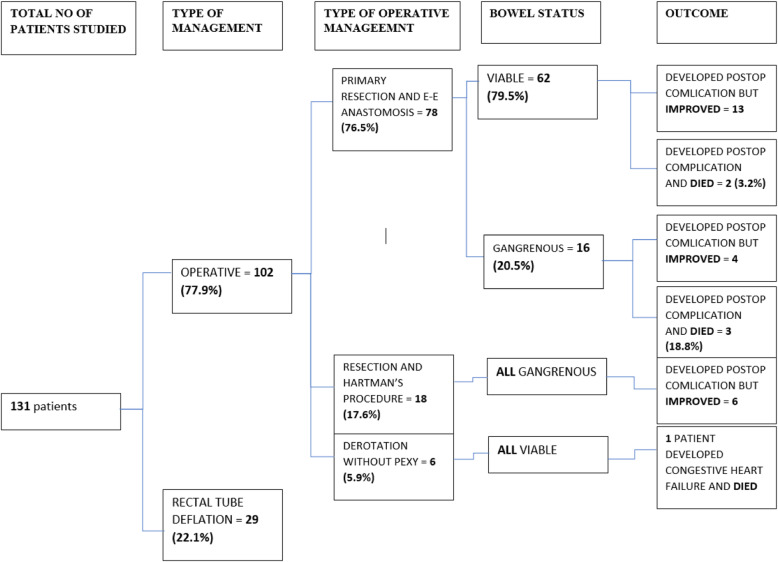
A total of 131 patients were managed for acute sigmoid volvulus. 108 (82.4%) were men with a male to female ratio of 4.7:1. The hospital prevalence of acute sigmoid volvulus was 27.9%. Majority (42%) of the patients were in the 6th decades of life. Abdominal pain, abdominal distention & inability to pass feces & flatus were the predominant presenting compliant while abdominal distention was the dominant physical finding in all of the patients. Ninety-seven patients (74%) had viable bowel obstruction of which 29 patients had successful rectal tube deflation. The remaining 68 patients were managed operatively by either primary resection & anastomosis (62 patients) or derotation alone (6 patients). Thirty-four patients had gangrenous bowel obstruction and were managed by either primary resection and anastomosis (16 patients) or Hartman's colostomy (18 patients). Six patients died of which 5 had primary resection and anastomosis (2 for viable and 3 for gangrenous bowel obstruction).The predominant postoperative complication was wound infection in 11(10.7%) patients. Factors associated with unfavorable outcome were female sex, primary resection & end to end anastomosis and presentation of illness more than 24 h.
The most common management was primary resection and anastomosis. The overall mortality rate was 4.5% and the mortality rate related to primary resection and end to end anastomosis was 6.4%. Mortality rate was higher in those patients who had resection and anastomosis for gangrenous bowel compared to those who had viable bowel (19% vs 3%). Generally factors associated with poor outcome were duration of illness, primary resection and anastomosis and being female.
在世界许多地区,乙状结肠扭转是大肠梗阻最常见的原因。其患病率在地理上差异很大。在埃塞俄比亚,该疾病是肠梗阻导致急诊入院最常见的原因。然而,在埃塞俄比亚和非洲,很少有研究讨论其治疗结果。本研究旨在评估埃塞俄比亚西南部一家地区医院急性乙状结肠扭转的模式及治疗结果。
对手术记录进行基于机构的回顾性横断面审查,以确定患有急性乙状结肠扭转的患者。由三名经过预培训的数据收集员使用结构化问卷收集数据。对收集到的数据进行完整性检查,然后使用社会科学统计软件包(SPSS)22.0版本进行录入、编辑、清理和分析。所有统计学显著性检验的临界值设定为P < 0.05。
共有131例患者接受了急性乙状结肠扭转的治疗。108例(82.4%)为男性,男女比例为4.7:1。急性乙状结肠扭转的医院患病率为27.9%。大多数(42%)患者年龄在60多岁。腹痛、腹胀及无法排便排气是主要的就诊主诉,而腹胀是所有患者的主要体征。97例(74%)患者存在存活肠段梗阻,其中29例患者通过直肠管排气成功。其余68例患者接受了手术治疗,其中62例行一期切除吻合术,6例行单纯扭转复位术。34例患者存在坏疽性肠梗阻,并接受了一期切除吻合术(16例)或Hartmann结肠造口术(18例)。6例患者死亡,其中5例行一期切除吻合术(2例因存活肠段梗阻,3例因坏疽性肠梗阻)。主要的术后并发症是11例(10.7%)患者发生伤口感染。与不良结局相关的因素为女性、一期切除端端吻合术以及发病超过24小时。
最常见的治疗方法是一期切除吻合术。总体死亡率为4.5%,与一期切除端端吻合术相关的死亡率为6.4%。与存活肠段梗阻患者相比,坏疽性肠梗阻患者行切除吻合术的死亡率更高(19%对3%)。一般来说,与不良结局相关的因素为疾病持续时间、一期切除吻合术以及女性。