Department of Structural Biology, St. Jude Children's Research Hospital, Memphis, TN, USA.
Department of Microbiology, Immunology and Biochemistry, University of Tennessee Health Science Center, Memphis, TN, USA.
Nat Commun. 2019 Aug 9;10(1):3600. doi: 10.1038/s41467-019-11435-y.
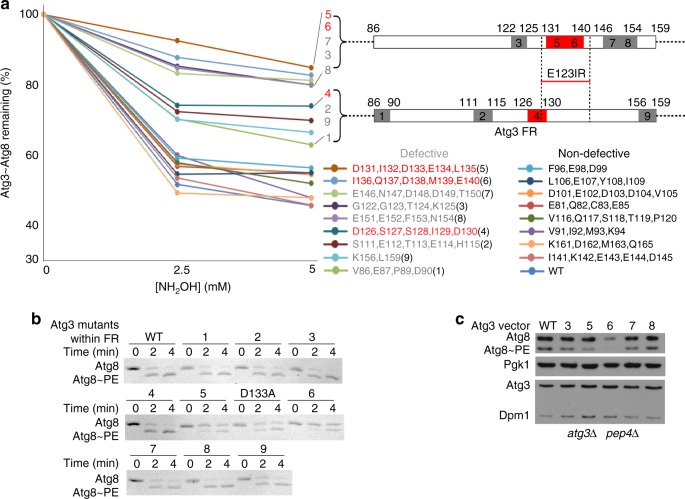
Autophagy depends on the E2 enzyme, Atg3, functioning in a conserved E1-E2-E3 trienzyme cascade that catalyzes lipidation of Atg8-family ubiquitin-like proteins (UBLs). Molecular mechanisms underlying Atg8 lipidation remain poorly understood despite association of Atg3, the E1 Atg7, and the composite E3 Atg12-Atg5-Atg16 with pathologies including cancers, infections and neurodegeneration. Here, studying yeast enzymes, we report that an Atg3 element we term E123IR (E1, E2, and E3-interacting region) is an allosteric switch. NMR, biochemical, crystallographic and genetic data collectively indicate that in the absence of the enzymatic cascade, the Atg3 makes intramolecular interactions restraining Atg3's catalytic loop, while E1 and E3 enzymes directly remove this brace to conformationally activate Atg3 and elicit Atg8 lipidation in vitro and in vivo. We propose that Atg3's E123IR protects the E2~UBL thioester bond from wayward reactivity toward errant nucleophiles, while Atg8 lipidation cascade enzymes induce E2 active site remodeling through an unprecedented mechanism to drive autophagy.
自噬依赖于 E2 酶 Atg3,其在保守的 E1-E2-E3 三酶级联中发挥作用,该级联催化 Atg8 家族泛素样蛋白 (UBL) 的脂质化。尽管 Atg3、E1 Atg7 和复合 E3 Atg12-Atg5-Atg16 与癌症、感染和神经退行性变等病理学有关联,但 Atg8 脂质化的分子机制仍知之甚少。在这里,我们通过研究酵母酶,报告了一个我们称之为 E123IR(E1、E2 和 E3 相互作用区域)的 Atg3 元件是一个别构开关。NMR、生化、晶体学和遗传数据共同表明,在没有酶级联的情况下,Atg3 进行分子内相互作用,限制 Atg3 的催化环,而 E1 和 E3 酶直接去除这个支架,从而使 Atg3 构象激活,并在体外和体内引发 Atg8 脂质化。我们提出 Atg3 的 E123IR 保护 E2~UBL 硫酯键免受异常亲核试剂的任性反应,而 Atg8 脂质化级联酶通过一种前所未有的机制诱导 E2 活性位点重塑,从而驱动自噬。