EcoHealth Alliance, New York, NY, United States.
Centre for Integrative Ecology, School of Life and Environmental Sciences, Deakin University, Geelong, VIC, Australia.
Front Public Health. 2023 Jul 6;11:1168613. doi: 10.3389/fpubh.2023.1168613. eCollection 2023.
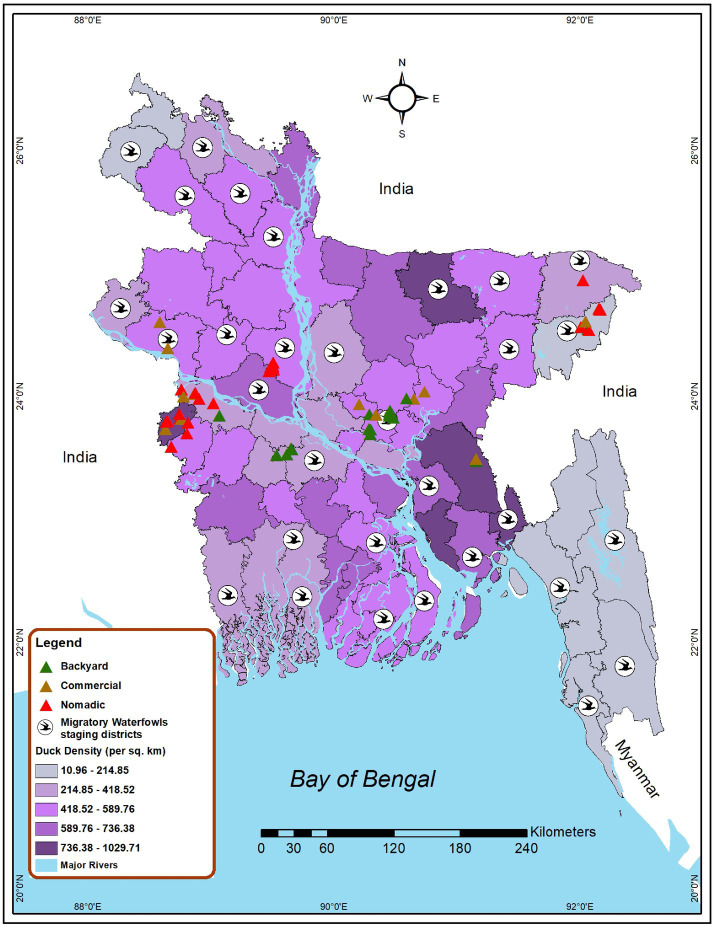
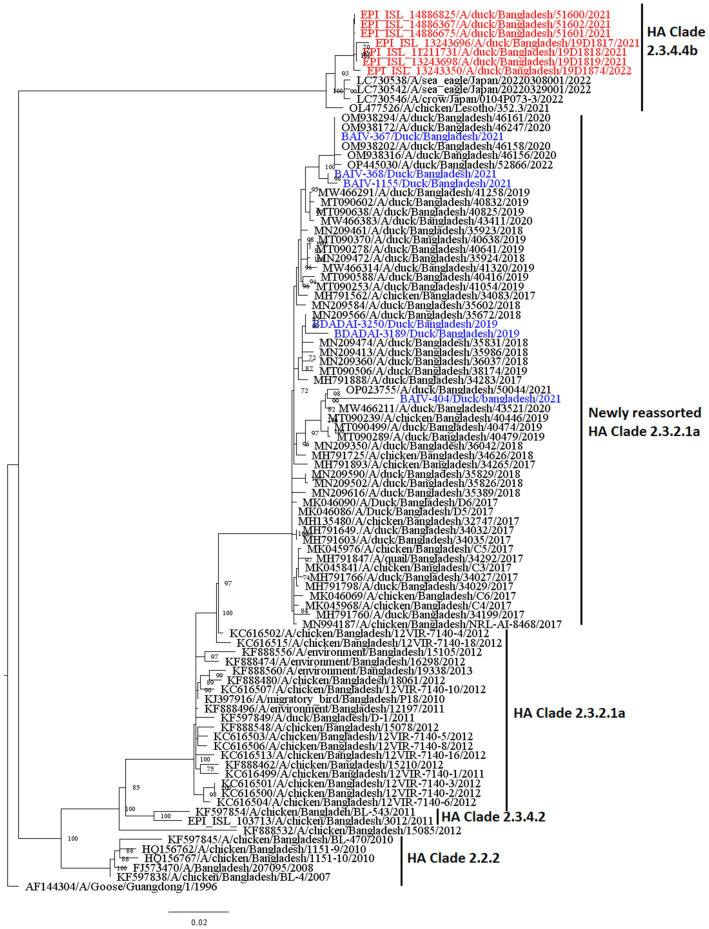
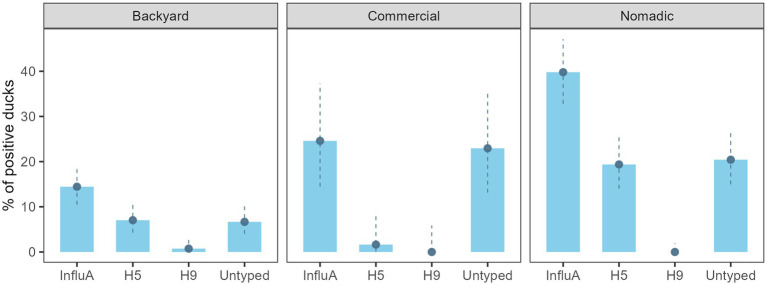
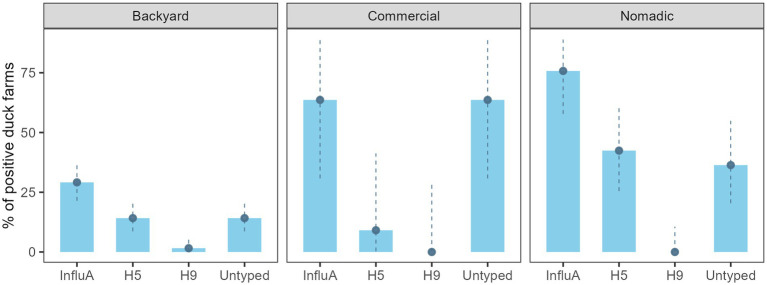
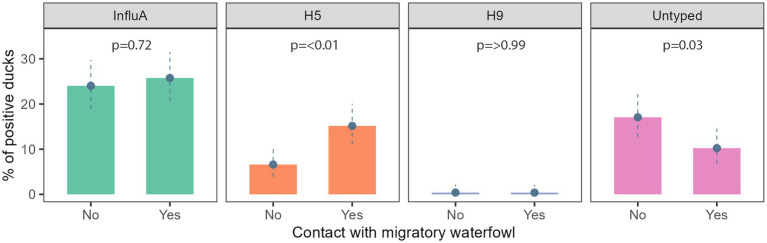
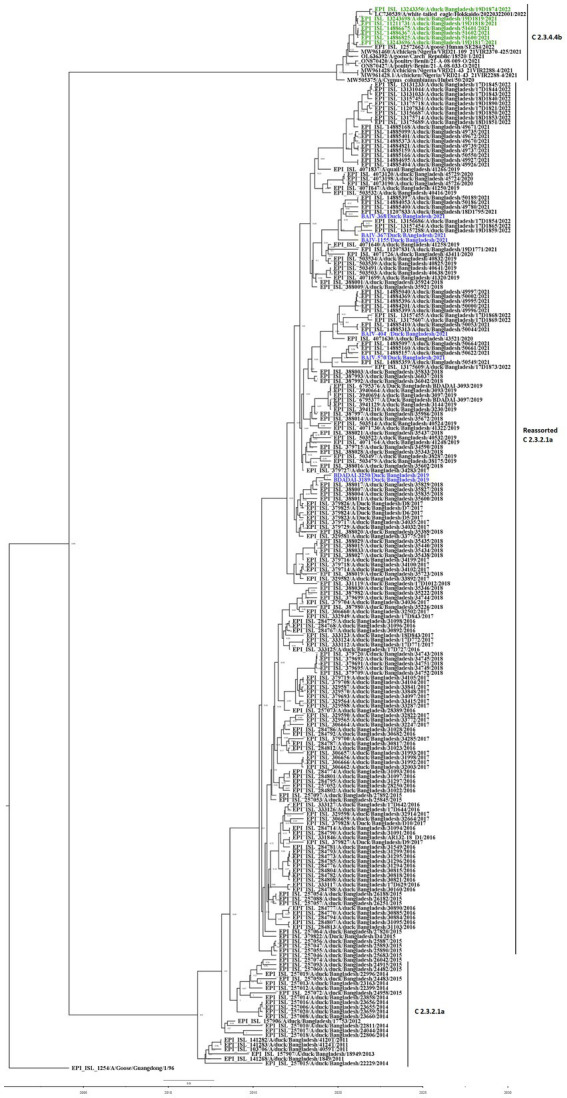
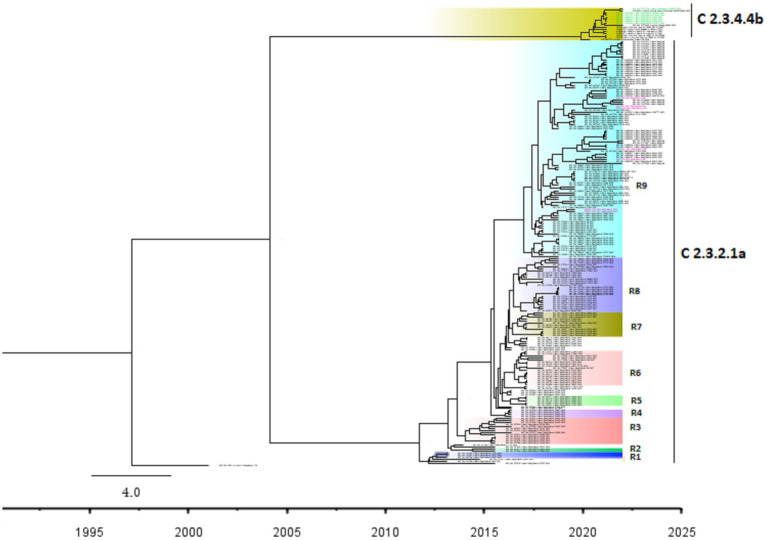
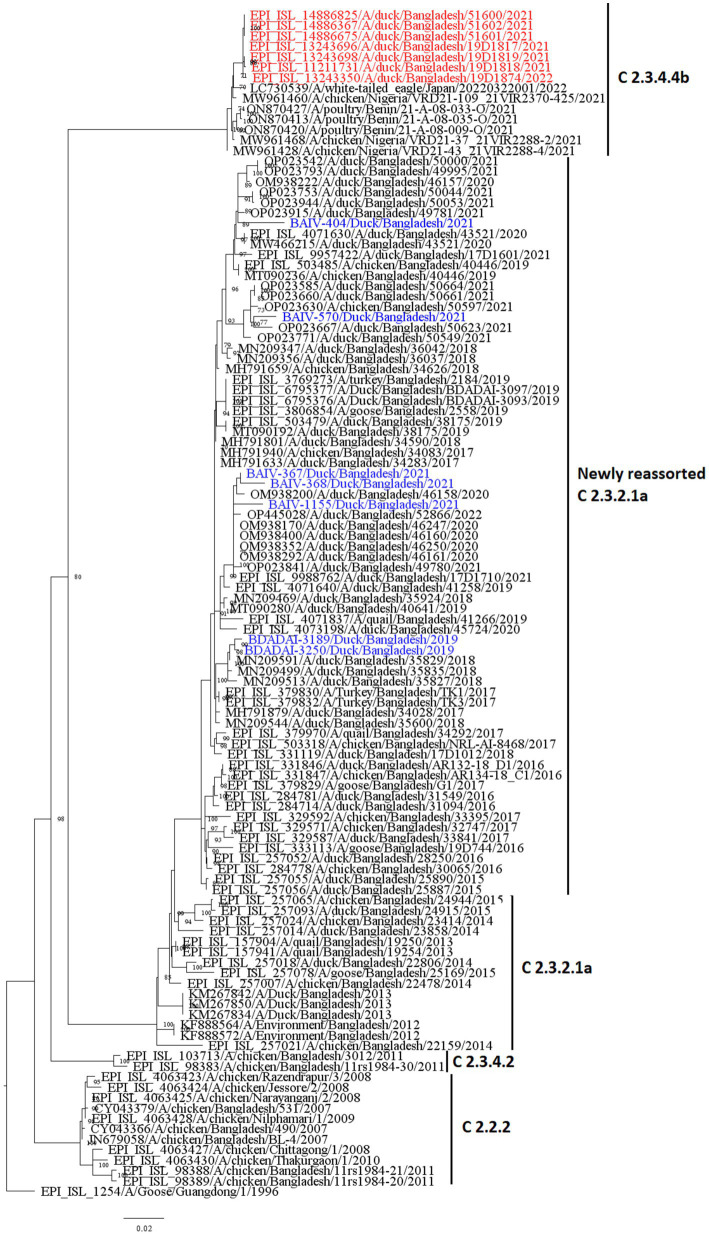
Waterfowl are considered to be natural reservoirs of the avian influenza virus (AIV). However, the dynamics of transmission and evolutionary patterns of AIV and its subtypes within duck farms in Bangladesh remain poorly documented. Hence, a cross-sectional study was conducted in nine districts of Bangladesh between 2019 and 2021, to determine the prevalence of AIV and its subtypes H5 and H9, as well as to identify risk factors and the phylodynamics of H5N1 clades circulating in domestic duck farms. The oropharyngeal and cloacal swab samples were tested for the AIV Matrix gene (M-gene) followed by H5, H7, and H9 subtypes using rRT-PCR. The exploratory analysis was performed to estimate AIV and its subtype prevalence in different production systems, and multivariable logistic regression model was used to identify the risk factors that influence AIV infection in ducks. Bayesian phylogenetic analysis was conducted to generate a maximum clade credibility (MCC) tree and the maximum likelihood method to determine the phylogenetic relationships of the H5N1 viruses isolated from ducks. AIV was detected in 40% (95% CI: 33.0-48.1) of the duck farms. The prevalence of AIV was highest in nomadic ducks (39.8%; 95% CI: 32.9-47.1), followed by commercial ducks (24.6%; 95% CI: 14.5-37.3) and backyard ducks (14.4%; 95% CI: 10.5-19.2). The H5 prevalence was also highest in nomadic ducks (19.4%; 95% CI: 14.0-25.7). The multivariable logistic regression model revealed that ducks from nomadic farms (AOR: 2.4; 95% CI: 1.45-3.93), juvenile (AOR: 2.2; 95% CI: 1.37-3.61), and sick ducks (AOR: 11.59; 95% CI: 4.82-32.44) had a higher risk of AIV. Similarly, the likelihood of H5 detection was higher in sick ducks (AOR: 40.8; 95% CI: 16.3-115.3). Bayesian phylogenetic analysis revealed that H5N1 viruses in ducks belong to two distinct clades, 2.3.2.1a, and 2.3.4.4b. The clade 2.3.2.1a (reassorted) has been evolving silently since 2015 and forming at least nine subgroups based on >90% posterior probability. Notably, clade 2.3.4.4b was introduced in ducks in Bangladesh by the end of the year 2020, which was genetically similar to viruses detected in wild birds in Japan, China, and Africa, indicating migration-associated transmission of an emerging panzootic clade. We recommend continuing AIV surveillance in the duck production system and preventing the intermingling of domestic ducks with migratory waterfowl in wetlands.
水禽被认为是禽流感病毒 (AIV) 的天然宿主。然而,孟加拉国鸭场中 AIV 及其亚型的传播动态和进化模式仍记录不佳。因此,本研究于 2019 年至 2021 年在孟加拉国的 9 个地区进行了一项横断面研究,以确定 AIV 及其亚型 H5 和 H9 的流行情况,并确定在国内鸭场中循环的 H5N1 分支的风险因素和系统发育。使用实时 RT-PCR 检测口咽和泄殖腔拭子的 AIV 基质基因 (M 基因),然后检测 H5、H7 和 H9 亚型。进行探索性分析以估计不同生产系统中 AIV 和其亚型的流行情况,并使用多变量逻辑回归模型确定影响鸭 AIV 感染的风险因素。进行贝叶斯系统发育分析以生成最大分支可信度 (MCC) 树,并使用最大似然法确定从鸭中分离的 H5N1 病毒的系统发育关系。在 40% (95%CI:33.0-48.1) 的鸭场中检测到 AIV。游牧鸭的 AIV 流行率最高 (39.8%;95%CI:32.9-47.1),其次是商业鸭 (24.6%;95%CI:14.5-37.3) 和后院鸭 (14.4%;95%CI:10.5-19.2)。游牧鸭的 H5 流行率也最高 (19.4%;95%CI:14.0-25.7)。多变量逻辑回归模型显示,来自游牧农场的鸭 (AOR:2.4;95%CI:1.45-3.93)、幼鸭 (AOR:2.2;95%CI:1.37-3.61) 和病鸭 (AOR:11.59;95%CI:4.82-32.44) 的 AIV 风险更高。同样,病鸭中 H5 的检测可能性更高 (AOR:40.8;95%CI:16.3-115.3)。贝叶斯系统发育分析显示,鸭中的 H5N1 病毒属于两个不同的分支,2.3.2.1a 和 2.3.4.4b。分支 2.3.2.1a(重配)自 2015 年以来一直在悄然进化,并根据 >90%的后验概率形成至少 9 个亚群。值得注意的是,分支 2.3.4.4b 于 2020 年底在孟加拉国的鸭中引入,其遗传与在日本、中国和非洲的野生鸟类中检测到的病毒相似,表明新兴泛生群的传播与迁徙有关。我们建议继续在鸭生产系统中进行 AIV 监测,并防止国内鸭与湿地中迁徙的水禽混合。