Kaur Talwinder, Rani Riveka, Manhas Rajesh Kumari
Department of Microbiology, Guru Nanak Dev University, Amritsar, Punjab, 143005, India.
AMB Express. 2019 Aug 9;9(1):125. doi: 10.1186/s13568-019-0849-7.
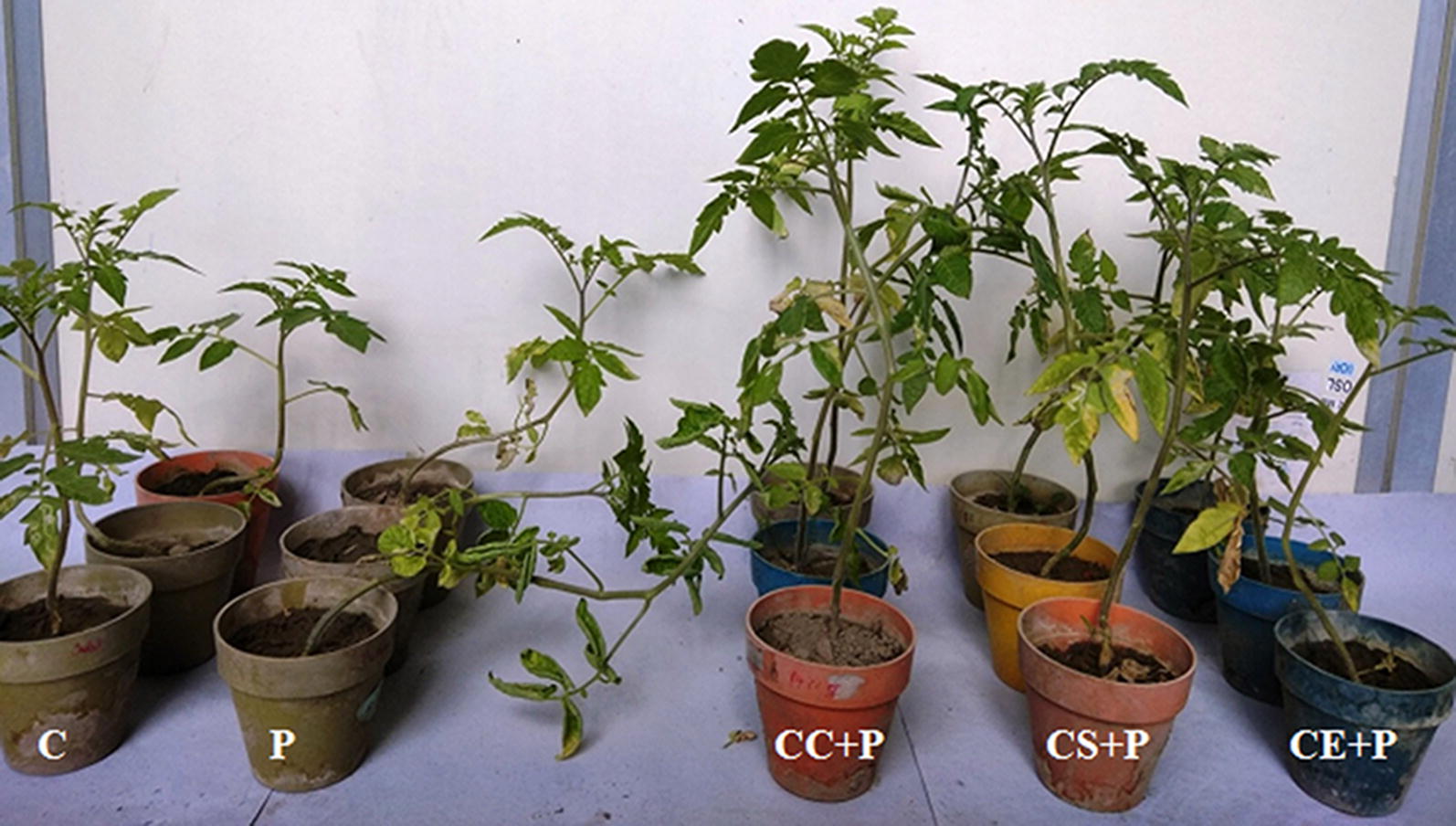
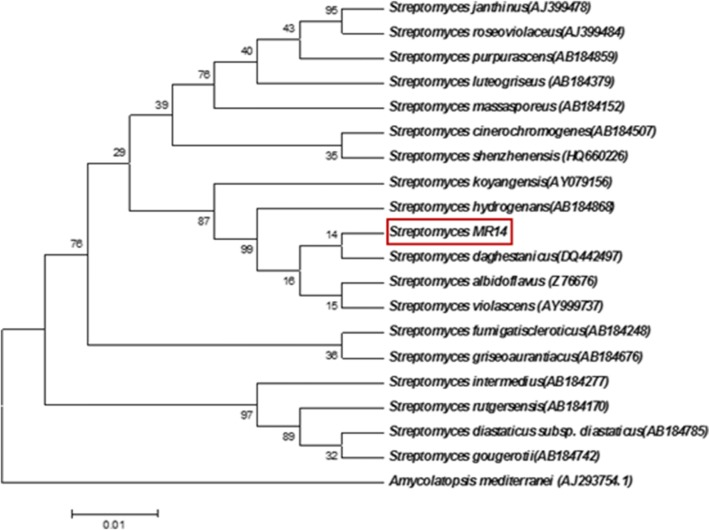
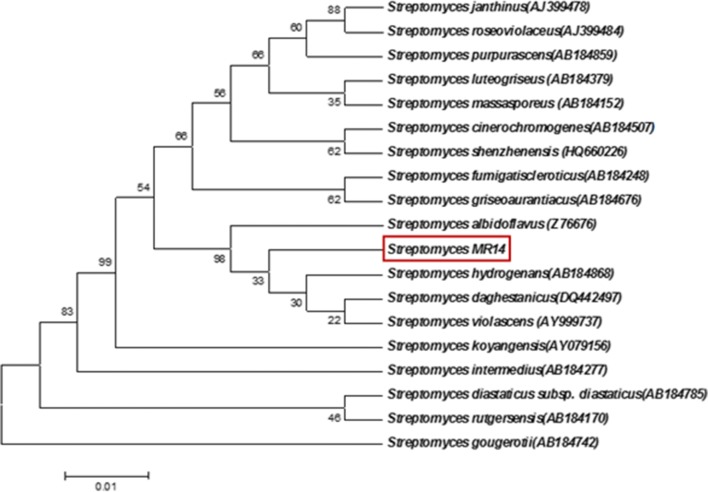
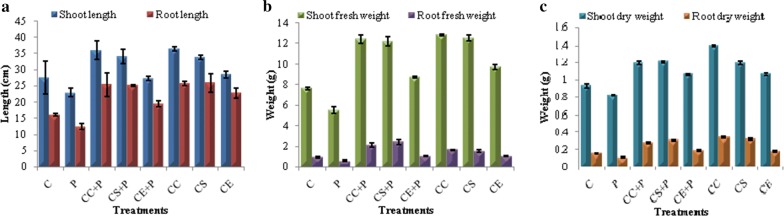
The detrimental effects of synthetic fungicides have increased the emphasis for biological control as an effective and safe sustainable alternative method. In the present work, a potent rhizospheric actinobacterium MR14 showed broad spectrum antifungal and plant growth promoting activities indicating the potential to fulfill the need. Phylogenetic analysis confirmed that the isolate could be assigned as new species of the Streptomyces, coded as Streptomyces sp. MR14. It formed clade with Streptomyces daghestanicus but with very low bootstrap value (14%). The MR14 supernatant showed potent antagonistic activity against 13 different tested fungal phytopathogens. The most and least sensitive fungal phytopathogens were found to be Pyricularia oryzae and Fusarium oxysporum with inhibition zones of 31 mm and 11 mm, respectively. The antifungal metabolites produced by strain MR14 were thermostable, photostable, and remained active at extreme acidic and neutral pH. In pot experiments, the Streptomyces sp. MR14 cells, supernatant and extract significantly suppressed Fusarium wilt caused by Fusarium moniliforme in tomato plants. Various growth parameters such as shoot and root lengths, and plant fresh and dry weights were significantly enhanced by 19.65 to 321.62% over the pathogen infested plants only. The treatment with culture cells/supernatant/extract in the rhizosphere soil also reduced the microbial count as compared to control. In addition, the strain also possessed plant growth promoting potential which was indicated by the increase in various agronomic traits from 3.64 to 116.88%. This study provided a scientific validation that the new rhizobacterium Streptomyces sp. MR14 could be further developed as bioformulation, exhibiting biocontrol and plant growth promoting capabilities.
合成杀菌剂的有害影响使得人们更加重视生物防治,将其作为一种有效且安全的可持续替代方法。在本研究中,一种强大的根际放线菌MR14表现出广谱抗真菌和促进植物生长的活性,显示出满足这一需求的潜力。系统发育分析证实,该分离株可被归类为链霉菌属的一个新物种,编码为链霉菌属MR14。它与达吉斯坦链霉菌形成一个分支,但自展值非常低(14%)。MR14的上清液对13种不同的受试真菌植物病原菌表现出强大的拮抗活性。最敏感和最不敏感的真菌植物病原菌分别是稻瘟病菌和尖孢镰刀菌,抑菌圈分别为31毫米和11毫米。菌株MR14产生的抗真菌代谢产物具有热稳定性、光稳定性,并且在极端酸性和中性pH条件下仍保持活性。在盆栽试验中,链霉菌属MR14的细胞、上清液和提取物显著抑制了番茄植株中由串珠镰刀菌引起的枯萎病。与仅受病原菌侵染的植株相比,各种生长参数,如地上部和根部长度以及植株鲜重和干重,显著提高了19.65%至321.62%。与对照相比,在根际土壤中用培养细胞/上清液/提取物处理也减少了微生物数量。此外,该菌株还具有促进植物生长的潜力,各种农艺性状增加了3.64%至116.88%。这项研究提供了科学验证,新的根际细菌链霉菌属MR14可进一步开发为生物制剂,具有生物防治和促进植物生长的能力。