Lazarus Jenny, Akiska Yagiz, Perusina Lanfranca Mirna, Delrosario Lawrence, Sun Lei, Long Daniel, Shi Jiaqi, Crawford Howard, Di Magliano Marina P, Zou Weiping, Frankel Timothy
Department of Surgery, University of Michigan.
Department of Molecular and Cellular Physiology, University of Michigan.
J Vis Exp. 2019 Jul 26(149). doi: 10.3791/59915.
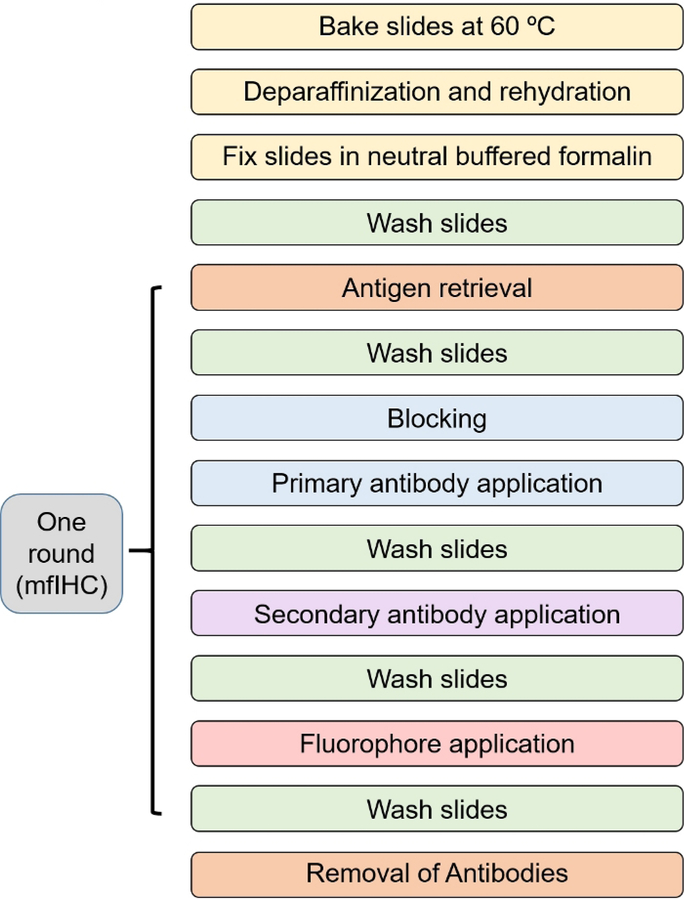
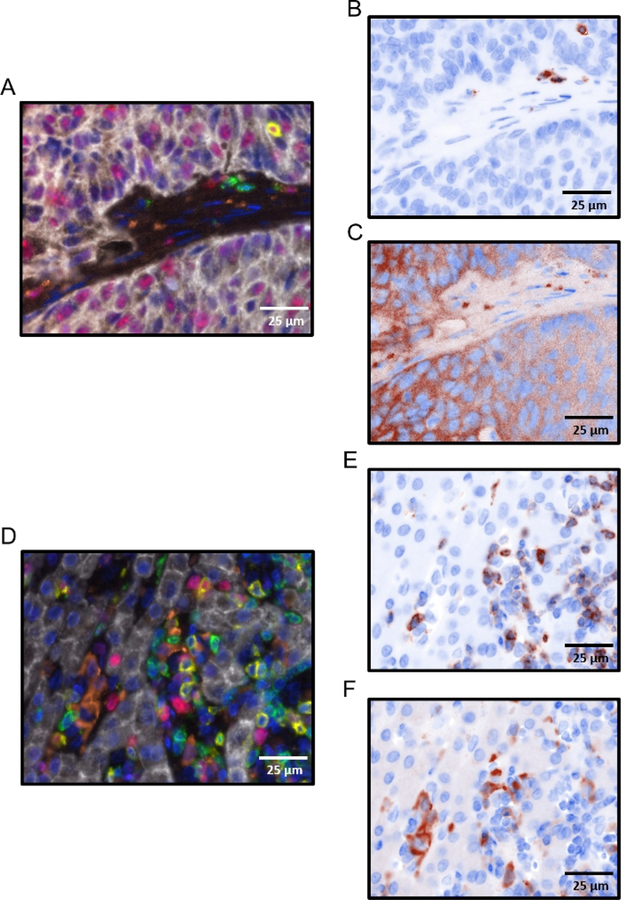
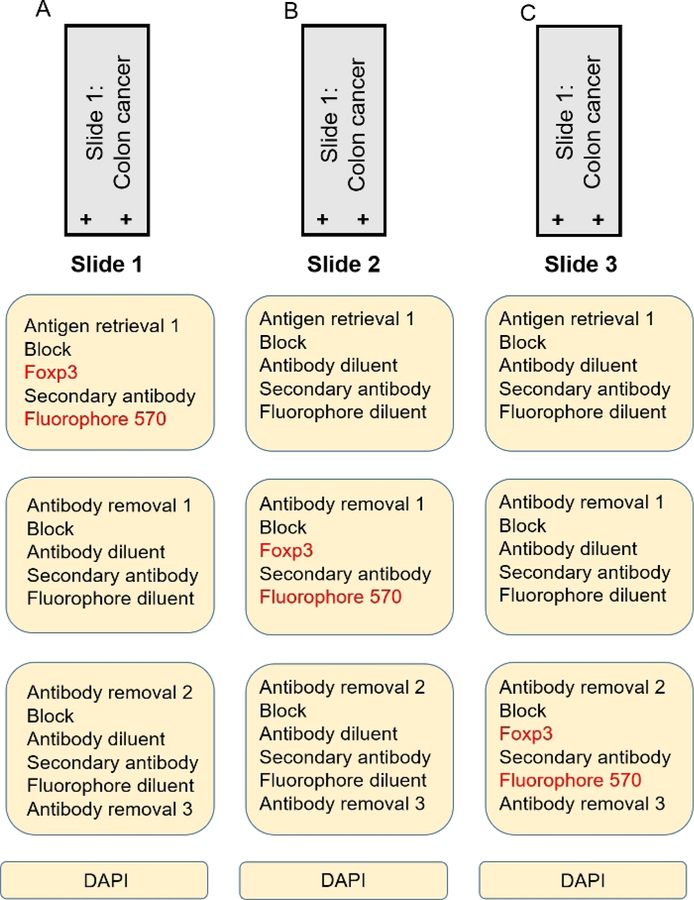
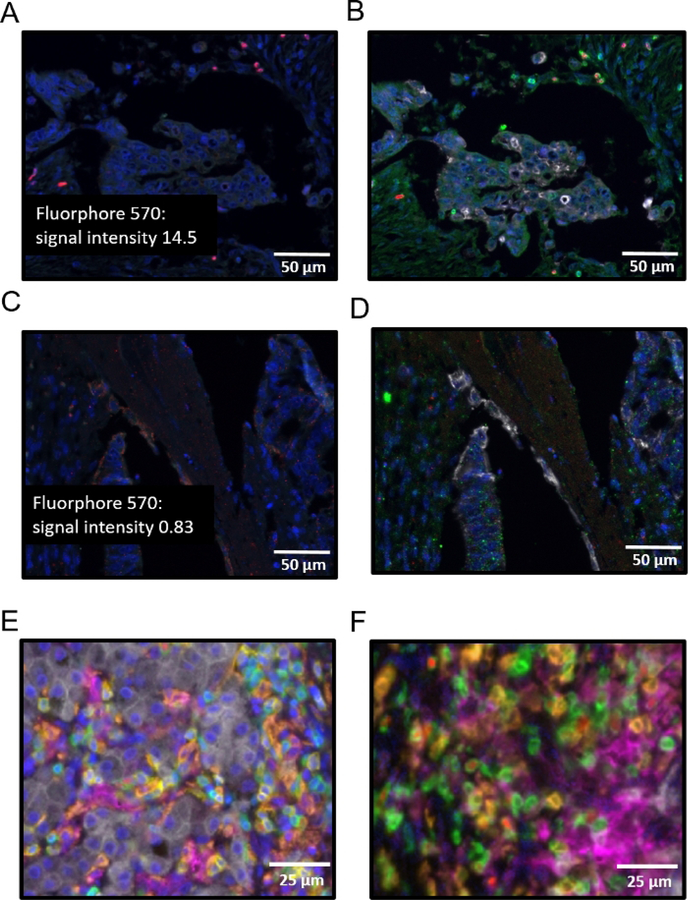
Microenvironment evaluation of intact tissue for analysis of cell infiltration and spatial organization are essential in understanding the complexity of disease processes. The principle techniques used in the past include immunohistochemistry (IHC) and immunofluorescence (IF) which enable visualization of cells as a snapshot in time using between 1 and 4 markers. Both techniques have shortcomings including difficulty staining poorly antigenic targets and limitations related to cross-species reactivity. IHC is reliable and reproducible, but the nature of the chemistry and reliance on the visible light spectrum allows for only a few markers to be used and makes co-localization challenging. Use of IF broadens potential markers but typically relies on frozen tissue due to the extensive tissue autofluorescence following formalin fixation. Flow cytometry, a technique that enables simultaneous labeling of multiple epitopes, abrogates many of the deficiencies of IF and IHC, however, the need to examine cells as a single cell suspension loses the spatial context of cells discarding important biologic relationships. Multiplex fluorescent immunohistochemistry (mfIHC) bridges these technologies allowing for multi-epitope cellular phenotyping in formalin fixed paraffin embedded (FFPE) tissue while preserving the overall microenvironment architecture and spatial relationship of cells within intact undisrupted tissue. High fluorescent intensity fluorophores that covalently bond to the tissue epitope enables multiple applications of primary antibodies without worry of species specific cross-reactivity by secondary antibodies. Although this technology has been proven to produce reliable and accurate images for the study of disease, the process of creating a useful mfIHC staining strategy can be time consuming and exacting due to extensive optimization and design. In order to make robust images that represent accurate cellular interactions in-situ and to mitigate the optimization period for manual analysis, presented here are methods for slide preparation, optimizing antibodies, multiplex design as well as errors commonly encountered during the staining process.
对完整组织进行微环境评估以分析细胞浸润和空间组织,对于理解疾病过程的复杂性至关重要。过去使用的主要技术包括免疫组织化学(IHC)和免疫荧光(IF),这两种技术能够使用1至4种标记物将细胞可视化为某个时间点的快照。这两种技术都有缺点,包括难以对低抗原性靶点进行染色以及与种间反应性相关的局限性。IHC可靠且可重复,但化学性质和对可见光谱的依赖使得只能使用少数标记物,并且使得共定位具有挑战性。IF的使用拓宽了潜在标记物的范围,但由于福尔马林固定后组织存在广泛的自发荧光,通常依赖于冷冻组织。流式细胞术是一种能够同时标记多个表位的技术,消除了IF和IHC的许多缺陷,然而,将细胞作为单细胞悬液进行检测的需要失去了细胞的空间背景,丢弃了重要的生物学关系。多重荧光免疫组织化学(mfIHC)弥补了这些技术的不足,允许在福尔马林固定石蜡包埋(FFPE)组织中进行多表位细胞表型分析,同时保留完整未破坏组织内细胞的整体微环境结构和空间关系。与组织表位共价结合的高荧光强度荧光团使得能够多次应用一抗,而无需担心二抗的种属特异性交叉反应。尽管该技术已被证明可为疾病研究产生可靠且准确的图像,但由于需要进行广泛的优化和设计,创建有用的mfIHC染色策略的过程可能既耗时又严格。为了制作能够代表原位准确细胞相互作用的稳健图像,并缩短手动分析的优化周期,本文介绍了载玻片制备、抗体优化、多重设计以及染色过程中常见错误的方法。