Jiang Wen, Guo Qing, Wang Chenghe, Zhu Yu
1Department of Urology, Ruijin Hospital, School of Medicine, Shanghai Jiao Tong University, Shanghai, 200025 China.
2Department of Pediatrics, Union Hospital, Tongji Medical College, Huazhong University of Science and Technology, 1277 Jiefang Avenue, Wuhan, 430022 China.
Cancer Cell Int. 2019 Aug 5;19:208. doi: 10.1186/s12935-019-0928-5. eCollection 2019.
Abnormal expressions of long noncoding RNAs (lncRNAs) are very common in clear cell renal cell carcinoma (ccRCC), and some of these have been reported to be highly correlated with prognosis of ccRCC patients.
"edgeR" AND "DEseq" R packages were used to explore differentially expressed genes (DEGs) between normal and tumor tissues of ccRCC samples from The Cancer Genome Atlas (TCGA). Univariable Cox survival analysis, robust likelihood-based survival model and multivariable Cox regression analysis were used to identify prognostic lncRNAs and construct lncRNAs signature. Finally, a graphic nomogram based on the lncRNAs signature was developed to predict 1-, 3- and 5-year survival probability of ccRCC patients by using rms R package.
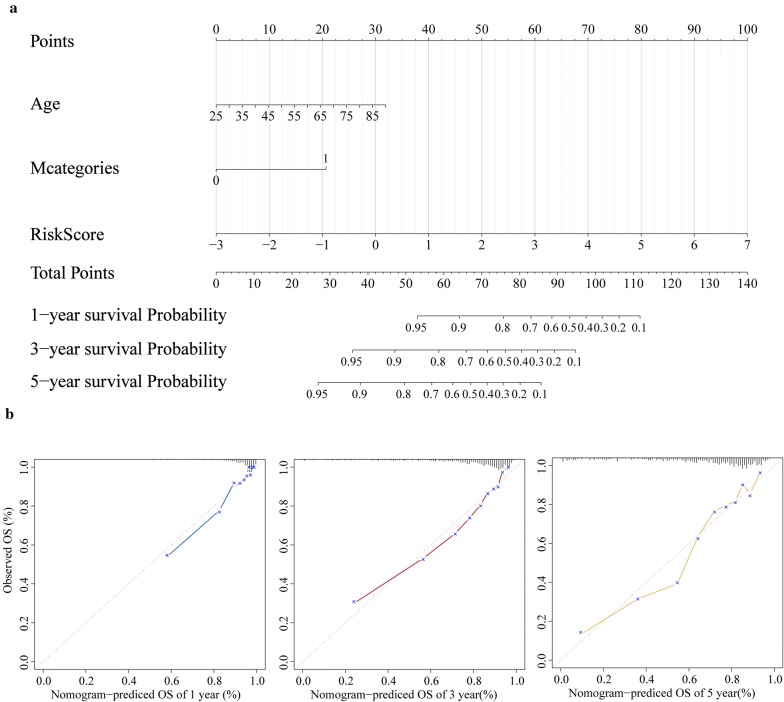
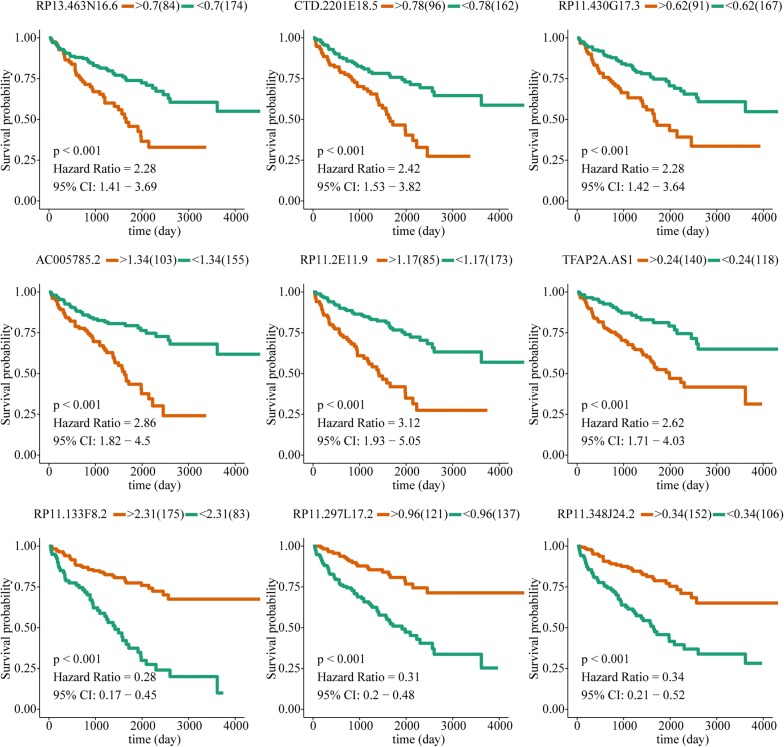
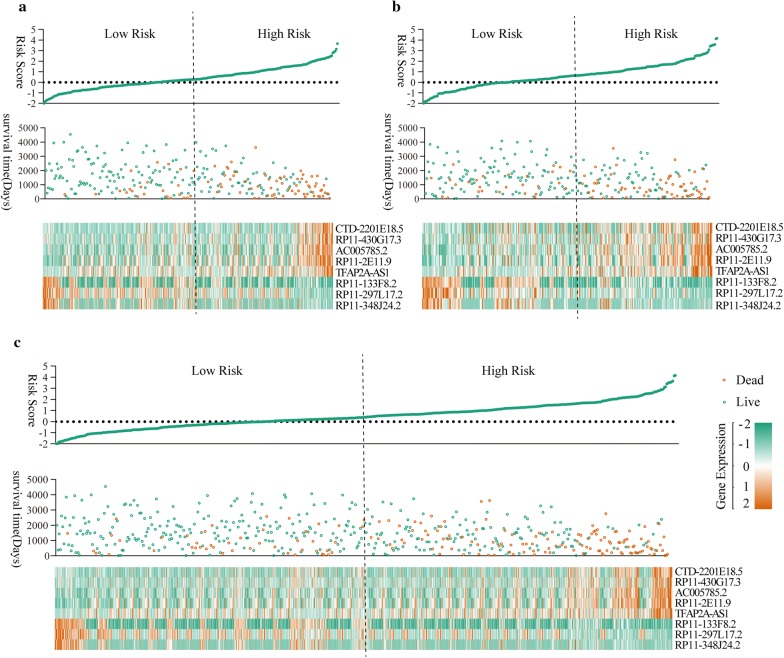
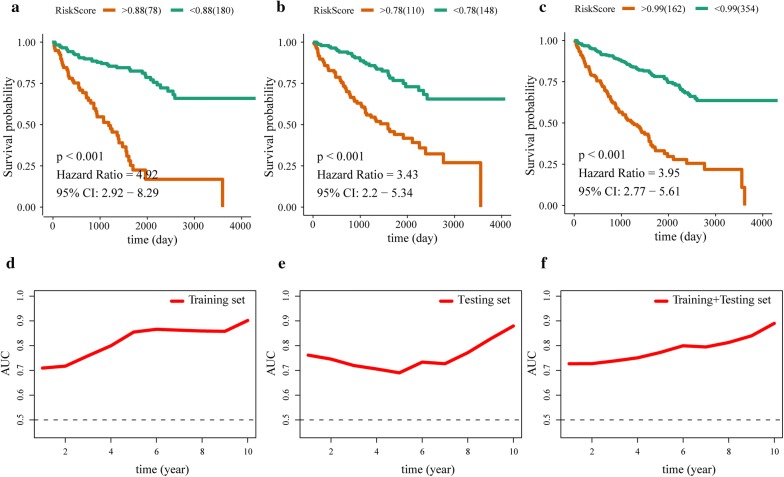
8413 DEGs including 2740 lncRNAs and 4530 mRNAs were identified between normal and tumor tissues. 395 lncRNAs were found to be associated with prognosis of ccRCC patients (P < 0.05). Among these 395 prognostic lncRNAs, 9 key prognostic lncRNAs (RP13-463N16.6, CTD-2201E18.5, RP11-430G17.3, AC005785.2, RP11-2E11.9, TFAP2A-AS1, RP11-133F8.2, RP11-297L17.2 and RP11-348J24.2) were identified by using robust likelihood-based survival model. A 9-lncRNAs signature was constructed by using estimated regression coefficients of the 9 key prognostic lncRNAs. Results of χ-test or Fisher's exact test indicated that the 9-lncRNAs signature was significantly associated with clinicopathological characteristics such as tumor grade, T stage, N stage, M stage, TNM stage and survival outcome of ccRCC patients. Multivariate analysis showed that the 9-lncRNAs signature, age and M stage were independent prognostic factors. Finally, a graphic nomogram based on the lncRNAs signature, age and M stage was developed to predict 1-, 3- and 5-year survival probability of ccRCC patients by using rms R package.
A 9-lncRNAs signature associated with prognosis of ccRCC patients was constructed and a promising prognostic nomogram based on the 9-lncRNAs signature was developed for 1-, 3- and 5-year OS prediction of ccRCC patients in this study.
长链非编码RNA(lncRNA)的异常表达在肾透明细胞癌(ccRCC)中非常普遍,其中一些已被报道与ccRCC患者的预后高度相关。
使用“edgeR”和“DEseq”R包来探索来自癌症基因组图谱(TCGA)的ccRCC样本的正常组织和肿瘤组织之间的差异表达基因(DEG)。使用单变量Cox生存分析、基于稳健似然的生存模型和多变量Cox回归分析来鉴定预后lncRNA并构建lncRNA特征。最后,使用rms R包开发了基于lncRNA特征的图形列线图,以预测ccRCC患者1年、3年和5年的生存概率。
在正常组织和肿瘤组织之间鉴定出8413个DEG,包括2740个lncRNA和4530个mRNA。发现395个lncRNA与ccRCC患者的预后相关(P < 0.05)。在这395个预后lncRNA中,使用基于稳健似然的生存模型鉴定出9个关键预后lncRNA(RP13 - 463N16.6、CTD - 2201E18.5、RP11 - 430G17.3、AC005785.2、RP11 - 2E11.9、TFAP2A - AS1、RP11 - 133F8.2、RP11 - 297L17.2和RP11 - 348J24.2)。使用这9个关键预后lncRNA的估计回归系数构建了一个9 - lncRNA特征。χ检验或Fisher精确检验的结果表明,9 - lncRNA特征与ccRCC患者的临床病理特征如肿瘤分级、T分期、N分期、M分期、TNM分期和生存结果显著相关。多变量分析表明,9 - lncRNA特征、年龄和M分期是独立的预后因素。最后,使用rms R包开发了基于lncRNA特征、年龄和M分期的图形列线图,以预测ccRCC患者1年、3年和5年的生存概率。
本研究构建了一个与ccRCC患者预后相关的9 - lncRNA特征,并开发了一个基于9 - lncRNA特征的有前景的预后列线图,用于预测ccRCC患者1年、3年和5年的总生存期。