Salgado-Albarrán Marisol, González-Barrios Rodrigo, Guerra-Calderas Lissania, Alcaraz Nicolás, Estefanía Sánchez-Correa Thalía, Castro-Hernández Clementina, Sánchez-Pérez Yesennia, Aréchaga-Ocampo Elena, García-Carrancá Alejandro, Cantú de León David, Herrera Luis A, Baumbach Jan, Soto-Reyes Ernesto
Natural Sciences Department, Universidad Autónoma Metropolitana-Cuajimalpa (UAM-C), Mexico City, 05300, Mexico.
Chair of Experimental Bioinformatics, TUM School of Life Sciences Weihenstephan, Technical University of Munich, Munich, Germany.
Oncogenesis. 2019 Aug 12;8(8):41. doi: 10.1038/s41389-019-0150-2.
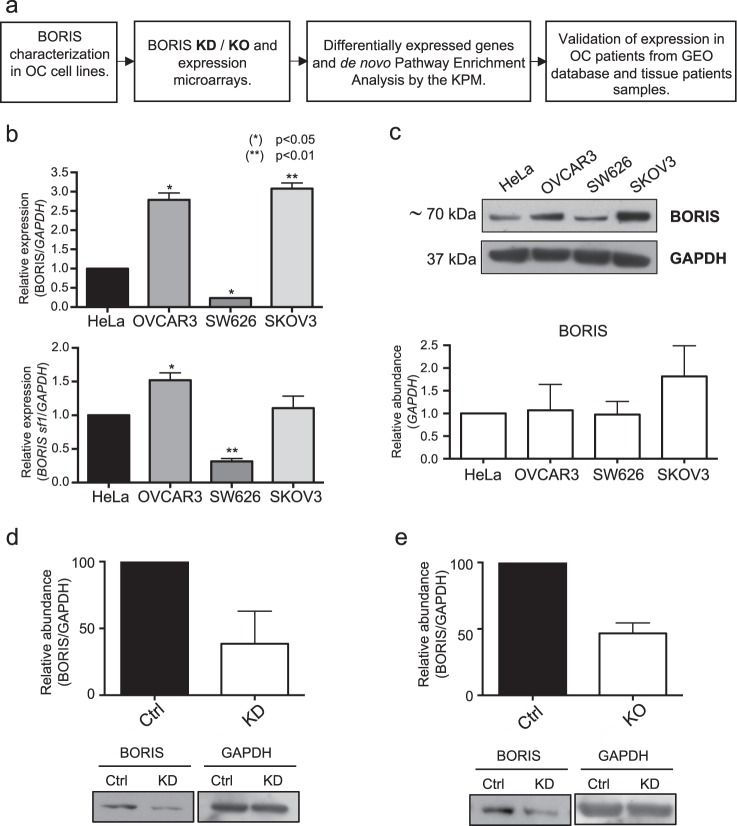
The identification of prognostic biomarkers is a priority for patients suffering from high-grade serous ovarian cancer (SOC), which accounts for >70% of ovarian cancer (OC) deaths. Meanwhile, borderline ovarian cancer (BOC) is a low malignancy tumor and usually patients undergo surgery with low probabilities of recurrence. However, SOC remains the most lethal neoplasm due to the lack of biomarkers for early diagnosis and prognosis. In this regard, BORIS (CTCFL), a CTCF paralog, is a promising cancer biomarker that is overexpressed and controls transcription in several cancer types, mainly in OC. Studies suggest that BORIS has an important function in OC by altering gene expression, but the effect and extent to which BORIS influences transcription in OC from a genome-wide perspective is unclear. Here, we sought to identify BORIS target genes in an OC cell line (OVCAR3) with potential biomarker use in OC tumor samples. To achieve this, we performed in vitro knockout and knockdown experiments of BORIS in OVCAR3 cell line followed by expression microarrays and bioinformatics network enrichment analysis to identify relevant BORIS target genes. In addition, ex vivo expression data analysis of 373 ovarian cancer patients were evaluated to identify the expression patterns of BORIS target genes. In vitro, we uncovered 130 differentially expressed genes and obtained the BORIS-associated regulatory network, in which the androgen receptor (AR) acts as a major transcription factor. Also, FN1, FAM129A, and CD97 genes, which are related to chemoresistance and metastases in OC, were identified. In SOC patients, we observed that malignancy is associated with high levels of BORIS expression while BOC patients show lower levels. Our study suggests that BORIS acts as a main regulator, and has the potential to be used as a prognostic biomarker and to yield novel drug targets among the genes BORIS controls in SOC patients.
对于浆液性卵巢癌(SOC)患者而言,识别预后生物标志物是首要任务,浆液性卵巢癌导致的卵巢癌(OC)死亡占比超过70%。同时,卵巢交界性肿瘤(BOC)是一种低恶性肿瘤,患者通常接受手术治疗,复发概率较低。然而,由于缺乏早期诊断和预后的生物标志物,SOC仍然是最致命的肿瘤。在这方面,BORIS(CTCFL)作为CTCF的旁系同源物,是一种很有前景的癌症生物标志物,在几种癌症类型中过度表达并控制转录,主要是在OC中。研究表明,BORIS通过改变基因表达在OC中发挥重要作用,但从全基因组角度来看,BORIS影响OC转录的作用和程度尚不清楚。在此,我们试图在一种OC细胞系(OVCAR3)中识别BORIS靶基因,这些基因在OC肿瘤样本中具有作为生物标志物的潜在用途。为实现这一目标,我们在OVCAR3细胞系中对BORIS进行了体外敲除和敲低实验,随后进行表达微阵列和生物信息学网络富集分析,以识别相关的BORIS靶基因。此外,对373例卵巢癌患者的离体表达数据分析进行评估,以确定BORIS靶基因的表达模式。在体外,我们发现了130个差异表达基因,并获得了与BORIS相关的调控网络,其中雄激素受体(AR)作为主要转录因子。此外,还鉴定出了与OC中的化疗耐药性和转移相关的FN1、FAM129A和CD97基因。在SOC患者中,我们观察到恶性程度与BORIS的高表达水平相关,而BOC患者的表达水平较低。我们的研究表明,BORIS作为主要调节因子,在SOC患者中BORIS控制的基因中具有作为预后生物标志物以及产生新的药物靶点的潜力。