School of Geography, Geology and the Environment, University of Leicester, Leicester, LE1 7RH, United Kingdom.
School of Museum Studies, University of Leicester, Leicester, LE1 7RF, United Kingdom.
Sci Rep. 2019 Aug 12;9(1):11691. doi: 10.1038/s41598-019-48154-9.
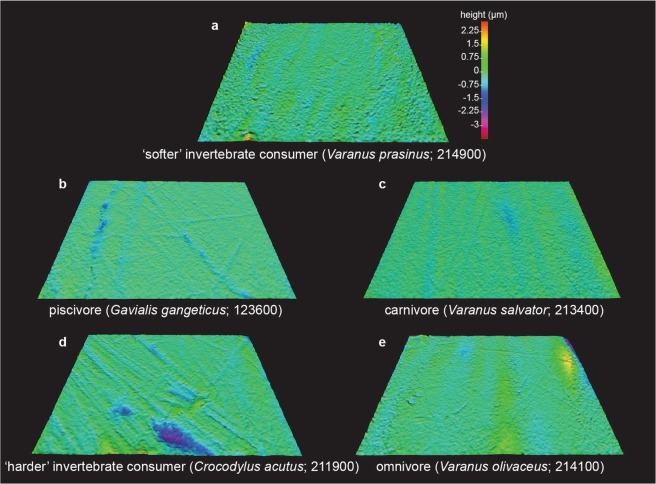
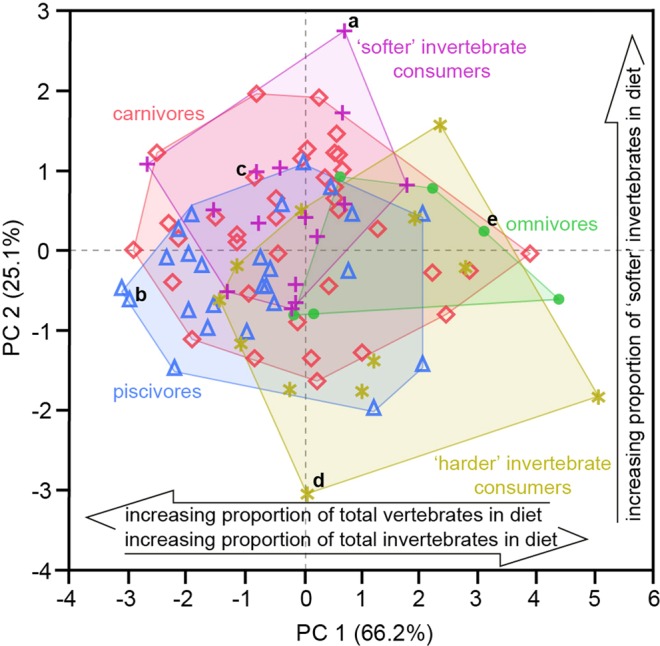
Reptiles are key components of modern ecosystems, yet for many species detailed characterisations of their diets are lacking. Data currently used in dietary reconstructions are limited either to the last few meals or to proxy records of average diet over temporal scales of months to years, providing only coarse indications of trophic level(s). Proxies that record information over weeks to months would allow more accurate reconstructions of reptile diets and better predictions of how ecosystems might respond to global change drivers. Here, we apply dental microwear textural analysis (DMTA) to dietary guilds encompassing both archosaurian and lepidosaurian reptiles, demonstrating its value as a tool for characterising diets over temporal scales of weeks to months. DMTA, involving analysis of the three-dimensional, sub-micrometre scale textures created on tooth surfaces by interactions with food, reveals that the teeth of reptiles with diets dominated by invertebrates, particularly invertebrates with hard exoskeletons (e.g. beetles and snails), exhibit rougher microwear textures than reptiles with vertebrate-dominated diets. Teeth of fish-feeding reptiles exhibit the smoothest textures of all guilds. These results demonstrate the efficacy of DMTA as a dietary proxy in taxa from across the phylogenetic range of extant reptiles. This method is applicable to extant taxa (living or museum specimens) and extinct reptiles, providing new insights into past, present and future ecosystems.
爬行动物是现代生态系统的关键组成部分,但对于许多物种来说,其饮食的详细特征描述仍然缺乏。目前用于饮食重建的数据要么仅限于最近的几餐,要么是代表数月至数年时间内的平均饮食的代理记录,只能粗略地指示营养水平。记录数周至数月内信息的代理记录将允许更准确地重建爬行动物的饮食,并更好地预测生态系统可能对全球变化驱动因素的反应。在这里,我们将牙齿微观磨损纹理分析(DMTA)应用于涵盖恐龙和蜥蜴的饮食类群,证明其作为一种在数周至数月的时间尺度上描述饮食的工具的价值。DMTA 涉及对由食物相互作用在牙齿表面产生的三维、亚微米尺度纹理的分析,表明饮食以无脊椎动物为主的爬行动物的牙齿,特别是具有硬外骨骼的无脊椎动物(例如甲虫和蜗牛),其微观磨损纹理比以脊椎动物为主的饮食的爬行动物更粗糙。以鱼类为食的爬行动物的牙齿具有所有类群中最光滑的纹理。这些结果证明了 DMTA 作为一种在现存爬行动物的整个系统发育范围内的分类群的饮食代理的有效性。该方法适用于现存的分类群(活体或博物馆标本)和已灭绝的爬行动物,为过去、现在和未来的生态系统提供了新的见解。