Luo Yi, Feng Yu, Song Lei, He Gan-Qing, Li Sha, Bai Sha-Sha, Huang Yu-Jie, Li Si-Ying, Almutairi Mohammed M, Shi Hong-Lian, Wang Qi, Hong Ming
1Institute of Clinical Pharmacology, Guangzhou University of Chinese Medicine, Guangzhou, 510405 China.
2Department of Traumatology, General Hospital of Ningxia Medical University, Yinchuan, 750004 China.
Chin Med. 2019 Aug 6;14:27. doi: 10.1186/s13020-019-0249-6. eCollection 2019.
Radix (RSM), a well-known traditional Chinese medicine, has been shown to inhibit tumorigenesis in various human cancers. However, the anticancer effects of RSM on human hepatocellular carcinoma (HCC) and the underlying mechanisms of action remain to be fully elucidated.
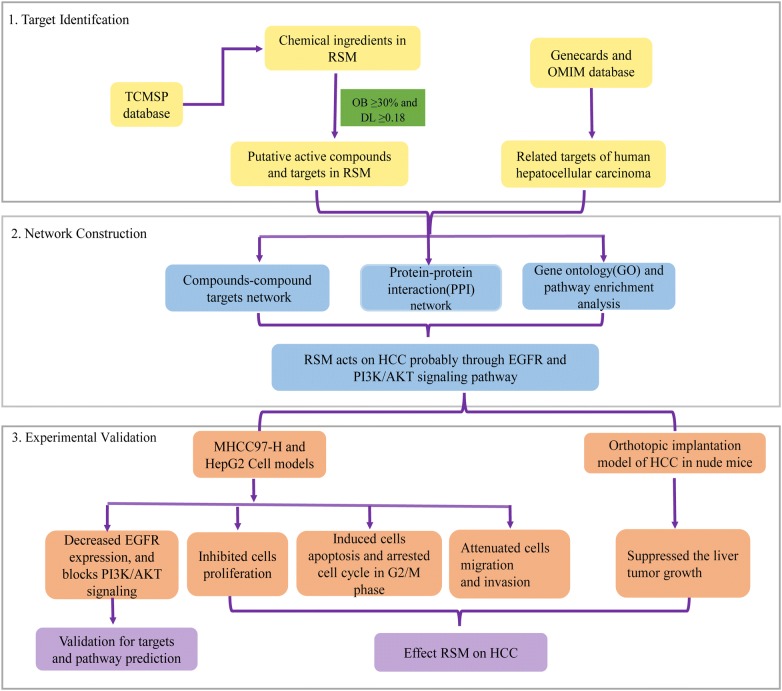
In this study, we aimed to elucidate the underlying molecular mechanisms of RSM in the treatment of HCC using a network pharmacology approach. In vivo and in vitro experiments were also performed to validate the therapeutic effects of RSM on HCC.
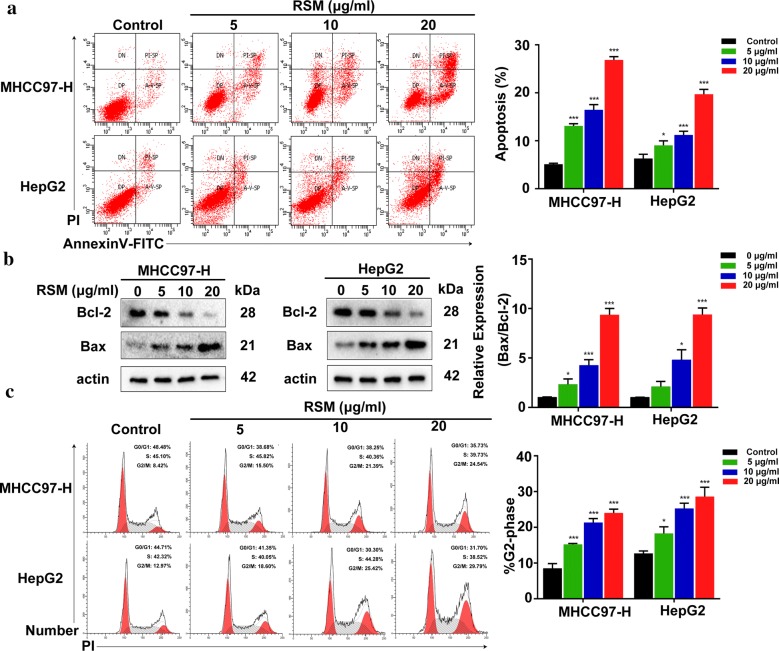
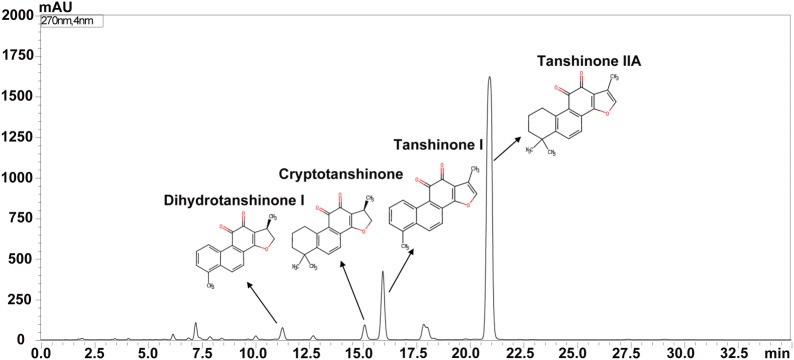
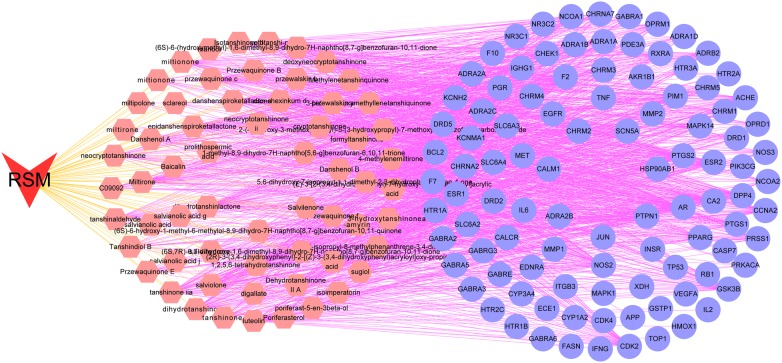
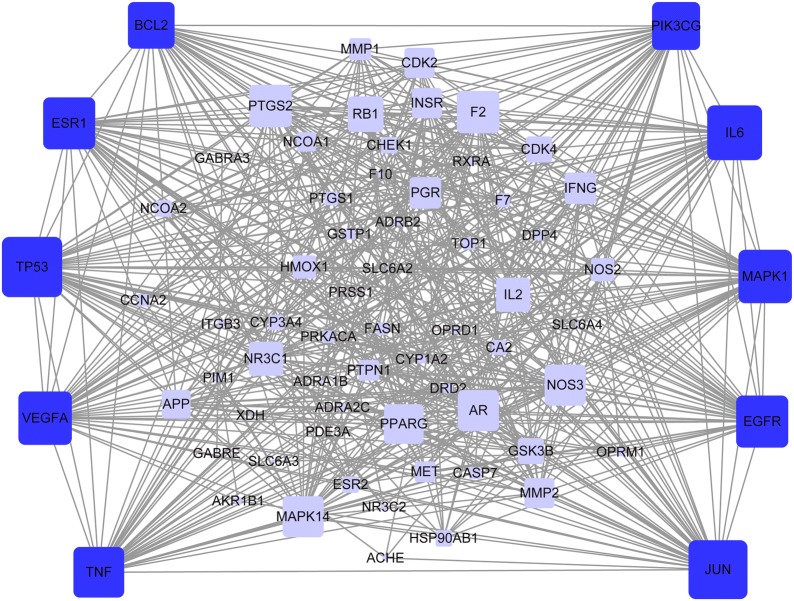
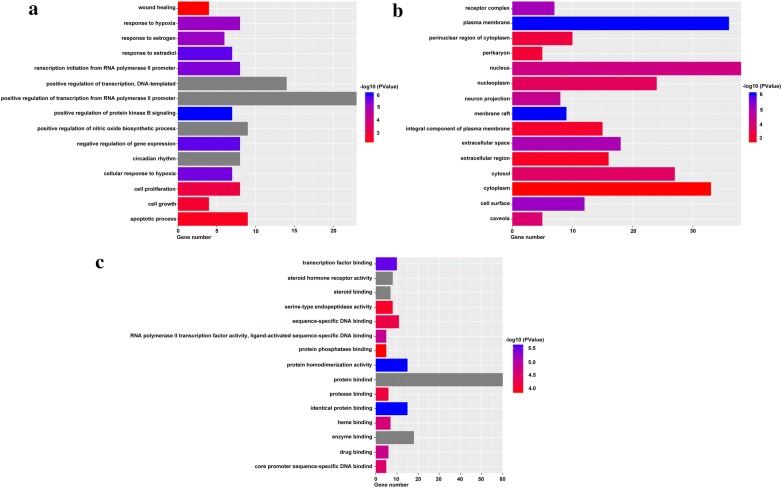
In total, 62 active compounds from RSM and 72 HCC-related targets were identified through network pharmacological analysis. RSM was found to play a critical role in HCC via multiple targets and pathways, especially the EGFR and PI3K/AKT signaling pathways. In addition, RSM was found to suppress HCC cell proliferation, and impair cancer cell migration and invasion in vitro. Flow cytometry analysis revealed that RSM induced cell cycle G2/M arrest and apoptosis, and western blot analysis showed that RSM up-regulated the expression of BAX and down-regulated the expression of Bcl-2 in MHCC97-H and HepG2 cells. Furthermore, RSM administration down-regulated the expression of EGFR, PI3K, and p-AKT proteins, whereas the total AKT level was not altered. Finally, the results of our in vivo experiments confirmed the therapeutic effects of RSM on HCC in nude mice.
We provide an integrative network pharmacology approach, in combination with in vitro and in vivo experiments, to illustrate the underlying therapeutic mechanisms of RSM action on HCC.
丹参(RSM)是一种著名的传统中药,已被证明可抑制多种人类癌症的肿瘤发生。然而,丹参对人类肝细胞癌(HCC)的抗癌作用及其潜在作用机制仍有待充分阐明。
在本研究中,我们旨在使用网络药理学方法阐明丹参治疗肝癌的潜在分子机制。还进行了体内和体外实验以验证丹参对肝癌的治疗效果。
通过网络药理学分析,共鉴定出62种来自丹参的活性化合物和72个与肝癌相关的靶点。发现丹参通过多个靶点和途径在肝癌中发挥关键作用,尤其是表皮生长因子受体(EGFR)和磷脂酰肌醇-3激酶/蛋白激酶B(PI3K/AKT)信号通路。此外,发现丹参可抑制肝癌细胞增殖,并在体外损害癌细胞的迁移和侵袭。流式细胞术分析显示,丹参诱导细胞周期G2/M期阻滞和凋亡,蛋白质印迹分析表明,丹参上调MHCC97-H和HepG2细胞中BAX的表达并下调Bcl-2的表达。此外,丹参给药下调了EGFR、PI3K和磷酸化AKT蛋白的表达,而总AKT水平未改变。最后,我们的体内实验结果证实了丹参对裸鼠肝癌的治疗效果。
我们提供了一种综合网络药理学方法,并结合体外和体内实验,以阐明丹参对肝癌作用的潜在治疗机制。