Leung Ming, Chan Kenny Kin Chung, Wong Wing Leung, Law Alexander Chun Bon
Princess Margaret Hospital, Hong Kong, China.
Tuen Mun Hospital, Hong Kong, China.
Int J Nurs Sci. 2018 Jan 12;5(1):50-56. doi: 10.1016/j.ijnss.2018.01.003. eCollection 2018 Jan 10.
The In-patient Medication Order Entry System (IPMOE) was first implemented in the medical ward of Princess Margaret Hospital, Hong Kong. It was a local developed close-loop system including prescription, dispensing and administration modules. Evaluation on its impact on nursing tasks would be important for practice improvement and subsequent system enhancement.
The study was conducted to quantify the nursing times across medication-associated tasks for paper-based MAR and computer-based IPMOE, including change in the tasks and time patterns before and after IPMOE implementation.
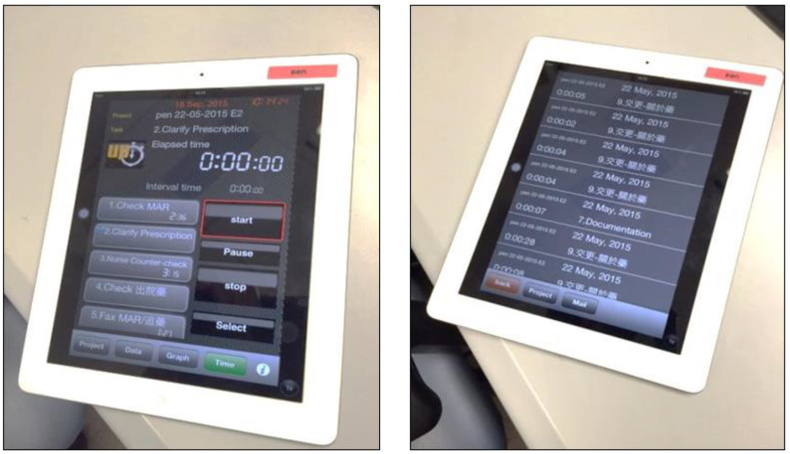
This was a prospective observation study in medical wards before (Jan 2014-Jun 2014) and after (Mar 2015-Jun 2015) the implementation of IPMOE. We conducted 8-hr observation studies of individual nurses with a customized application to time various pre-categorized nursing tasks. Statistical inferences and interrupted time series analysis was performed to identify the change in the intercept and trends over time after implementation.
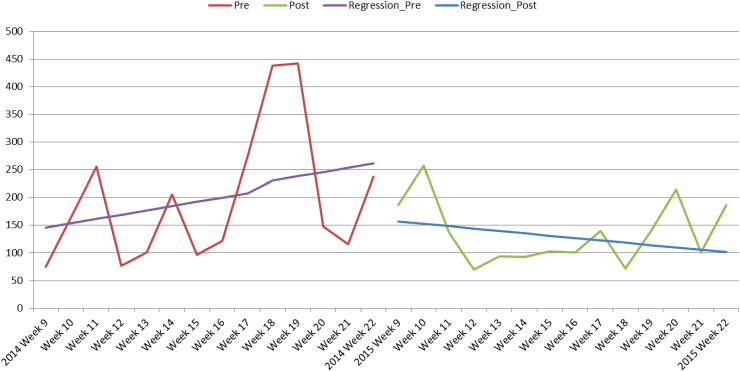
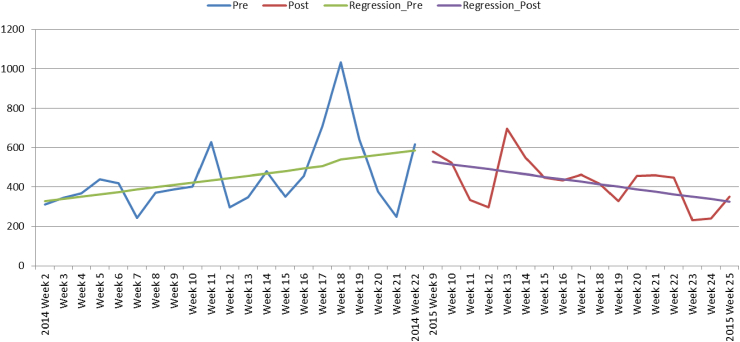
The average number of medication-related tasks was significantly reduced from 61.07 to 29.81, a reduction of 31.26 episodes per duty ( < 0.001, 95% CI 22.9-39.63). The time for the medication-related tasks was reduced from 32 min (SD = 21.57) to 26.57 min (SD = 11.35) and the medication administration time increased from 37.93 min (SD = 14.78) to 44.37 min (SD = 19.45), but there was no overall significant difference in the time spent on each duty ( = 0.315) between the two groups. An improving trend in the delayed effect was observed ( = 0.03), which indicated a run-in period for new application was needed in clinical setting.
Our study had shown the time motion observation could be applied to measure the impact of the IPMOE in a busy clinical setting. Through classification of activities, validation, objective measurement and longitudinal evaluation, the method could be applied in various systems as well as different clinical settings in measure efficiency.
住院用药医嘱录入系统(IPMOE)最初在香港玛嘉烈医院的内科病房实施。它是一个本地开发的闭环系统,包括处方、配药和给药模块。评估其对护理工作的影响对于改进实践和后续系统增强很重要。
本研究旨在量化纸质MAR和基于计算机的IPMOE在与用药相关任务上的护理时间,包括IPMOE实施前后任务和时间模式的变化。
这是一项在IPMOE实施前(2014年1月 - 2014年6月)和实施后(2015年3月 - 2015年6月)在内科病房进行的前瞻性观察研究。我们使用定制应用程序对个体护士进行了8小时的观察研究,以记录各种预先分类的护理任务的时间。进行统计推断和中断时间序列分析以确定实施后截距和随时间趋势的变化。
与用药相关的任务平均数量从61.07显著减少到29.81,每次值班减少31.26次(<0.001,95% CI 22.9 - 39.63)。与用药相关任务的时间从32分钟(标准差 = 21.57)减少到26.57分钟(标准差 = 11.35),给药时间从37.93分钟(标准差 = 14.78)增加到44.37分钟(标准差 = 19.45),但两组在每次值班花费的总时间上没有总体显著差异(= 0.315)。观察到延迟效应有改善趋势(= 0.03),这表明在临床环境中需要为新应用设置一个磨合期。
我们的研究表明时间动作观察可用于测量繁忙临床环境中IPMOE的影响。通过活动分类、验证、客观测量和纵向评估,该方法可应用于各种系统以及不同临床环境中以衡量效率。