Department of Cardiology and Cardiovascular Intervention, Interventional Medical Center, The Fifth Affiliated Hospital of Sun Yat-sen University, Zhuhai, PR China.
Clin Cardiol. 2019 Oct;42(10):889-898. doi: 10.1002/clc.23238. Epub 2019 Aug 12.
The 30-day readmission is associated with increased medical costs, which has become an important quality metric in several medical institutions. This current study is aimed at clarifying the prevalence, the underlying risk factors, and reasons of the 30-day readmission after acute myocardial infarction (AMI).
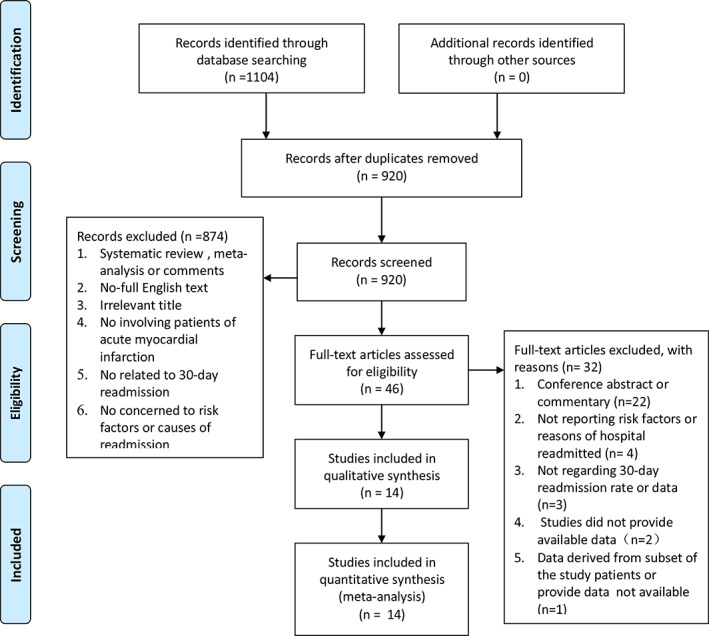
PubMed, Cochrane Library, and EMBASE were systematically searched to identify eligible studies. Random-effect models were employed to perform pooled analyses. Means and 95% confidence intervals (CIs) were used to estimate prevalence and reasons for 30-day readmission. We also used Odds ratios (ORs) to explore the potential significant predictors of risk factors of 30-day readmission after AMI. Potential publication bias was assessed using funnel plot and Begg'test.
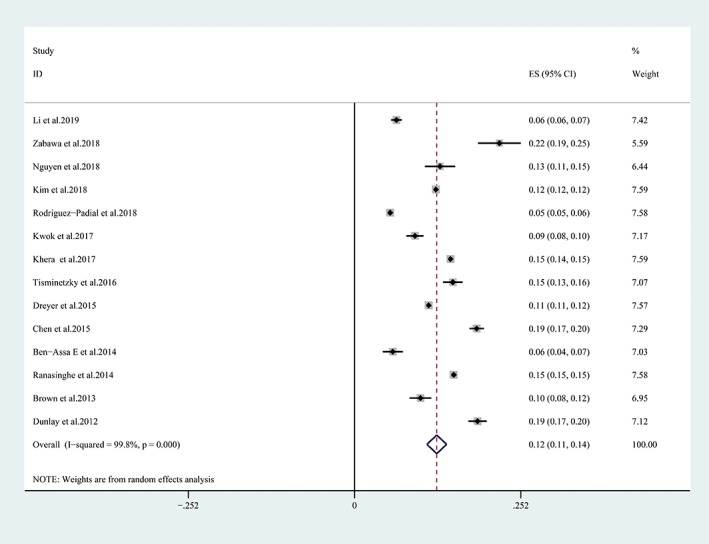
A total of 14 relevant studies were included in this systematic review and meta-analysis. The pooled 30-day readmission rate of AMI was 12% (95% CI 0.11-0.14). Acute coronary syndrome (ACS), angina and acute ischemic heart disease, and heart failure (HF) were the principal cardiovascular reasons of 30-day readmission. Meanwhile, non-specific chest pain was regarded as the significant cause among non-cardiovascular reasons. The common co-morbidities kidney disease, HF and diabetes mellitus were significant risk factors for 30-day readmission. No significant publication bias was found by funnel plot and statistical tests.
The 30-day readmission rate of post-AMI ranged from 11% to 14% and can be mainly attributed to cardiovascular and non-cardiovascular events. The common co-morbidities, such as kidney disease, HF, and diabetes mellitus were significant risk factors for 30-day readmission.
30 天再入院与医疗费用增加有关,这已成为多家医疗机构的重要质量指标。本研究旨在阐明急性心肌梗死(AMI)后 30 天再入院的发生率、潜在危险因素和原因。
系统检索 PubMed、Cochrane 图书馆和 EMBASE,以确定合格的研究。采用随机效应模型进行汇总分析。采用均数和 95%置信区间(CI)来估计 30 天再入院的发生率和原因。我们还使用比值比(OR)来探讨 AMI 后 30 天再入院的潜在危险因素的显著预测因素。使用漏斗图和 Begg 检验评估潜在的发表偏倚。
本系统评价和荟萃分析共纳入 14 项相关研究。AMI 的 30 天再入院率为 12%(95%CI 0.11-0.14)。急性冠状动脉综合征(ACS)、心绞痛和急性缺血性心脏病以及心力衰竭(HF)是 30 天再入院的主要心血管原因。同时,非特异性胸痛被认为是非心血管原因的重要原因。常见的合并症如肾脏病、HF 和糖尿病是 30 天再入院的显著危险因素。漏斗图和统计检验未发现明显的发表偏倚。
AMI 后 30 天再入院率在 11%至 14%之间,主要归因于心血管和非心血管事件。常见的合并症,如肾脏病、HF 和糖尿病是 30 天再入院的显著危险因素。