Leon H. Charney Division of Cardiology, Department of Medicine, New York University School of Medicine, New York, New York, USA
Division of Healthcare Delivery Science, Department of Population Health, New York University School of Medicine, New York, New York, USA.
Open Heart. 2021 Jan;8(1). doi: 10.1136/openhrt-2020-001442.
To develop a 180-day readmission risk model for older adults with acute myocardial infarction (AMI) that considered a broad range of clinical, demographic and age-related functional domains.
We used data from ComprehenSIVe Evaluation of Risk in Older Adults with AMI (SILVER-AMI), a prospective cohort study that enrolled participants aged ≥75 years with AMI from 94 US hospitals. Participants underwent an in-hospital assessment of functional impairments, including cognition, vision, hearing and mobility. Clinical variables previously shown to be associated with readmission risk were also evaluated. The outcome was 180-day readmission. From an initial list of 72 variables, we used backward selection and Bayesian model averaging to derive a risk model (N=2004) that was subsequently internally validated (N=1002).
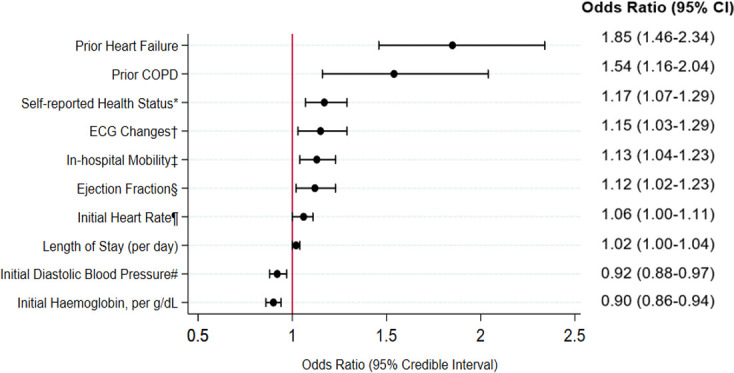
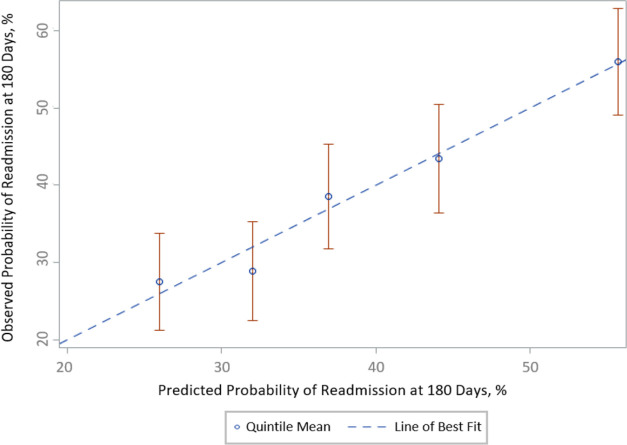
Of the 3006 SILVER-AMI participants discharged alive, mean age was 81.5 years, 44.4% were women and 10.5% were non-white. Within 180 days, 1222 participants (40.7%) were readmitted. The final risk model included 10 variables: history of chronic obstructive pulmonary disease, history of heart failure, initial heart rate, first diastolic blood pressure, ischaemic ECG changes, initial haemoglobin, ejection fraction, length of stay, self-reported health status and functional mobility. Model discrimination was moderate (0.68 derivation cohort, 0.65 validation cohort), with good calibration. The predicted readmission rate (derivation cohort) was 23.0% in the lowest quintile and 65.4% in the highest quintile.
Over 40% of participants in our sample experienced hospital readmission within 180 days of AMI. Our final readmission risk model included a broad range of characteristics, including functional mobility and self-reported health status, neither of which have been previously considered in 180-day risk models.
为急性心肌梗死(AMI)的老年患者开发一种 180 天再入院风险模型,该模型考虑了广泛的临床、人口统计学和与年龄相关的功能领域。
我们使用了 ComprehenSIVe Evaluation of Risk in Older Adults with AMI(SILVER-AMI)的数据,这是一项前瞻性队列研究,纳入了来自 94 家美国医院的年龄≥75 岁的 AMI 患者。参与者在住院期间接受了认知、视力、听力和移动能力等功能障碍的评估。还评估了先前与再入院风险相关的临床变量。研究的结局是 180 天再入院。从最初的 72 个变量列表中,我们使用向后选择和贝叶斯模型平均法得出了一个风险模型(N=2004),然后对其进行了内部验证(N=1002)。
在 3006 名 SILVER-AMI 存活出院患者中,平均年龄为 81.5 岁,44.4%为女性,10.5%为非白人。在 180 天内,1222 名患者(40.7%)再次入院。最终的风险模型包括 10 个变量:慢性阻塞性肺疾病史、心力衰竭史、初始心率、首次舒张压、缺血性心电图改变、初始血红蛋白、射血分数、住院时间、自我报告的健康状况和功能性移动能力。模型的区分度中等(推导队列为 0.68,验证队列为 0.65),校准良好。预测的再入院率(推导队列)在最低五分位数为 23.0%,在最高五分位数为 65.4%。
在我们的样本中,超过 40%的患者在 AMI 后 180 天内经历了医院再入院。我们最终的再入院风险模型包括了广泛的特征,包括功能性移动能力和自我报告的健康状况,这两个特征在 180 天风险模型中都没有被考虑过。