Stewart Erica, Triccas James A, Petrovsky Nikolai
Discipline of Infectious Diseases and Immunology, Central Clinical School, Faculty of Medicine and Health, The University of Sydney, Camperdown, NSW 2006, Australia.
Charles Perkins Centre, The University of Sydney, Camperdown, NSW 2006, Australia.
Microorganisms. 2019 Aug 12;7(8):255. doi: 10.3390/microorganisms7080255.
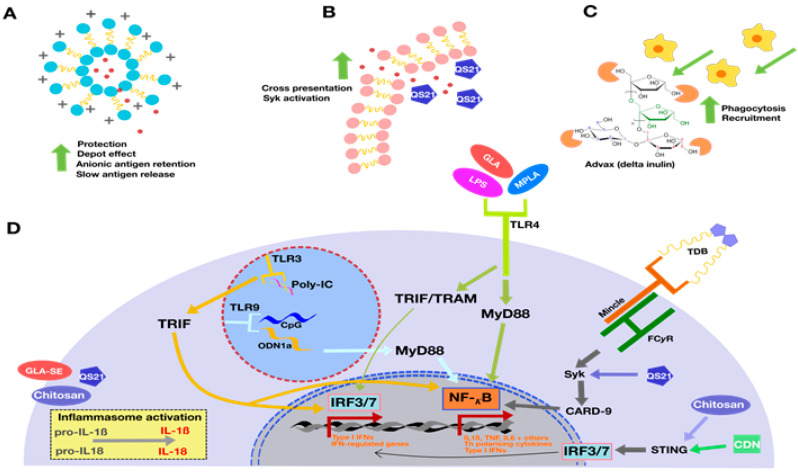
Tuberculosis (TB) caused by infection is responsible for the most deaths by a single infectious agent worldwide, with 1.6 million deaths in 2017 alone. The World Health Organization, through its "End TB" strategy, aims to reduce TB deaths by 95% by 2035. In order to reach this goal, a more effective vaccine than the Bacillus Calmette-Guerin (BCG) vaccine currently in use is needed. Subunit TB vaccines are ideal candidates, because they can be used as booster vaccinations for individuals who have already received BCG and would also be safer for use in immunocompromised individuals in whom BCG is contraindicated. However, subunit TB vaccines will almost certainly require formulation with a potent adjuvant. As the correlates of vaccine protection against TB are currently unclear, there are a variety of adjuvants currently being used in TB vaccines in preclinical and clinical development. This review describes the various adjuvants in use in TB vaccines, their effectiveness, and their proposed mechanisms of action. Notably, adjuvants with less inflammatory and reactogenic profiles that can be administered safely via mucosal routes, may have the biggest impact on future directions in TB vaccine design.
由感染引起的结核病(TB)是全球单一感染源导致死亡人数最多的疾病,仅2017年就有160万人死亡。世界卫生组织通过其“终止结核病”战略,旨在到2035年将结核病死亡人数减少95%。为实现这一目标,需要一种比目前使用的卡介苗(BCG)更有效的疫苗。亚单位结核病疫苗是理想的候选疫苗,因为它们可用于已接种卡介苗个体的加强接种,并且对于禁忌接种卡介苗的免疫功能低下个体使用起来也更安全。然而,亚单位结核病疫苗几乎肯定需要与强效佐剂一起配制。由于目前尚不清楚针对结核病的疫苗保护相关因素,在临床前和临床开发的结核病疫苗中目前正在使用多种佐剂。本综述描述了结核病疫苗中使用的各种佐剂、它们的有效性及其拟议的作用机制。值得注意的是,具有较低炎症和反应原性特征且可通过粘膜途径安全给药的佐剂,可能对未来结核病疫苗设计方向产生最大影响。