Department of Clinical Physiology, Nuclear Medicine & PET and Cluster for Molecular Imaging, Department of Biomedical Sciences, Rigshospitalet and University of Copenhagen, Copenhagen, Denmark.
Niels Bohr Institute, University of Copenhagen, Copenhagen, Denmark.
Int J Nanomedicine. 2019 Jul 18;14:5369-5379. doi: 10.2147/IJN.S205409. eCollection 2019.
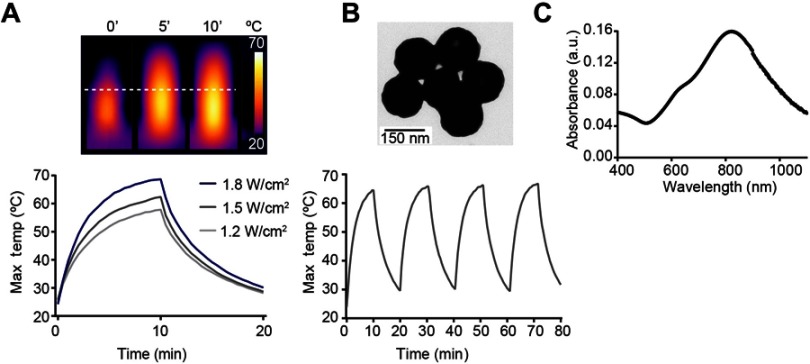
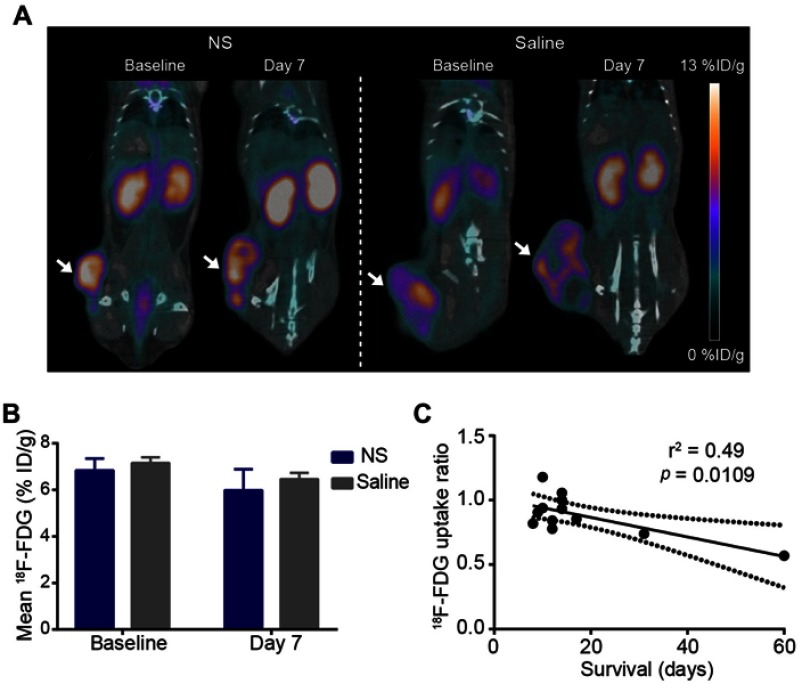
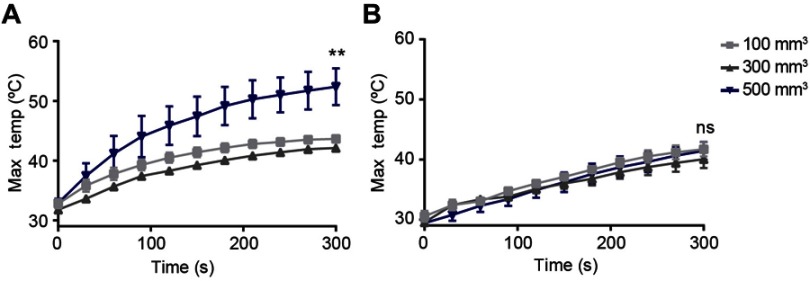
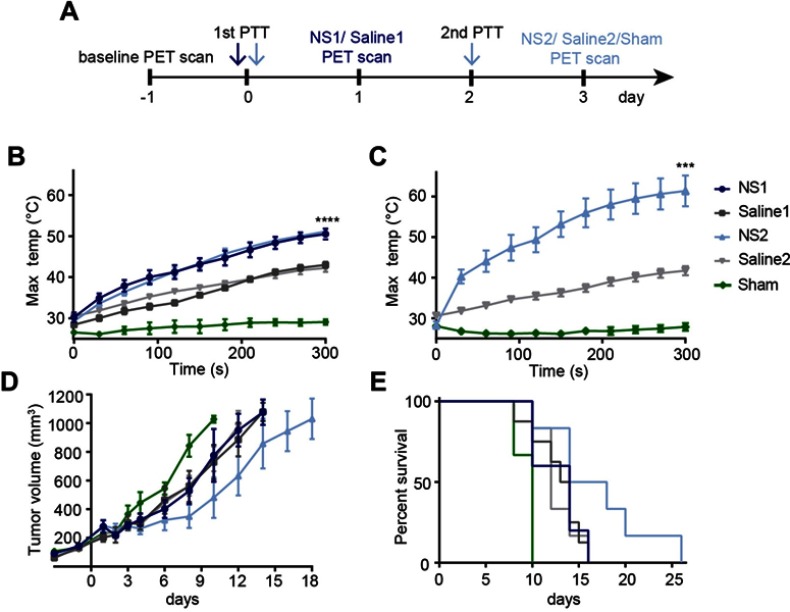
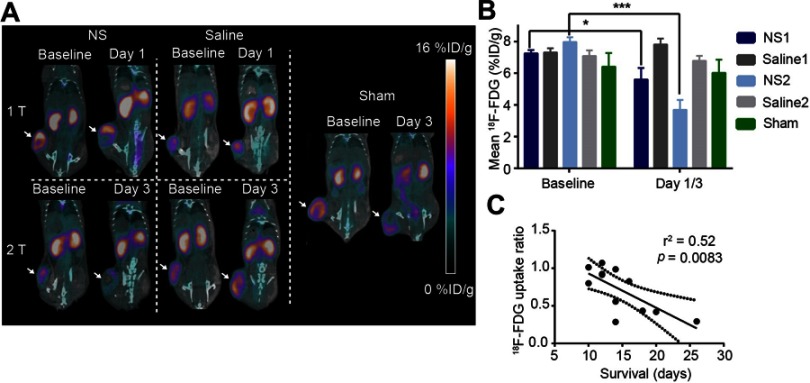
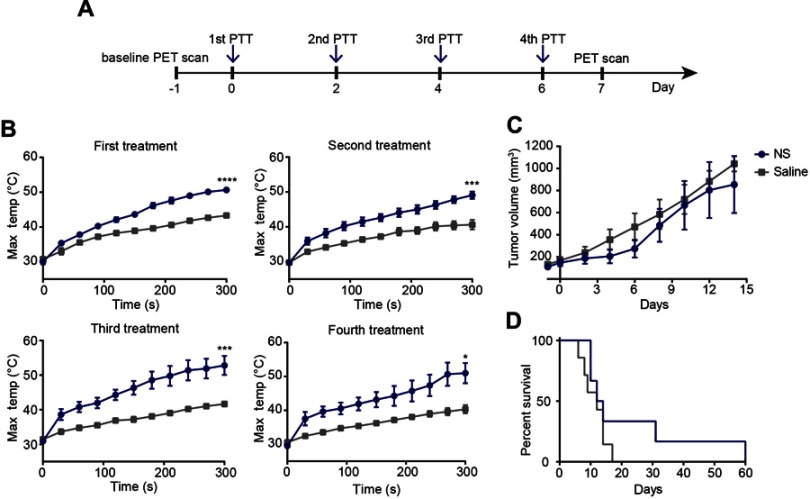
Photothermal therapy (PTT) exploits the light-absorbing properties of nanomaterials such as silica-gold nanoshells (NS) to inflict tumor death through local hyperthermia. However, in in vivo studies of PTT, the heat distribution is often found to be heterogeneous throughout the tumor volume, which leaves parts of the tumor untreated and impairs the overall treatment outcome. As this challenges PTT as a one-dose therapy, this study here investigates if giving the treatment repeatedly, ie, fractionated PTT, increases the efficacy in mice bearing subcutaneous tumors. The NS heating properties were first optimized in vitro and in vivo. Two fractionated PTT protocols, consisting of two and four laser treatments, respectively, were developed and applied in a murine subcutaneous colorectal tumor model. The efficacy of the two fractionated protocols was evaluated both by longitudinal monitoring of tumor growth and, at an early time point, by positron emission tomography (PET) imaging of F-labeled glucose analog F-FDG. Overall, there were no significant differences in tumor growth and survival between groups of mice receiving single-dose PTT and fractionated PTT in our study. Nonetheless, some animals did experience inhibited tumor growth or even complete tumor disappearance due to fractionated PTT, and these animals also showed a significant decrease in tumor uptake of F-FDG after therapy. This study only found an effect of giving PTT to tumors in fractions compared to a single-dose approach in a few animals. However, many factors can affect the outcome of PTT, and reliable tools for optimization of treatment protocol are needed. Despite the modest treatment effect, our results indicate that F-FDG PET/CT imaging can be useful to guide the number of treatment sessions necessary.
光热疗法(PTT)利用纳米材料的光吸收特性,如硅-金纳米壳(NS),通过局部高热来导致肿瘤死亡。然而,在 PTT 的体内研究中,通常会发现肿瘤体积内的热量分布不均匀,这使得肿瘤的某些部分未得到治疗,并影响了整体治疗效果。由于这对 PTT 作为一次性治疗提出了挑战,因此本研究探讨了是否通过重复给予治疗,即分次 PTT,是否可以提高患有皮下肿瘤的小鼠的疗效。首先在体外和体内优化了 NS 的加热特性。开发了两种分次 PTT 方案,分别由两次和四次激光治疗组成,并应用于小鼠皮下结直肠肿瘤模型中。通过对肿瘤生长的纵向监测以及在早期通过正电子发射断层扫描(PET)对 F-标记的葡萄糖类似物 F-FDG 的成像,评估了两种分次方案的疗效。总的来说,在我们的研究中,单次 PTT 和分次 PTT 组的小鼠在肿瘤生长和生存方面没有显著差异。尽管如此,由于分次 PTT,一些动物确实经历了抑制肿瘤生长甚至完全肿瘤消失,并且这些动物在治疗后肿瘤对 F-FDG 的摄取也显著减少。本研究仅在少数动物中发现分次给予 PTT 与单次剂量方法相比对肿瘤的效果。然而,许多因素会影响 PTT 的结果,因此需要可靠的工具来优化治疗方案。尽管治疗效果不大,但我们的结果表明 F-FDG PET/CT 成像可用于指导所需的治疗次数。