Simón Marina, Jørgensen Jesper Tranekjær, Melander Fredrik, Andresen Thomas Lars, Christensen Anders, Kjaer Andreas
Department of Clinical Physiology, Nuclear Medicine and PET & Cluster for Molecular Imaging, Copenhagen University Hospital-Rigshospitalet & Department of Biomedical Sciences, University of Copenhagen, 2100 Copenhagen, Denmark.
Department of Health Technology, Section for Biotherapeutic Engineering and Drug Targeting, Technical University of Denmark, 2800 Kongens Lyngby, Denmark.
Cancers (Basel). 2021 Nov 20;13(22):5820. doi: 10.3390/cancers13225820.
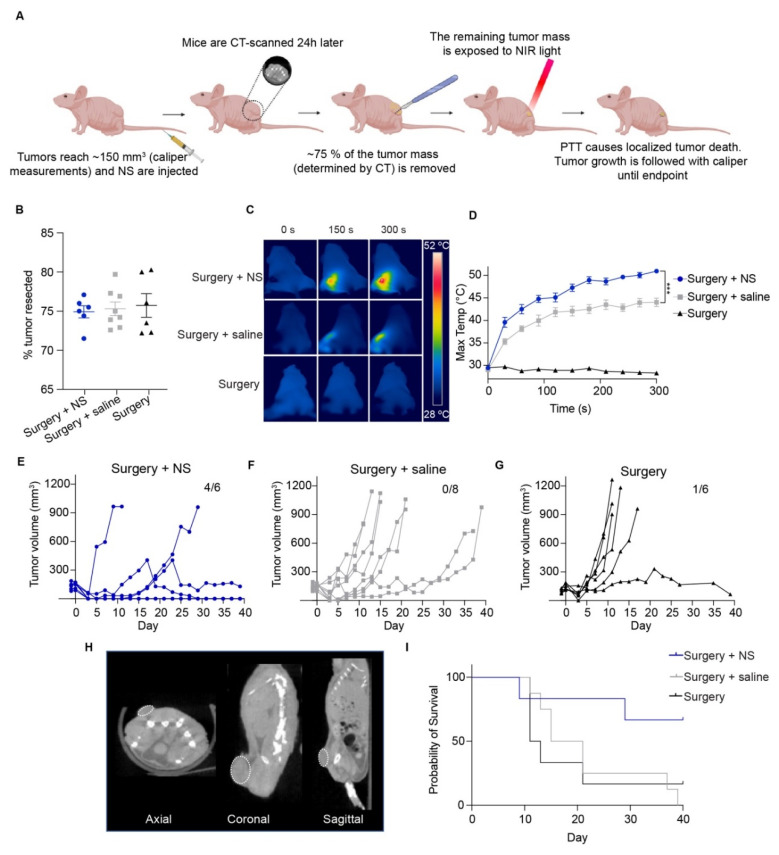
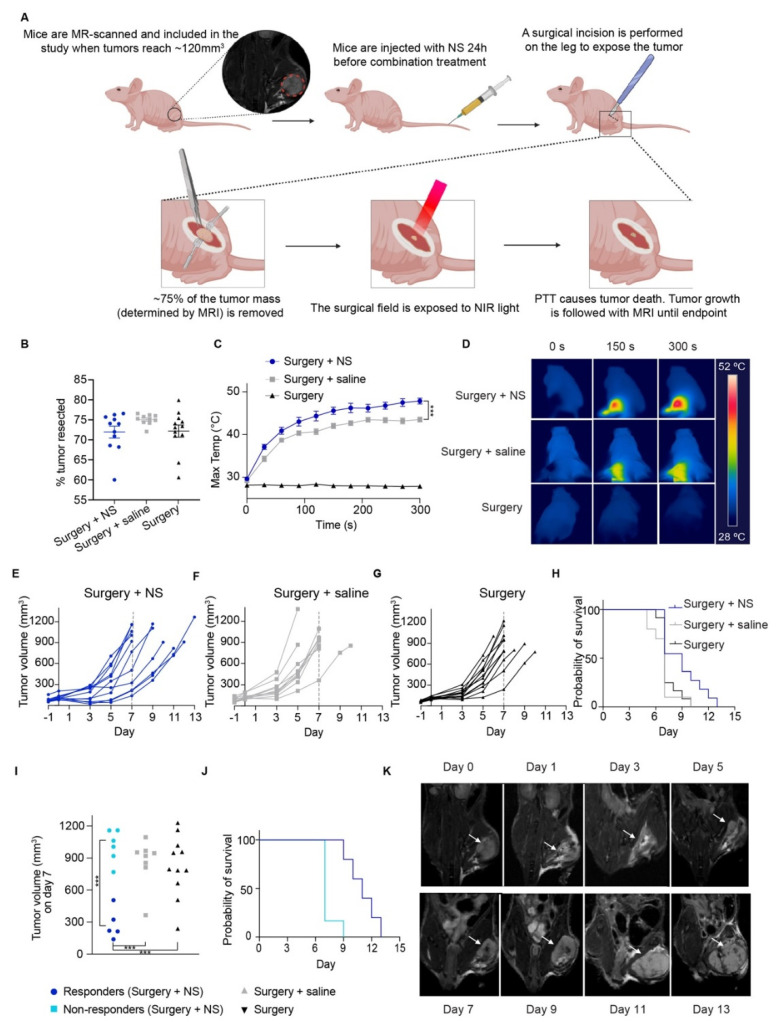
Surgery is still the first-line treatment for multiple solid cancers. However, recurrence is a common issue, especially when dealing with aggressive tumors or tumors that are difficult to completely remove due to their location. Getting clear surgical margins can be challenging, but treatment strategies combining surgery with other anti-cancer therapies can potentially improve the outcome. Photothermal therapy (PTT) is a technique that relies on photoabsorbing agents, such as gold nanoparticles, to transform light into local hyperthermia. This technique can be used to ablate tumor tissue where the photoabsorbing agent accumulates, sparing healthy surrounding tissue. In this study, we examined the potential of gold nanoparticle-based PTT as an adjuvant treatment to surgery in a mouse model of human fibrosarcoma. For this we performed subtotal tumor resection to mimic a clinical situation where total tumor removal is not achieved, and subsequent PTT was applied on the surgical field. Our results showed that animals undergoing adjuvant PTT after surgery presented sustained delayed tumor growth and improved survival when compared to animals that only underwent surgery. We believe that these findings show the potential of PTT as an adjuvant method to traditional tumor surgery and could pave way to more personalized treatment options.
手术仍然是多种实体癌的一线治疗方法。然而,复发是一个常见问题,尤其是在处理侵袭性肿瘤或因位置原因难以完全切除的肿瘤时。获得清晰的手术切缘可能具有挑战性,但将手术与其他抗癌疗法相结合的治疗策略可能会改善治疗效果。光热疗法(PTT)是一种依靠光吸收剂(如金纳米颗粒)将光转化为局部热疗的技术。该技术可用于消融光吸收剂积聚的肿瘤组织,同时保留周围健康组织。在本研究中,我们在人纤维肉瘤小鼠模型中研究了基于金纳米颗粒的光热疗法作为手术辅助治疗的潜力。为此,我们进行了肿瘤次全切除以模拟未实现肿瘤完全切除的临床情况,随后在手术区域应用光热疗法。我们的结果表明,与仅接受手术的动物相比,术后接受辅助光热疗法的动物肿瘤生长持续延迟且生存率提高。我们认为这些发现表明光热疗法作为传统肿瘤手术辅助方法的潜力,并可能为更个性化的治疗选择铺平道路。