Biopharmaceutics and Pharmacokinetic Division, Department of Pharmaceutics, Faculty of Pharmacy, Tehran University of Medical Sciences, Tehran, Iran.
Experimental Medicine Research Center, Faculty of Pharmacy, Tehran University of Medical Sciences, Tehran, Iran.
Int J Nanomedicine. 2019 Jul 19;14:5477-5490. doi: 10.2147/IJN.S199624. eCollection 2019.
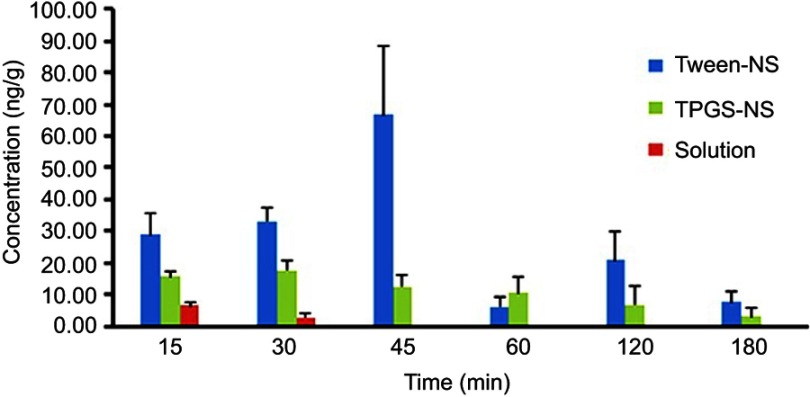
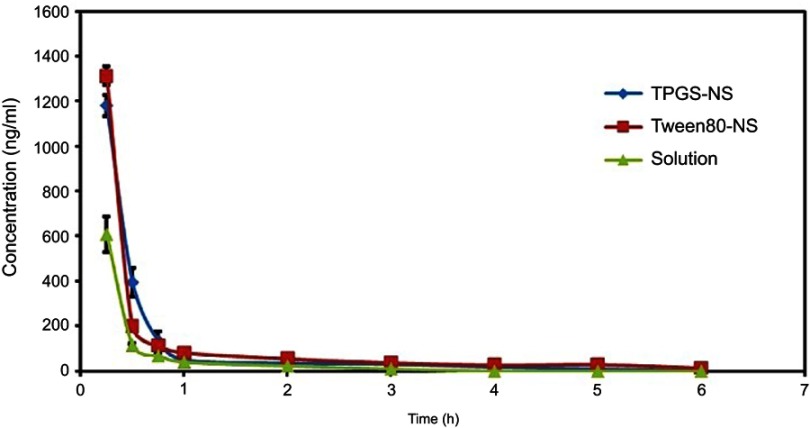
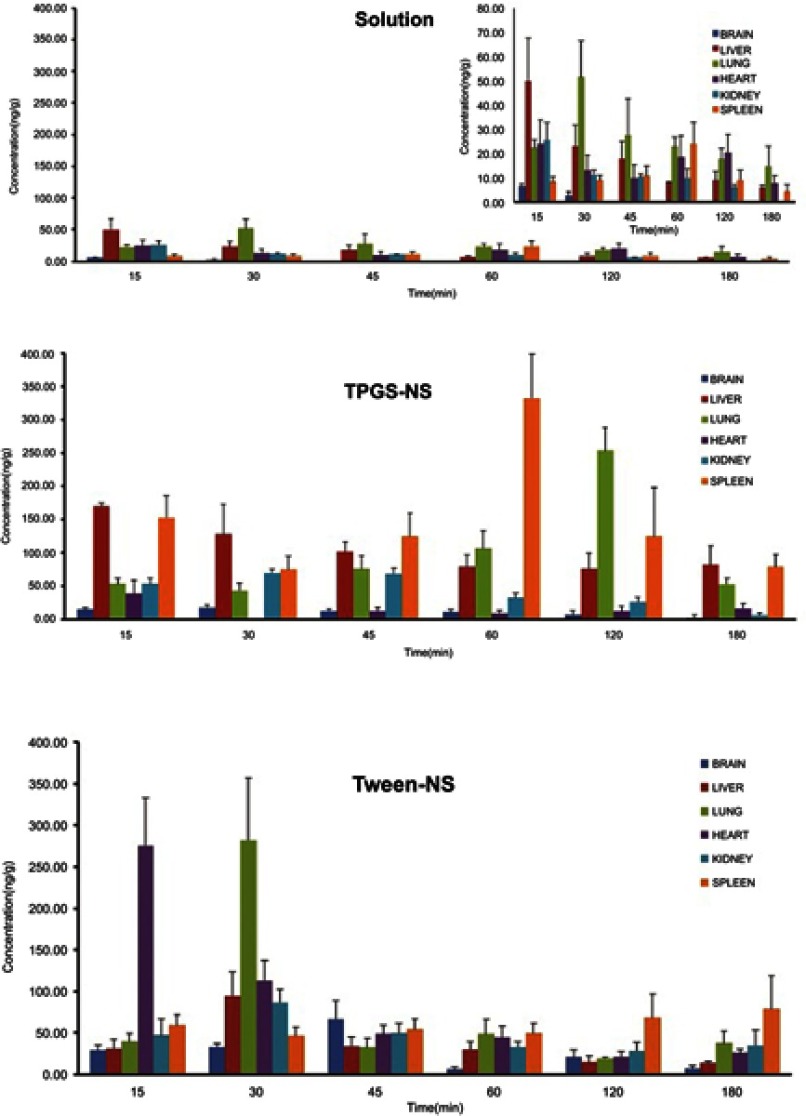
Curcumin, a bioactive component with multiple characteristics, has been shown to have many therapeutic effects. However, there are several limitations regarding the use of curcumin such as instability, low solubility, poor bioavailability, and rapid elimination. Different approaches have been used to solve these problems. In this study, surface-modified nanosuspension (NS) is investigated as a novel brain delivery system. Two different methods were used for the preparation of nanosuspensions with two different stabilizers. The surface of the nanosuspensions was coated with D-α-tocopheryl polyethylene glycol 1,000 succinate (TPGS) and Tween 80 using physical adsorption. Curcumin NSs were prepared using two different top-down techniques by high-pressure homogenizer and probe sonicator. A validated sensitive and selective high-performance liquid chromatography method using fluorescence detection was used for the determination and quantification of curcumin. Pharmacokinetics and biodistribution of curcumin NSs and solutions after intravenous administration in rats were studied. Higher levels of curcumin in the brain were detected when Tween 80-coated NS was used compared with the curcumin solution and TPGS coated NS (TPGS-NS) (-value<0.05). Absorption of ApoE and/or B by Tween 80-coated nanoparticles (NPs) from the blood were caused transferring of these NPs into the brain using receptor-mediated endocytosis. Distribution of TPGS-NS in the brain compared with the curcumin solution was higher (-value<0.05). Higher levels of curcumin concentration in the liver, spleen, and lung were also observed with TPGS-NS. The results of this study indicate that the surface-coating of NSs by Tween 80 may be used to improve the biodistribution of curcumin in the brain.
姜黄素是一种具有多种特性的生物活性成分,已被证明具有许多治疗效果。然而,姜黄素的应用存在一些局限性,如不稳定性、低溶解度、生物利用度差和快速消除。已经采用了不同的方法来解决这些问题。在本研究中,表面修饰的纳米混悬剂(NS)被研究作为一种新型的脑内递药系统。使用两种不同的稳定剂,通过两种不同的方法制备了纳米混悬剂。通过物理吸附,将纳米混悬剂的表面用 D-α-生育酚聚乙二醇 1000 琥珀酸酯(TPGS)和吐温 80 进行了包覆。使用高压匀质机和探针超声仪通过两种不同的自上而下的技术制备了姜黄素 NS。使用荧光检测的验证后的灵敏和选择性高效液相色谱法用于姜黄素的测定和定量。研究了静脉给予大鼠后姜黄素 NS 和溶液的药代动力学和生物分布。与姜黄素溶液和 TPGS 包覆的 NS(TPGS-NS)相比,用吐温 80 包覆的 NS 时脑内检测到的姜黄素水平更高(P 值<0.05)。通过受体介导的内吞作用,血液中的 ApoE 和/或 B 与吐温 80 包覆的纳米粒子(NPs)结合,导致这些 NPs 转移到大脑中。与姜黄素溶液相比,TPGS-NS 在大脑中的分布更高(P 值<0.05)。还观察到 TPGS-NS 在肝脏、脾脏和肺部中的姜黄素浓度更高。本研究结果表明,通过吐温 80 对 NS 进行表面包覆可能用于改善姜黄素在脑内的生物分布。