Reserach Center for Biopharmaceutics and Pharmacokinetics, College of Pharmacy, Jinan University, 601 Huangpu Avenue West, Guangzhou 510632, China.
Integrated Chinese and Western Medicine Postdoctoral research station, Jinan University, 601 Huangpu Avenue West, Guangzhou, China.
Theranostics. 2019 Jul 9;9(18):5122-5133. doi: 10.7150/thno.35773. eCollection 2019.
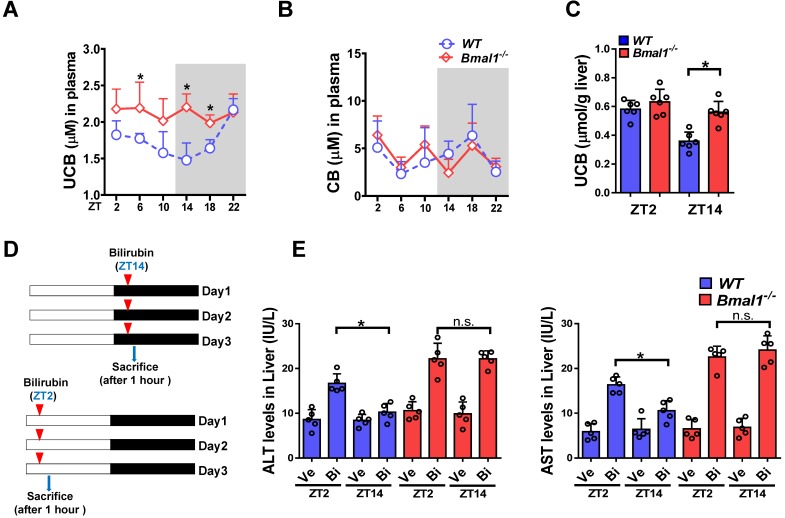
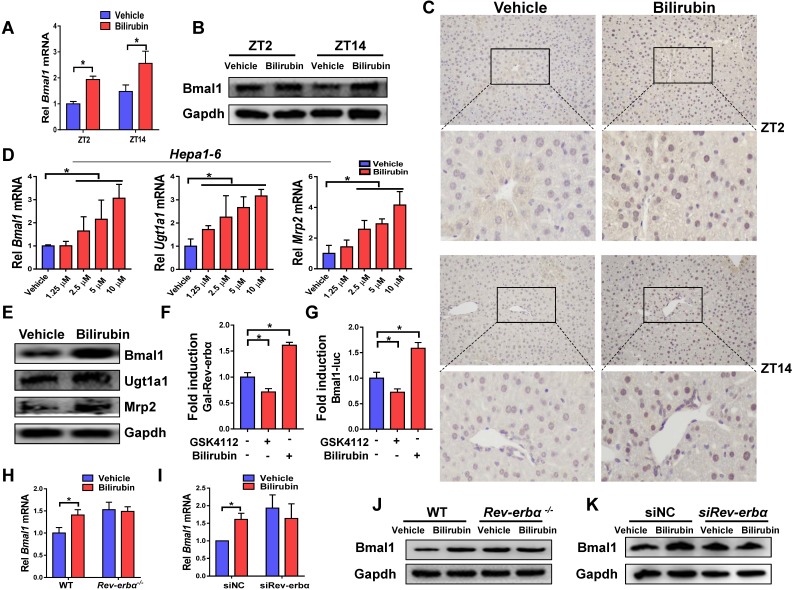
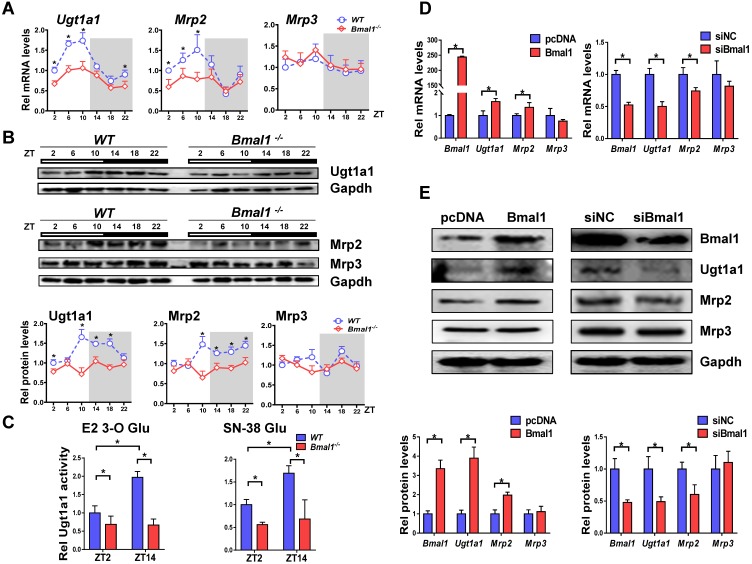
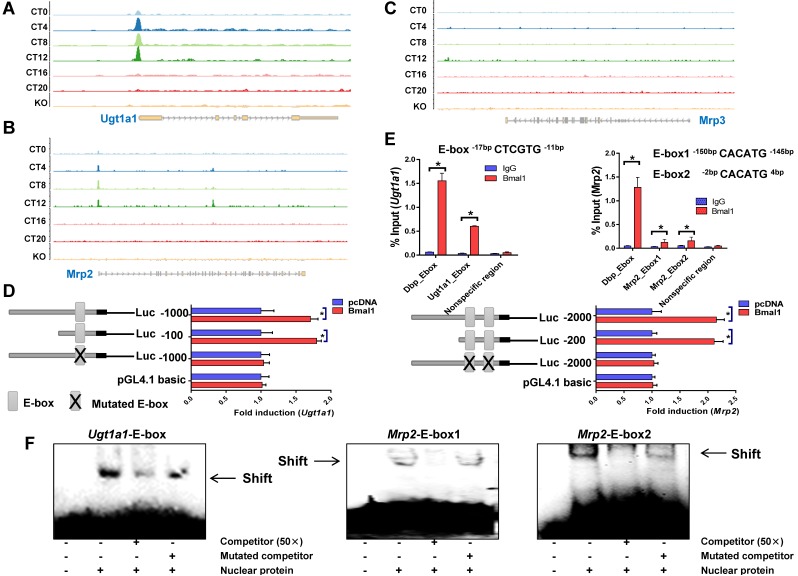
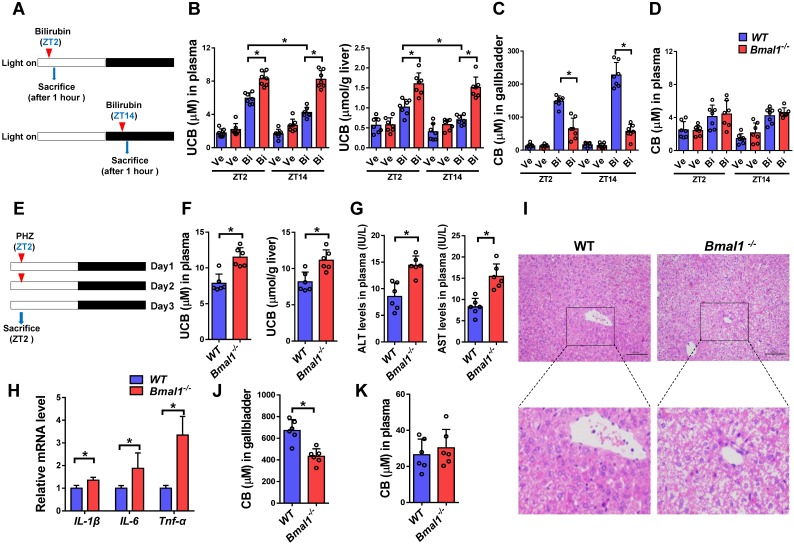
Controlling bilirubin to a low level is necessary in physiology because of its severe neurotoxicity. Therefore, it is of great interest to understand the regulatory mechanisms for bilirubin homeostasis. In this study, we uncover a critical role for circadian clock in regulation of bilirubin detoxification and homeostasis. : The mRNA and protein levels of Bmal1 (a core clock gene), metabolic enzymes and transporters were measured by qPCR and Western blotting, respectively. Luciferase reporter, mobility shift and chromatin immunoprecipitation were used to investigate transcriptional gene regulation. Experimental hyperbilirubinemia was induced by injection of bilirubin or phenylhydrazine. Unconjugated bilirubin (UCB) and conjugated bilirubin were assessed by ELISA. : We first demonstrated diurnal variations in plasma UCB levels and in main bilirubin-detoxifying genes and . Of note, the circadian UCB levels were antiphase to the circadian expressions of Ugt1a1 and Mrp2. Bmal1 ablation abrogated the circadian rhythms of UCB and bilirubin-induced hepatotoxicity in mice. Bmal1 ablation also decreased mRNA and protein expressions of both Ugt1a1 and Mrp2 in mouse livers, and blunted their circadian rhythms. A combination of luciferase reporter, mobility shift, and chromatin immunoprecipitation assays revealed that Bmal1 trans-activated and through specific binding to the E-boxes in the promoter region. Further, Bmal1 ablation caused a loss of circadian time-dependency in bilirubin clearance and sensitized mice to chemical induced-hyperbilirubinemia. Moreover, bilirubin stimulated Bmal1 expression through antagonism of Rev-erbα, constituting a feedback mechanism in bilirubin detoxification. : These data supported a dual role for circadian clock in regulation of bilirubin detoxification, generating circadian variations in bilirubin level via direct transactivation of detoxifying genes Ugt1a1 and Mrp2, and defending the body against hyperbilirubinemia via Rev-erbα antagonism. Thereby, our study provided a potential mechanism for management of bilirubin related diseases.
在生理学中,胆红素的严重神经毒性使得将其控制在低水平是必要的。因此,了解胆红素动态平衡的调节机制非常重要。在这项研究中,我们揭示了生物钟在胆红素解毒和动态平衡调节中的关键作用。:通过 qPCR 和 Western blot 分别测量了 Bmal1(核心时钟基因)、代谢酶和转运蛋白的 mRNA 和蛋白水平。使用荧光素酶报告基因、迁移率变动分析和染色质免疫沉淀来研究转录基因调控。通过注射胆红素或苯肼诱导实验性高胆红素血症。通过 ELISA 评估未结合胆红素 (UCB) 和结合胆红素。:我们首先证明了血浆 UCB 水平和主要胆红素解毒基因 和 的昼夜变化。值得注意的是,UCB 的昼夜节律与 Ugt1a1 和 Mrp2 的昼夜表达呈相反相位。Bmal1 缺失消除了小鼠 UCB 和胆红素诱导的肝毒性的昼夜节律。Bmal1 缺失还降低了小鼠肝脏中 Ugt1a1 和 Mrp2 的 mRNA 和蛋白表达,并减弱了它们的昼夜节律。荧光素酶报告基因、迁移率变动分析和染色质免疫沉淀分析的组合表明,Bmal1 通过与启动子区域的 E 盒特异性结合,反式激活 和 。此外,Bmal1 缺失导致胆红素清除的昼夜时间依赖性丧失,并使小鼠对化学诱导的高胆红素血症敏感。此外,胆红素通过拮抗 Rev-erbα 刺激 Bmal1 表达,构成胆红素解毒的反馈机制。:这些数据支持生物钟在胆红素解毒调节中的双重作用,通过直接反式激活解毒基因 Ugt1a1 和 Mrp2 产生胆红素水平的昼夜变化,通过拮抗 Rev-erbα 保护机体免受高胆红素血症。因此,我们的研究为胆红素相关疾病的管理提供了潜在的机制。