Department of Biochemistry and Biophysics, Stockholm University, Svante Arrhenius väg 16C, 10691, Stockholm, Sweden.
PRA Health Sciences, Amerikaweg 18, 9407 TK, Assen, The Netherlands.
J Biol Inorg Chem. 2019 Sep;24(6):849-861. doi: 10.1007/s00775-019-01703-z. Epub 2019 Aug 13.
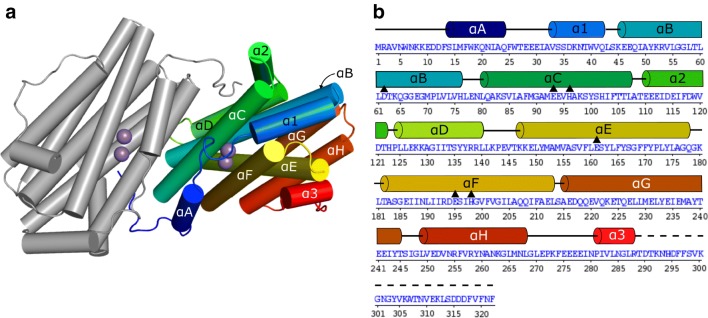
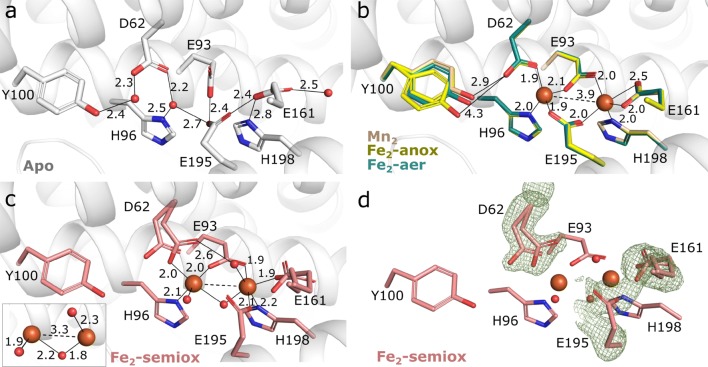
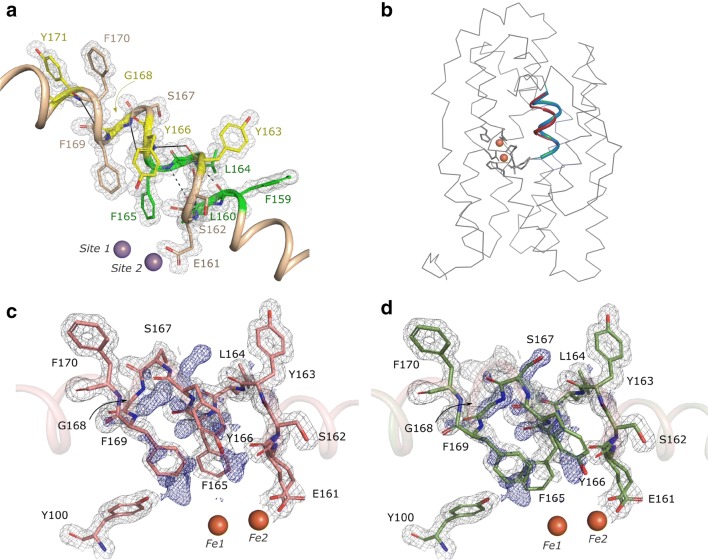
Class Ib ribonucleotide reductases (RNR) utilize a di-nuclear manganese or iron cofactor for reduction of superoxide or molecular oxygen, respectively. This generates a stable tyrosyl radical (Y·) in the R2 subunit (NrdF), which is further used for ribonucleotide reduction in the R1 subunit of RNR. Here, we report high-resolution crystal structures of Bacillus anthracis NrdF in the metal-free form (1.51 Å) and in complex with manganese (Mn/Mn, 1.30 Å). We also report three structures of the protein in complex with iron, either prepared anaerobically (Fe/Fe form, 1.32 Å), or prepared aerobically in the photo-reduced Fe/Fe form (1.63 Å) and with the partially oxidized metallo-cofactor (1.46 Å). The structures reveal significant conformational dynamics, likely to be associated with the generation, stabilization, and transfer of the radical to the R1 subunit. Based on observed redox-dependent structural changes, we propose that the passage for the superoxide, linking the FMN cofactor of NrdI and the metal site in NrdF, is closed upon metal oxidation, blocking access to the metal and radical sites. In addition, we describe the structural mechanics likely to be involved in this process.
I 类核糖核苷酸还原酶(RNR)利用双核锰或铁辅因子分别还原超氧化物或分子氧。这会在 R2 亚基(NrdF)中产生稳定的酪氨酸自由基(Y·),该自由基进一步用于 RNR 的 R1 亚基中的核糖核苷酸还原。在这里,我们报告了炭疽芽孢杆菌 NrdF 在无金属形式(1.51 Å)和与锰结合形式(Mn/Mn,1.30 Å)的高分辨率晶体结构。我们还报告了三种该蛋白与铁结合的结构,要么是在厌氧条件下制备的(Fe/Fe 形式,1.32 Å),要么是在光还原的 Fe/Fe 形式下(1.63 Å)和部分氧化的金属辅因子(1.46 Å)下制备的。这些结构揭示了显著的构象动力学,可能与自由基的产生、稳定和向 R1 亚基的转移有关。基于观察到的氧化还原依赖性结构变化,我们提出,连接 NrdI 的 FMN 辅因子和 NrdF 中金属位点的超氧化物通道在金属氧化时关闭,阻止了金属和自由基位点的进入。此外,我们描述了可能参与这一过程的结构力学。