Department of Population Health, University of Georgia, Athens, Georgia.
Department of Clinical Sciences, Colorado State University, Fort Collins, Colorado.
J Vet Intern Med. 2019 Sep;33(5):2239-2248. doi: 10.1111/jvim.15579. Epub 2019 Aug 13.
Transmission of Salmonella in veterinary hospitals is typically associated with environmental contamination. Links between isolates recovered from hospitalized large animals and environment suggest animals as the likely source. Therefore, understanding factors influencing shedding is key in control. Shedding in hospitalized animals has been investigated, but many studies focused on subsets of animals limiting generalizability.
(1) Investigate factors associated with fecal shedding of Salmonella among hospitalized large animals at a veterinary hospital. (2) Compare results obtained using 2 comparison groups for risk factor analysis-large animals with high confidence in negative shedding status and those with potential for misclassification of shedding status.
Large animals admitted from March 2002 through December 2012.
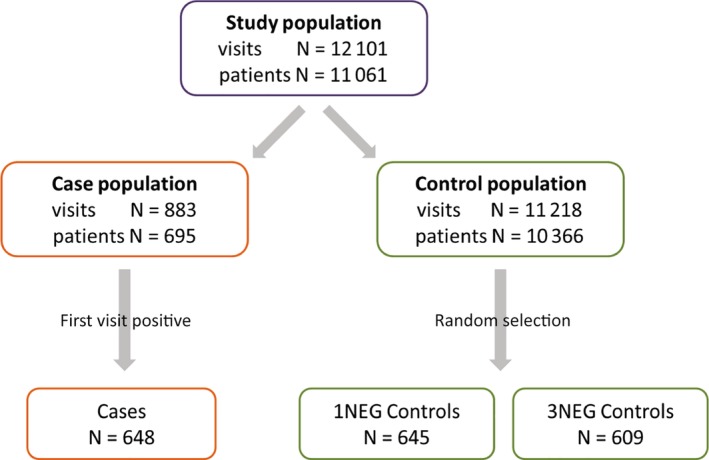
A case-control study was conducted among all hospitalized large animals that were routinely cultured as part of infection control efforts. Animal and hospital factors were evaluated. Data on factors of interest were collected retrospectively from electronic medical records. Multivariable conditional logistic regression was used to evaluate associations between animal factors and fecal shedding of Salmonella enterica.
During the study period, 5.9% (648/11 061) of hospitalized large animals were culture positive for Salmonella, with the majority being cattle (72%; 467/648) and horses (22%; 143/648). Although the odds of shedding varied by comparison group, overall, 69.4% of animal shedding could be attributed to systemic illness (population attributable fraction) in this study.
Findings of this study inform our understanding of factors affecting Salmonella shedding in hospitalized large animals, thus improving our ability for implementation of evidence-based control measures.
兽医医院中沙门氏菌的传播通常与环境污染有关。从住院大型动物中分离出的菌株与环境之间的联系表明动物是可能的来源。因此,了解影响脱落的因素是控制的关键。已经对住院动物的脱落情况进行了研究,但许多研究都集中在动物的子集上,限制了其普遍性。
(1)调查兽医医院住院大型动物粪便中沙门氏菌脱落的相关因素。(2)使用 2 个比较组进行风险因素分析-具有高置信度阴性脱落状态的大型动物和可能存在脱落状态分类错误的大型动物,比较结果。
2002 年 3 月至 2012 年 12 月期间收治的大型动物。
对作为感染控制工作的一部分进行常规培养的所有住院大型动物进行了病例对照研究。评估了动物和医院因素。从电子病历中回顾性收集了有关感兴趣因素的数据。使用多变量条件逻辑回归评估了动物因素与沙门氏菌肠杆菌粪便脱落之间的关联。
在研究期间,5.9%(648/11061)的住院大型动物培养出沙门氏菌阳性,其中大多数是牛(72%;467/648)和马(22%;143/648)。尽管在比较组中脱落的可能性有所不同,但总体而言,在本研究中,69.4%的动物脱落归因于全身性疾病(人群归因分数)。
本研究的结果使我们更好地了解影响住院大型动物沙门氏菌脱落的因素,从而提高我们实施基于证据的控制措施的能力。