Department of Endocrinology, Sanjay Gandhi Postgraduate Institute of Medical Sciences, Lucknow, India.
Department of Endocrinology, Christian Medical College, Vellore, India.
Indian J Med Res. 2019 Apr;149(4):479-488. doi: 10.4103/ijmr.IJMR_1004_17.
BACKGROUND & OBJECTIVES: In contrast to Caucasians of European origin, the aetiology of diabetes mellitus (DM) in young adults in other ethnic groups, including Indians is likely to be heterogeneous and difficult to determine. This study was undertaken to determine the aetiology of diabetes in young Indian adults using a protocol-based set of simple clinical and investigation tools.
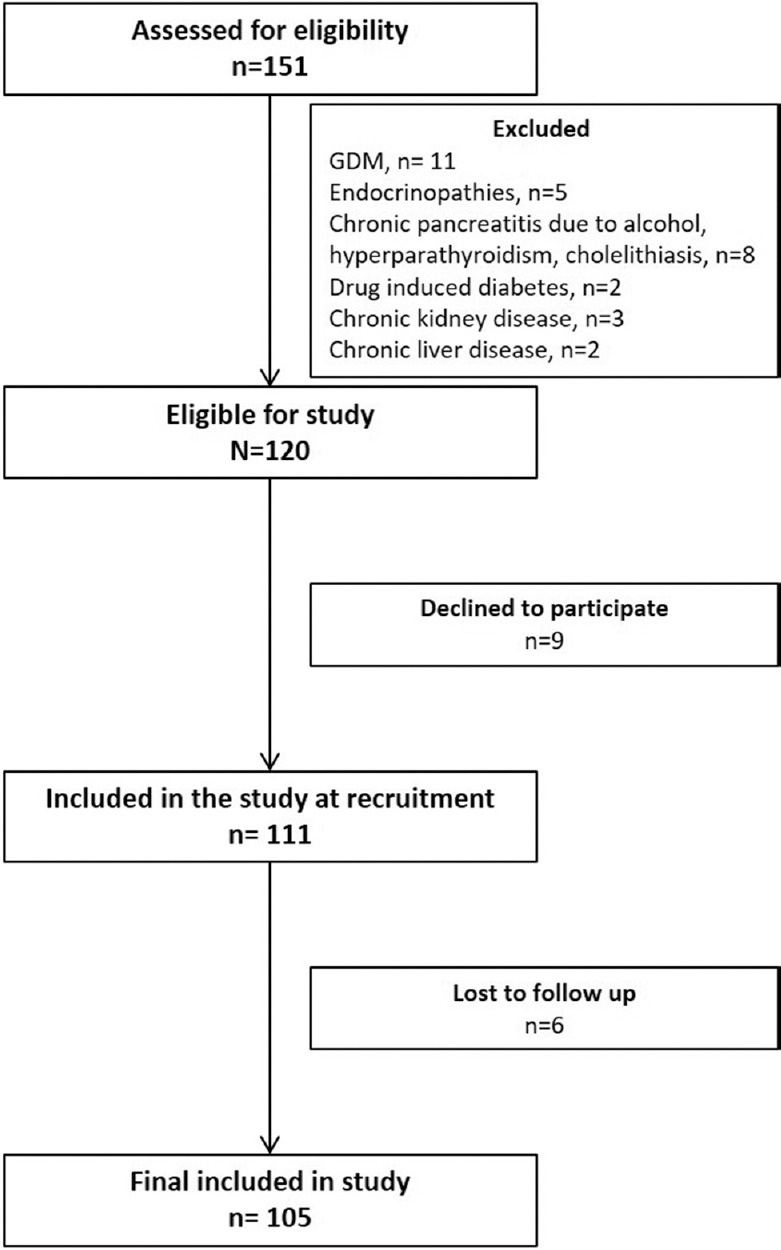
In this prospective study, 105 Indian young adults with diabetes (age at onset 18-35 yr; duration <2 yr) were studied for a period of 1-3 years. Pancreatic imaging, fasting C-peptide, islet antibodies (against glutamic acid decarboxylase, tyrosine phosphatase and zinc transporter-8) and mitochondrial A3243G mutational analysis were performed in all patients. Four patients were screened for maturity-onset diabetes of the young (MODY) using next-generation sequencing.
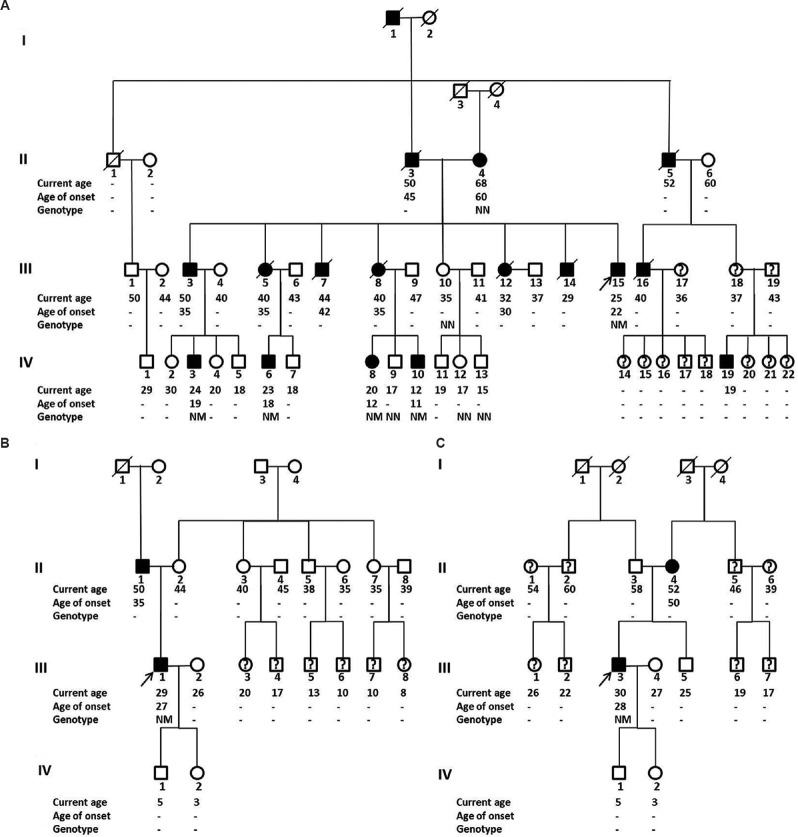
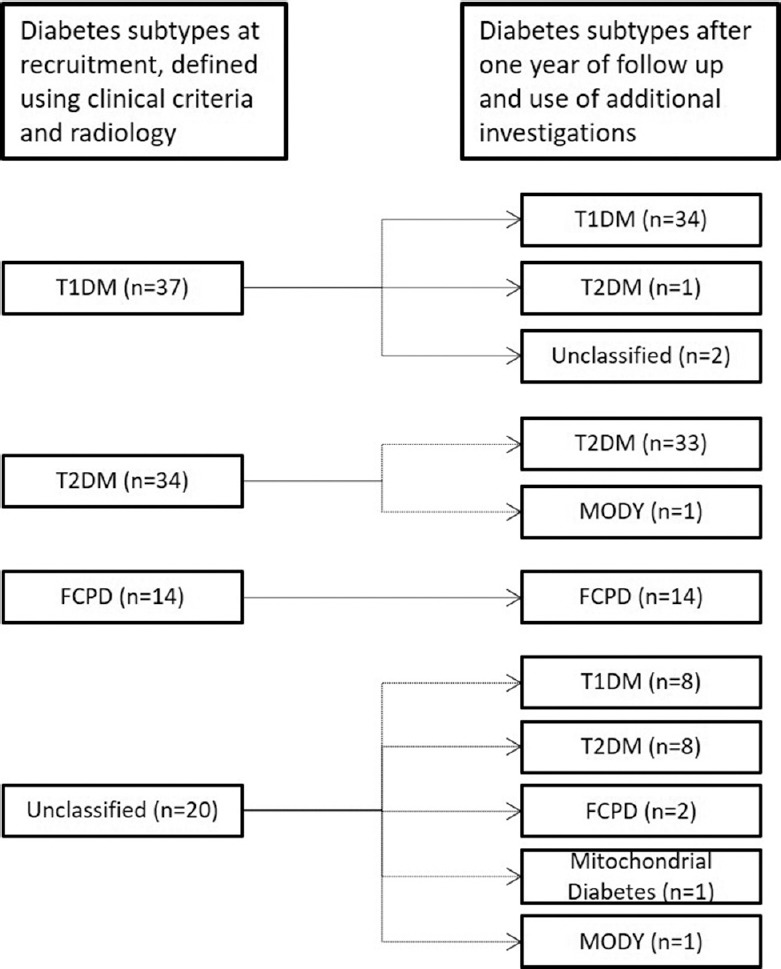
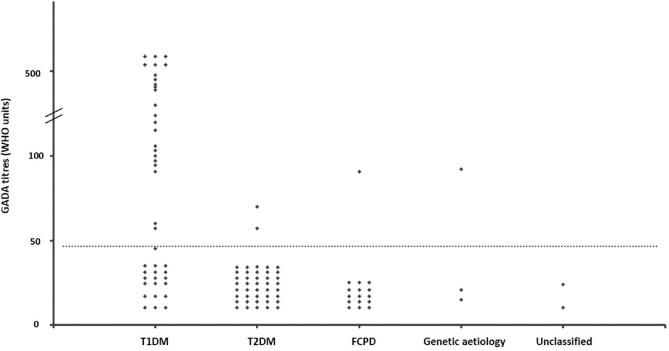
Type 1 and type 2 diabetes mellitus (T1DM and T2DM) were equally frequent (40% each), followed by fibrocalculous pancreatic diabetes (FCPD, 15%). Less common aetiologies included MODY (2%), mitochondrial diabetes (1%) and Flatbush diabetes (2%). There was considerable phenotypic overlap between the main aetiological subtypes. Elevated islet antibodies were noted in 62 per cent of T1DM patients [positive predictive value (PPV) 84%; negative predictive value (NPV) 78%] while low plasma C-peptide (<250 pmol/l) was present in 56 per cent of T1DM patients [PPV 96% (after excluding FCPD), NPV 72%]. Using these tests and observing the clinical course over one year, a final diagnosis was made in 103 (99%) patients, while the diagnosis at recruitment changed in 23 per cent of patients.
INTERPRETATION & CONCLUSIONS: The aetiology of diabetes in young adults was heterogeneous, with T1DM and T2DM being equally common. FCPD was also frequent, warranting its screening in Indian patients. Testing for islet antibodies and C-peptide in this age group had good PPV for diagnosis of T1DM.
与欧洲裔白种人不同,包括印度人在内的其他族裔年轻人的糖尿病(DM)病因可能具有异质性,难以确定。本研究旨在使用基于方案的一系列简单临床和调查工具来确定年轻印度成年人糖尿病的病因。
在这项前瞻性研究中,对 105 名年龄在 18-35 岁之间(发病年龄)、病程<2 年的年轻印度糖尿病患者进行了为期 1-3 年的研究。所有患者均进行胰腺影像学检查、空腹 C 肽、胰岛自身抗体(谷氨酸脱羧酶、酪氨酸磷酸酶和锌转运蛋白-8 抗体)和线粒体 A3243G 突变分析。对 4 名患者进行了下一代测序,以筛查青少年起病的成年型糖尿病(MODY)。
1 型和 2 型糖尿病(T1DM 和 T2DM)的发病率相等(各占 40%),其次是纤维钙化性胰腺糖尿病(FCPD,占 15%)。较少见的病因包括 MODY(2%)、线粒体糖尿病(1%)和 Flatbush 糖尿病(2%)。主要病因亚型之间存在明显的表型重叠。62%的 T1DM 患者存在胰岛自身抗体升高(阳性预测值[PPV]84%;阴性预测值[NPV]78%),而 56%的 T1DM 患者血浆 C 肽水平低(<250 pmol/l)(PPV 96%[排除 FCPD 后],NPV 72%)。使用这些检测方法,并观察一年的临床病程,在 103 名(99%)患者中做出了最终诊断,而在招募时的诊断在 23%的患者中发生了变化。
年轻人糖尿病的病因具有异质性,T1DM 和 T2DM 的发病率相等。FCPD 也很常见,因此需要在印度患者中进行筛查。在该年龄组中检测胰岛自身抗体和 C 肽对 T1DM 的诊断具有良好的阳性预测值。